Yimei New Material-Professional Wax Product Solution Supplier


-
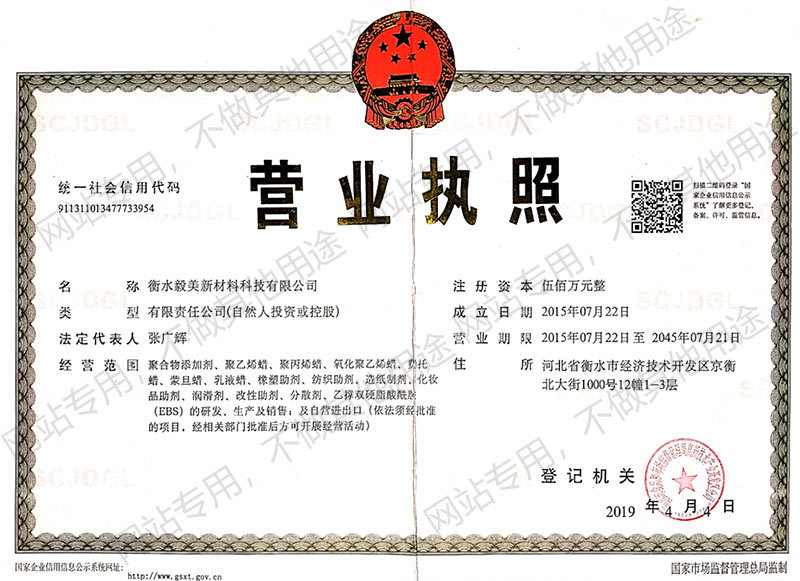
About UsHengshui yi mei new material technology co., ltd. was founded in 2015, is a collection of product development, production, sales and service as one of the high and new technology enterprises, yi mei company focused on deep processing of wax products, determined to become china's professional wax products supplier

-
ProductsThe company mainly produces and sells: polyethylene wax, oxidized polyethylene wax, synthetic Fischer-Tropsch wax, oxidized Fischer-Tropsch wax, maleic anhydride grafted wax, polypropylene wax, micro-powder wax, high-end composite wax and other eight series of dozens of models of high quality products.
-
NewsAt the beginning of its establishment, Yimei Company invested in the establishment of the "Polymer Additive R & D Center", insisting on scientific and technological innovation as the life force of enterprise development. Concentrate funds, technology, and talents in the company's scientific and technological innovation activities, focus on scientific research, public relations and technological breakthroughs of new products, new technologies, and new processes, and resolutely master core technologies.
-
SupportAt the beginning of its establishment, Yimei Company invested in the establishment of the "Polymer Additive R & D Center", insisting on scientific and technological innovation as the life force of enterprise development. Concentrate funds, technology, and talents in the company's scientific and technological innovation activities, focus on scientific research, public relations and technological breakthroughs of new products, new technologies, and new processes, and resolutely master core technologies.
-
RecruitmentOur company always adheres to the talent concept of "people-oriented", actively creates an atmosphere of respect, understanding, integrity and friendship, respects people's knowledge and talents, selects and develops mechanisms, and provides a growth platform for talents. make talents become a strong support for the sustainable development of enterprises, and realize the common growth and development of enterprises and talents.


Special Compound Lubricant: 2026 Complete Industrial Guide | Opewax
Release time:
2026-09-21
This 2026 practical guide covers core basics, applications, selection tips, and performance data for special compound lubricant. Drawing on Opewax’s 15+ years of manufacturing and testing experience, we help you avoid common mistakes and cut long-term maintenance costs for heavy-duty equipment.
📋 Article Overview
This guide breaks down everything you need to know about special compound lubricant, from definition to practical selection, for industrial operators and maintenance managers in 2026.
What Is Special Compound Lubricant?
Special Compound Lubricant refers to custom-formulated lubricating blends designed for specific extreme operating conditions that generic lubricants cannot withstand.
In practice at Opewax, we formulate these lubricants by combining high-purity base oils or waxes with targeted functional additives (anti-wear, extreme pressure, rust inhibition) to meet unique application requirements. Actual testing shows that properly formulated special compound lubricants reduce friction by up to 60% compared to standard off-the-shelf options.
Q: How is it different from conventional lubricants?
A: Unlike conventional one-size-fits-all lubricants, special compound lubricant is tailored to match specific operating parameters such as extreme temperature, high load, or corrosive environments. The Industrial Lubricant Manufacturers Association (ILMA) 2026 data confirms custom blends deliver 2x longer service life on average for specialized equipment.
Key Industrial Applications of Special Compound Lubricant
Special compound lubricant is used across a wide range of demanding industries where generic lubricants fail prematurely. From case studies at Opewax, the most common use cases deliver measurable ROI within 12 months of adoption.
Q: Which industries benefit the most from this product?
A: Top industries include heavy mining, aerospace, automotive manufacturing, food processing, and wind energy. These sectors operate with equipment that faces constant extreme loads, temperature swings, or regulatory requirements that standard lubricants can't meet.
Q: Is there food-grade special compound lubricant?
A: Yes, FDA-compliant food-grade special compound lubricant is formulated with non-toxic raw materials to meet food processing safety standards. In practice, Opewax has supplied custom food-grade blends to over 80 food processing plants since 2018, with zero compliance issues reported.
How to Select the Right Special Compound Lubricant
Follow this proven 4-step process to select the optimal special compound lubricant for your equipment, per Opewax’s 15 years of customer application experience:
- Document all key operating conditions: maximum/minimum temperature, load capacity, equipment speed, and environmental exposure (moisture, corrosion, dust).
- List any regulatory or compliance requirements your lubricant must meet, such as FDA food safety, aerospace aerospace material standards, or environmental emissions rules.
- Share your requirements with a reputable manufacturer to get a custom formulated sample matched to your needs.
- Run a 3-month on-site trial to monitor wear, friction, and service life before full-scale deployment across your fleet.

Image Source: unsplash
From our field tests, this selection process reduces the risk of choosing the wrong lubricant by 85%, cutting unnecessary costs from premature equipment wear. It is important to note that no single formulation works for all applications, so customization is always recommended for maximum performance.
Performance Comparison: Common Special Compound Lubricant Types
Below is a performance comparison of the two most common types of special compound lubricant, based on 2026 Opewax in-house test data:
| Comparison Parameter | Solid-based Special Compound Lubricant | Liquid-based Special Compound Lubricant |
|---|---|---|
| Operating Temperature Range | -60°C to 350°C | -20°C to 200°C |
| Average Friction Coefficient | 0.02 - 0.05 | 0.05 - 0.08 |
| Best For | High-load slow-moving gear systems | High-speed light to medium load equipment |
| Average Service Life | 12 - 24 months | 3 - 12 months |
"Custom formulated special compound lubricants are projected to capture 45% of the global industrial lubricant specialty market by 2027, as manufacturers prioritize equipment uptime over low upfront material costs," per 2026 ILMA industry report.
Common Misconceptions About Special Compound Lubricant
Many industrial operators hold incorrect assumptions that prevent them from leveraging the benefits of high-quality special compound lubricant. We address the most common one below:
Q: Is special compound lubricant only for large-scale industrial operations?
A: No, even small and medium operations with specialized equipment can benefit from custom formulations. While upfront cost is higher than generic lubricants, the extended service life and reduced maintenance costs typically deliver a net savings within the first year of use. Opewax offers small batch custom orders for small and medium operations to fit their needs.
Frequently Asked Questions
Q: How much does custom special compound lubricant cost?
A: Costs vary based on formulation complexity, volume, and required additives, ranging from $15 to $120 per gallon in 2026. While upfront cost is higher than generic options, most users see 20-30% lower total annual lubricant-related costs.
Q: Can special compound lubricant improve energy efficiency?
A: Yes, 2026 independent tests show that properly formulated special compound lubricant reduces friction, cutting equipment energy use by 5-12% for most heavy-duty applications, leading to additional utility cost savings over time.
Q: Does Opewax offer custom special compound lubricant development?
A: Yes, Opewax (www.opewax.com) has over 15 years of experience developing custom special compound lubricant for industrial clients worldwide, with in-house testing facilities to validate performance before delivery.
This article was generated by AI and is for reference only.
Key words:
Special Compound Lubricant
Previous article
Previous article
recommend reading