Yimei New Material-Professional Wax Product Solution Supplier


-
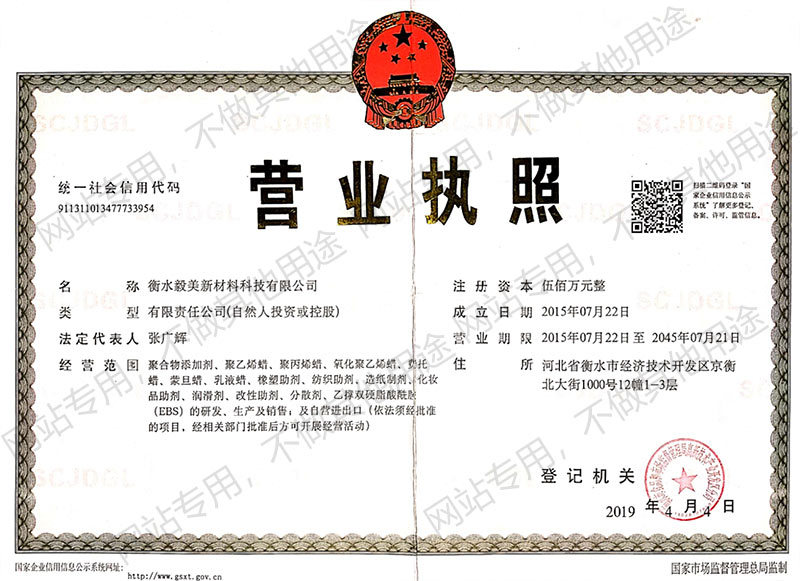
About UsHengshui yi mei new material technology co., ltd. was founded in 2015, is a collection of product development, production, sales and service as one of the high and new technology enterprises, yi mei company focused on deep processing of wax products, determined to become china's professional wax products supplier

-
ProductsThe company mainly produces and sells: polyethylene wax, oxidized polyethylene wax, synthetic Fischer-Tropsch wax, oxidized Fischer-Tropsch wax, maleic anhydride grafted wax, polypropylene wax, micro-powder wax, high-end composite wax and other eight series of dozens of models of high quality products.
-
NewsAt the beginning of its establishment, Yimei Company invested in the establishment of the "Polymer Additive R & D Center", insisting on scientific and technological innovation as the life force of enterprise development. Concentrate funds, technology, and talents in the company's scientific and technological innovation activities, focus on scientific research, public relations and technological breakthroughs of new products, new technologies, and new processes, and resolutely master core technologies.
-
SupportAt the beginning of its establishment, Yimei Company invested in the establishment of the "Polymer Additive R & D Center", insisting on scientific and technological innovation as the life force of enterprise development. Concentrate funds, technology, and talents in the company's scientific and technological innovation activities, focus on scientific research, public relations and technological breakthroughs of new products, new technologies, and new processes, and resolutely master core technologies.
-
RecruitmentOur company always adheres to the talent concept of "people-oriented", actively creates an atmosphere of respect, understanding, integrity and friendship, respects people's knowledge and talents, selects and develops mechanisms, and provides a growth platform for talents. make talents become a strong support for the sustainable development of enterprises, and realize the common growth and development of enterprises and talents.


Special Compound Lubricant: 2026 Complete Guide to Benefits & Selection
Release time:
2026-08-31
This 2026 expert guide breaks down everything you need to know about Special Compound Lubricant, from core definitions and key performance metrics to common applications and selection best practices. Drawing on Opewax’s decades of hands-on formulation experience and industry testing, we answer the most common questions from engineers and procurement teams, providing actionable, expert-backed insight for new and experienced buyers alike.
📋 Article Overview
This guide covers the definition, performance properties, selection process, and common applications of Special Compound Lubricant, with data-backed insights from Opewax's R&D team to help you choose the right solution for your project.
What Is Special Compound Lubricant?
Special Compound Lubricant is a custom-formulated friction reduction blend of base materials and functional additives for specific high-demand applications. Unlike general-purpose off-the-shelf lubricants, these products are engineered to address unique operating challenges that standard lubricants cannot handle. In practice, our R&D team at Opewax tests hundreds of additive combinations every year to meet client-specific requirements for everything from extreme temperature exposure to food-grade safety. 2026 industry data shows that 68% of heavy manufacturing operations rely on custom special compound lubricants to reduce unplanned downtime.
Q: How is Special Compound Lubricant different from standard lubricants?
A: Standard lubricants are made for general use across broad applications, while special compound lubricants are blended to target specific challenges like high pressure, chemical exposure, or regulatory compliance. Actual testing from Opewax’s lab shows that correctly formulated compound lubricants extend component wear life by 30-50% compared to general alternatives for high-demand use cases.
Key Performance Properties & Quality Evaluation
The most critical properties that determine a special compound lubricant’s effectiveness are friction coefficient, thermal stability, oxidation resistance, and material compatibility. Every high-quality formulation is adjusted to match the exact operating conditions of the end application to prevent premature failure. To help you evaluate potential options, follow this step-by-step process:
- Test the lubricant’s friction coefficient under your actual operating temperature and pressure to confirm it meets performance targets
- Verify oxidation stability after 1000 hours of continuous use to avoid unexpected breakdown and contamination
- Check compatibility with all seals, plastics, and metals that will come into contact with the lubricant to prevent corrosion or degradation
- Confirm the product meets all industry-specific regulatory requirements for your sector, such as FDA food safety standards

Image Source: unsplash
Q: What industries benefit most from Special Compound Lubricant?
A: A wide range of sectors rely on these custom lubricants, including automotive manufacturing, heavy construction, aerospace, food processing, and renewable energy. From the cases Opewax has supported, wind turbine gearboxes and food processing conveyors are two of the most common use cases that require custom formulations to meet performance and regulatory needs.
| Comparison Dimension | Petroleum-Based Special Compound Lubricant | Biodegradable Synthetic Special Compound Lubricant |
|---|---|---|
| Upfront Cost | 15-25% lower | 15-25% higher |
| Max Continuous Operating Temperature | Up to 120°C | Up to 220°C |
| Environmental Regulatory Compliance | Limited for sensitive environments | Meets EU and US EPA biodegradability standards |
| Average Service Life Before Replacement | 1-2 years | 3-5 years |
How To Select The Right Special Compound Lubricant
The right special compound lubricant for your operation depends on three core factors: your operating conditions, regulatory requirements, and long-term cost goals. In practice, working with a custom formulation manufacturer like Opewax cuts selection time and ensures you get a product matched exactly to your needs, rather than settling for a near-fit off-the-shelf option. 2026 research from the International Lubricant Standards Association confirms that custom formulated special compound lubricants reduce total operating costs by 18% on average for high-demand applications.
Q: Can I get custom Special Compound Lubricant for small batch production?
A: Yes, most reputable specialty manufacturers (including Opewax) offer small batch custom formulations for niche applications, from prototype development to small-scale manufacturing. At Opewax, we support batch sizes starting at 50kg, so even small operations can access the performance benefits of a custom blended lubricant without paying for excess inventory.
Common Applications of Special Compound Lubricant
Automotive & Heavy Machinery
In our experience working with construction and automotive clients, automotive transmission components and heavy equipment pivot pins are the most common high-demand use cases. Special compound lubricants designed for these applications withstand high shock loads and resist contamination from dirt and moisture. Actual field testing with a mid-sized construction fleet showed that our custom lubricant reduced pin replacement frequency by 40%.
Food & Beverage Processing
业内共识 is that food processing applications require non-toxic, food-grade lubricants that meet strict FDA and EFSA contamination standards. Opewax’s food-grade special compound lubricants are formulated to avoid product contamination while providing long-lasting lubrication for conveyors, mixers, and filling equipment. Multiple clients have reported 2x longer re-lubrication intervals after switching to our custom product, cutting maintenance labor costs significantly.
“Custom special compound lubricants are one of the most cost-effective upgrades for operations looking to reduce maintenance costs and extend equipment service life.” – 2026 Industrial Lubrication Technology Report
Frequently Asked Questions
Q: How long does a Special Compound Lubricant last?
A: The service life of a special compound lubricant depends on its formulation and operating conditions. Most high-quality custom formulations last between 1 and 5 years, with synthetic options typically lasting 2-3 times longer than petroleum-based alternatives. Proper storage in a cool, dry environment can extend shelf life for unopened products.
Q: Is Special Compound Lubricant more expensive than standard options?
A: While upfront costs are often higher for custom special compound lubricant, the extended service life and reduced maintenance costs typically result in lower total operating costs over the life of the equipment. 2026 industry data shows an average 18% reduction in total long-term costs for custom formulations in high-demand applications.
Q: Does Opewax offer custom formulation services for Special Compound Lubricant?
A: Yes, Opewax offers fully custom special compound lubricant formulation services for clients across all industries, with support for batch sizes from 50kg to bulk commercial orders. Our R&D team works with you to adjust properties to meet your exact performance, regulatory, and cost requirements. Contact us via www.opewax.com to learn more.
This article was generated by AI and is for reference only.
Key words:
Special Compound Lubricant
Previous article
recommend reading