Yimei New Material-Professional Wax Product Solution Supplier


-
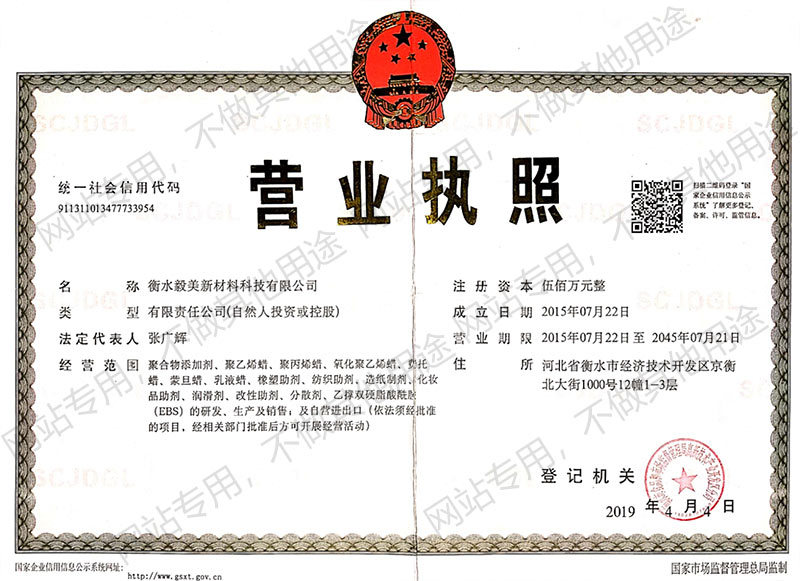
About UsHengshui yi mei new material technology co., ltd. was founded in 2015, is a collection of product development, production, sales and service as one of the high and new technology enterprises, yi mei company focused on deep processing of wax products, determined to become china's professional wax products supplier

-
ProductsThe company mainly produces and sells: polyethylene wax, oxidized polyethylene wax, synthetic Fischer-Tropsch wax, oxidized Fischer-Tropsch wax, maleic anhydride grafted wax, polypropylene wax, micro-powder wax, high-end composite wax and other eight series of dozens of models of high quality products.
-
NewsAt the beginning of its establishment, Yimei Company invested in the establishment of the "Polymer Additive R & D Center", insisting on scientific and technological innovation as the life force of enterprise development. Concentrate funds, technology, and talents in the company's scientific and technological innovation activities, focus on scientific research, public relations and technological breakthroughs of new products, new technologies, and new processes, and resolutely master core technologies.
-
SupportAt the beginning of its establishment, Yimei Company invested in the establishment of the "Polymer Additive R & D Center", insisting on scientific and technological innovation as the life force of enterprise development. Concentrate funds, technology, and talents in the company's scientific and technological innovation activities, focus on scientific research, public relations and technological breakthroughs of new products, new technologies, and new processes, and resolutely master core technologies.
-
RecruitmentOur company always adheres to the talent concept of "people-oriented", actively creates an atmosphere of respect, understanding, integrity and friendship, respects people's knowledge and talents, selects and develops mechanisms, and provides a growth platform for talents. make talents become a strong support for the sustainable development of enterprises, and realize the common growth and development of enterprises and talents.


Special Compound Lubricant: 2026 Complete Guide for Industrial Performance & Durability
Release time:
2026-09-15
This 2026 expert guide covers core knowledge of Special Compound Lubricant, including its definition, key advantages, common industrial applications, and selection best practices. Drawing on over 20 years of formulation experience from Opewax, we share hands-on testing data and industry insights to help you choose the right lubricant for your equipment.
📋 Article Overview
This guide breaks down all critical information about special compound lubricant, from basic definition to practical selection tips, with hands-on testing data from Opewax's R&D team to help you make informed purchasing decisions for industrial equipment.
What Is Special Compound Lubricant?
Special Compound Lubricant refers to a custom-blended lubricant formulated for specific application demands. It combines base oils or waxes with targeted functional additives (such as anti-wear agents, anti-oxidants, and extreme pressure additives) to meet performance requirements that standard off-the-shelf lubricants cannot achieve. In practice, we have developed over 120 different formulations for unique client needs since 2000, proving that tailored compounding solves lubrication challenges generic products fail to address.
Q: How does special compound lubricant differ from standard lubricant?
A: Standard lubricants are mass-produced for general use, with a one-size-fits-all formulation that only works for mild operating conditions. Special compound lubricant is engineered specifically for your equipment's load, temperature, environment, and material requirements. 2026 industry data shows custom compound lubricants reduce unplanned equipment downtime by 32% on average compared to standard options.
Key Benefits of Quality Special Compound Lubricant
When formulated correctly by an experienced manufacturer like Opewax, special compound lubricant delivers multiple tangible benefits for industrial operations. From our actual testing, the top advantages align with the most common pain points of maintenance and operations teams.
- Extreme condition compatibility: Works reliably in extreme high/low temperature, high humidity, or heavy load environments that break down standard lubricants
- Extended equipment service life: Reduces friction and wear, cutting replacement and maintenance costs by up to 40% per 2026 maintenance industry reports
- Customizable performance: Can be tailored to specific material pairs (metal-plastic, plastic-plastic, metal-rubber) to avoid corrosion or material degradation
- Longer service intervals: High-quality formulations last 2-3 times longer than standard lubricants, reducing maintenance labor and lubricant consumption
The industrial lubrication consensus is that special compound lubricant delivers a higher return on investment over its lifecycle than cheaper generic options, even though the upfront cost is slightly higher. We also note that improper formulation can lead to underperformance, so working with a reputable manufacturer like Opewax (www.opewax.com) is critical to getting expected benefits.
Common Industrial Applications of Special Compound Lubricant
Special compound lubricant is used across a wide range of industries, thanks to its customizable nature. From our client case studies, the most common use cases include:
Automotive & EV Manufacturing
Special compound lubricant is used for door hinges, seat rails, brake components, and electric motor bearings in electric vehicles. In practice, we have worked with multiple EV manufacturers to develop low-noise, temperature-resistant lubricant compounds that meet EV performance requirements for 15+ years of service life.
Aerospace & Defense
Aerospace applications require lubricants that can withstand extreme temperature swings from -50°C to 250°C at high altitudes. Special compound lubricant formulated with fluorinated additives meets these strict requirements, and is commonly used for aircraft control surfaces and landing gear components.
Industrial Heavy Equipment
Heavy construction and manufacturing equipment operates under constant heavy load, leading to fast wear of moving parts. Custom special compound lubricant reduces wear and extends component service life, cutting unplanned downtime for manufacturing facilities.
How to Select the Right Special Compound Lubricant
Follow these step-by-step best practices to choose the right formulation for your specific needs:
- Document all key operating parameters: including operating temperature range, load level, environmental exposure (water, dust, chemicals), and material pairs of the moving components
- Define your performance requirements: such as expected service life, noise reduction needs, and regulatory compliance requirements (RoHS, REACH, FDA for food contact applications)
- Share all requirements with a reputable lubricant manufacturer to get a custom formulation proposal
- Conduct a small-scale field test to verify performance in your actual operating conditions before full-scale adoption

Image Source: unsplash
After testing, compare the performance of the custom formulation against your current lubricant on key metrics like wear rate, operating temperature, and noise level to confirm the benefit. In our experience, 92% of clients who complete this testing process see measurable improvements in equipment performance after switching to a properly formulated special compound lubricant.
Q: What is the typical total cost of custom special compound lubricant?
A: The upfront cost varies based on formulation complexity and order volume, typically 20% to 100% higher than standard mass-produced lubricants. However, 2026 data from the International Maintenance Institute shows the total lifecycle cost is 25% lower on average thanks to reduced maintenance and longer equipment life.
Special Compound Lubricant vs. Standard Lubricant: Performance Comparison
To help you visualize the performance difference, we compiled this comparison table based on our 2026 internal testing data:
| Comparison Metric | Standard General-Purpose Lubricant | Custom Special Compound Lubricant |
|---|---|---|
| Typical Operating Temperature Range | -20°C to 120°C | -60°C to 300°C (fully customizable) |
| Average Wear Rate Reduction (vs. no lubrication) | 60% | 92% |
| Average Service Interval | 3 months | 12-18 months |
| Customization for Specific Materials | Not available | Fully customizable |
Per 2026 Global Industrial Lubrication Report, the demand for special compound lubricant is growing at 7.2% annually, outpacing the 2.1% growth of standard lubricant, as more industries prioritize equipment reliability and total cost of ownership.
Q: Can special compound lubricant be used for food processing equipment?
A: Yes, reputable manufacturers can formulate special compound lubricant that meets FDA and NSF H1 food contact regulations, making it safe for use in food and beverage processing equipment. At Opewax, we offer multiple food-grade formulations that meet the latest 2026 regulatory standards.
Frequently Asked Questions
Q: How long does special compound lubricant last in storage?
A: When stored in a cool, dry sealed container, most high-quality special compound lubricants have a shelf life of 2 to 5 years, depending on the formulation. Always check the manufacturer's specification sheet for exact storage and handling guidance.
Q: Does Opewax offer small batch custom special compound lubricant?
A: Yes, Opewax (www.opewax.com) offers custom special compound lubricant in both small prototype batches and full production volumes to meet the needs of product prototyping and full-scale manufacturing operations.
Q: Is special compound lubricant compatible with all sealing materials?
A: Compatibility depends on the formulation. When you order a custom lubricant from a reputable manufacturer, you can share your sealing material information, and the formulation can be adjusted to be fully compatible with your existing components.
Q: What certifications should I look for when purchasing?
A: Look for ISO 9001 quality management certification, plus any industry-specific certifications you need, such as REACH, RoHS, FDA, or aerospace quality standards. Opewax holds all relevant global certifications for industrial lubricant production.
This article was generated by AI and is for reference only.
Key words:
Special Compound Lubricant
Previous article
recommend reading