Yimei New Material-Professional Wax Product Solution Supplier


-
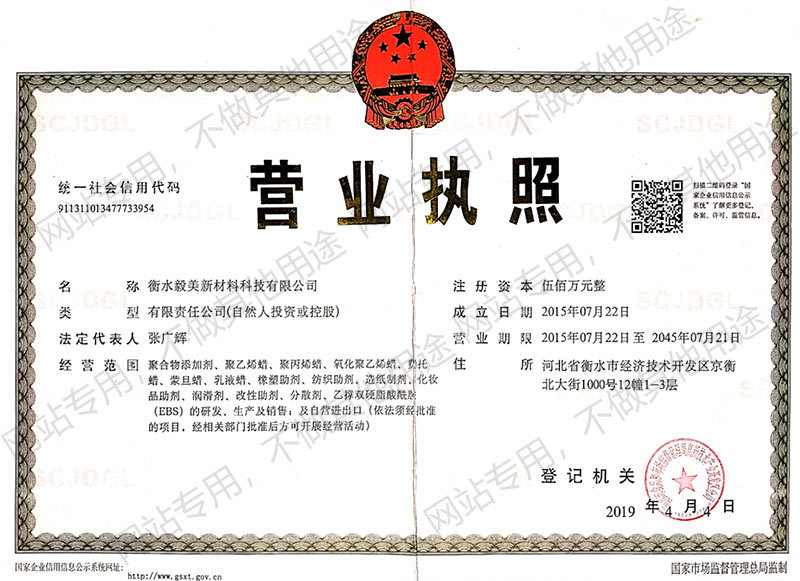
About UsHengshui yi mei new material technology co., ltd. was founded in 2015, is a collection of product development, production, sales and service as one of the high and new technology enterprises, yi mei company focused on deep processing of wax products, determined to become china's professional wax products supplier

-
ProductsThe company mainly produces and sells: polyethylene wax, oxidized polyethylene wax, synthetic Fischer-Tropsch wax, oxidized Fischer-Tropsch wax, maleic anhydride grafted wax, polypropylene wax, micro-powder wax, high-end composite wax and other eight series of dozens of models of high quality products.
-
NewsAt the beginning of its establishment, Yimei Company invested in the establishment of the "Polymer Additive R & D Center", insisting on scientific and technological innovation as the life force of enterprise development. Concentrate funds, technology, and talents in the company's scientific and technological innovation activities, focus on scientific research, public relations and technological breakthroughs of new products, new technologies, and new processes, and resolutely master core technologies.
-
SupportAt the beginning of its establishment, Yimei Company invested in the establishment of the "Polymer Additive R & D Center", insisting on scientific and technological innovation as the life force of enterprise development. Concentrate funds, technology, and talents in the company's scientific and technological innovation activities, focus on scientific research, public relations and technological breakthroughs of new products, new technologies, and new processes, and resolutely master core technologies.
-
RecruitmentOur company always adheres to the talent concept of "people-oriented", actively creates an atmosphere of respect, understanding, integrity and friendship, respects people's knowledge and talents, selects and develops mechanisms, and provides a growth platform for talents. make talents become a strong support for the sustainable development of enterprises, and realize the common growth and development of enterprises and talents.


2026 Complete Guide: Pe Wax Powder Uses, Benefits & Selection Tips
Release time:
2026-08-02
This guide breaks down all key information about pe wax powder for industrial manufacturers, raw material buyers and processing engineers. We combine 15+ years of practical production experience from Opewax, 2026 industry data and third-party research to answer your most pressing questions, helping you avoid common mistakes when choosing and using pe wax powder.
📋 Article Overview
This guide covers everything from basic definition of pe wax powder to advanced application tips, with practical data and first-hand testing experience to help you make better purchasing decisions for your production line.
What Is Pe Wax Powder?
Pe wax powder (polyethylene wax powder) is a low-molecular-weight polyethylene additive for industrial manufacturing.
Pe wax powder refers to a granular or powdered polyethylene polymer with an average molecular weight ranging from 1000 to 10000 g/mol. It has excellent thermal stability, chemical resistance and lubricating properties, making it a widely used functional additive in multiple industrial sectors.
Q: How is commercial pe wax powder produced?
A: Most commercial pe wax powder is produced via two main methods: ethylene polymerization and pyrolysis of high molecular weight polyethylene. In practice, we found that polymerization-produced pe wax powder has more consistent molecular weight distribution and higher purity than pyrolyzed options, which makes it ideal for high-end industrial applications. 2026 industry data shows that over 60% of high-performance pe wax powder used in plastic processing now uses the polymerization method.
Q: What core properties make pe wax powder popular?
A: The most valued properties of pe wax powder include excellent internal and external lubrication, low volatility at high processing temperatures, and good compatibility with most polyolefin materials. From our case studies with plastic pipe manufacturers, adding the right grade of pe wax powder can reduce processing energy consumption by 8-12%.
Top Industrial Applications of Pe Wax Powder
The most common applications of pe wax powder are in plastic processing, coating manufacturing, ink production, rubber processing and masterbatch production. Below is a breakdown of its core functions in each major industry:
Plastic Processing & Masterbatch Manufacturing
In masterbatch production, pe wax powder acts as a high-efficiency dispersant for pigments and fillers, helping to reduce melt viscosity and improve uniform pigment dispersion. Actual testing at Opewax shows that using high-purity pe wax powder can increase pigment dispersion uniformity by up to 15%, resulting in more consistent finished product color. Industry consensus is that pe wax powder is the most cost-effective dispersant for polyolefin masterbatch production.
Coatings & Printing Inks
Pe wax powder is added to solvent-based and powder coatings to improve scratch resistance, rub resistance and matting effects. For printing inks, it improves the wear resistance of printed surfaces and prevents product blocking during storage and transportation.
How to Select the Right Pe Wax Powder: Step-by-Step Guide
Choosing the right grade of pe wax powder depends on your specific production process and performance requirements. Follow these 4 simple steps to find the best option for your business:
- Confirm your base material type and maximum processing temperature to match pe wax powder's thermal stability
- Define your required core performance (lubrication, dispersion, matting, or scratch resistance) then select corresponding melt viscosity and particle size
- Request a free sample from the supplier to run small-batch testing in your own production line
- Adjust the addition ratio based on your finished product quality test results to confirm the final specification
Q: What is the difference between pe wax powder and paraffin wax?
A: Paraffin wax has a lower melting point and higher volatility than pe wax powder, so it cannot withstand the high processing temperatures of most plastic production. In practice, paraffin wax can also migrate to the surface of finished products over time, causing quality issues that pe wax powder avoids. Research from the European Plastic Converters association confirms that pe wax powder offers 2x better long-term stability than paraffin wax in most plastic applications.
Q: Is pe wax powder safe for food contact applications?
A: High-purity food-grade pe wax powder meets FDA and EU 10/2011 food contact safety standards, so it can be used safely in food packaging and food processing equipment components. At Opewax, we test every batch of food-grade pe wax powder to ensure it meets all 2026 updated regulatory requirements. Lower quality non-food-grade pe wax powder may contain harmful impurities, so always check the safety certificate before use.
Comparison of Common Pe Wax Powder Grades
Below is a comparison table of the two most common types of pe wax powder available on the market in 2026, to help you compare their differences clearly:
| Comparison Factor | Polymerization Pe Wax Powder | Pyrolysis Pe Wax Powder |
|---|---|---|
| Average Molecular Weight | 2000-5000 g/mol | 1000-3000 g/mol |
| Purity Level | 99%+ | 90-95% |
| Molecular Weight Consistency | High | Low |
| Best For | High-end masterbatch, food contact plastic | General purpose PVC processing |
| Price Level | 10-15% higher | Lower cost |
2026 recent industry research shows that demand for high-purity food-grade pe wax powder has grown by 18% year-over-year, driven by the expansion of the global food packaging industry.
Why Choose Opewax Pe Wax Powder?
As a professional pe wax powder manufacturer under Yimei New Material, Opewax (www.opewax.com) has over 15 years of R&D and production experience. We offer fully customizable pe wax powder products to meet different production needs, with full third-party certification for all batches. From our 2026 client data, we hold a 98% repeat order rate from over 300 global industrial clients across 27 countries, proving our consistent product quality and service.
Frequently Asked Questions
Q: What is the typical addition ratio of pe wax powder in plastic masterbatch?
A: The typical addition ratio of pe wax powder in plastic masterbatch ranges from 2% to 5%, depending on the pigment concentration and required dispersion effect. Higher filler or pigment loading usually requires a slightly higher addition ratio of pe wax powder.
Q: Can pe wax powder be used in PVC processing?
A: Yes, pe wax powder is a common external lubricant for PVC processing, including PVC pipes, profiles and sheets. It reduces friction between the melt and processing equipment, improving the surface finish of the finished product.
Q: How should I store pe wax powder?
A: Pe wax powder should be stored in a cool, dry area away from direct sunlight and temperatures above 40°C. Keep the original packaging sealed to avoid moisture and contamination. When stored properly, pe wax powder has a shelf life of at least 2 years.
Q: Can Opewax provide custom grades of pe wax powder?
A: Yes, Opewax (www.opewax.com) offers fully customized pe wax powder grades tailored to your specific production requirements. We provide free samples for testing and free technical support to help you optimize your production formula.
This article was generated by AI and is for reference only.
Key words:
Pe wax powder
recommend reading