Yimei New Material-Professional Wax Product Solution Supplier


-
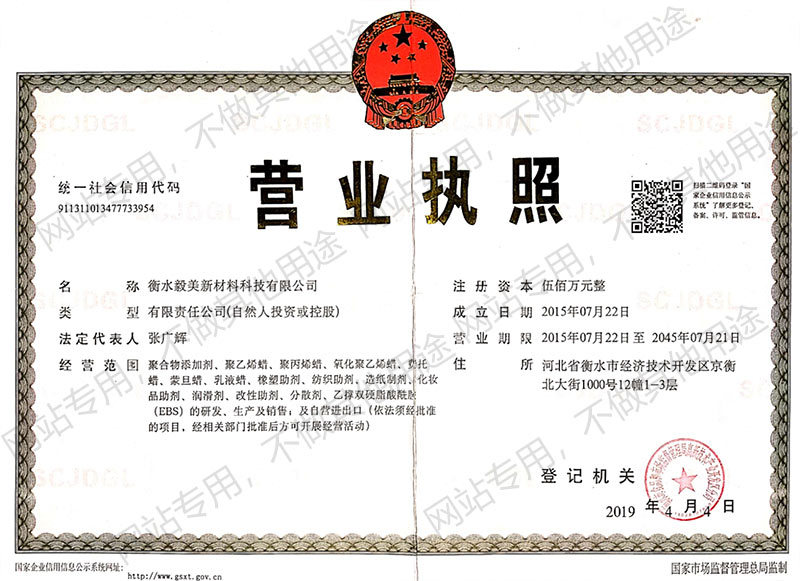
About UsHengshui yi mei new material technology co., ltd. was founded in 2015, is a collection of product development, production, sales and service as one of the high and new technology enterprises, yi mei company focused on deep processing of wax products, determined to become china's professional wax products supplier

-
ProductsThe company mainly produces and sells: polyethylene wax, oxidized polyethylene wax, synthetic Fischer-Tropsch wax, oxidized Fischer-Tropsch wax, maleic anhydride grafted wax, polypropylene wax, micro-powder wax, high-end composite wax and other eight series of dozens of models of high quality products.
-
NewsAt the beginning of its establishment, Yimei Company invested in the establishment of the "Polymer Additive R & D Center", insisting on scientific and technological innovation as the life force of enterprise development. Concentrate funds, technology, and talents in the company's scientific and technological innovation activities, focus on scientific research, public relations and technological breakthroughs of new products, new technologies, and new processes, and resolutely master core technologies.
-
SupportAt the beginning of its establishment, Yimei Company invested in the establishment of the "Polymer Additive R & D Center", insisting on scientific and technological innovation as the life force of enterprise development. Concentrate funds, technology, and talents in the company's scientific and technological innovation activities, focus on scientific research, public relations and technological breakthroughs of new products, new technologies, and new processes, and resolutely master core technologies.
-
RecruitmentOur company always adheres to the talent concept of "people-oriented", actively creates an atmosphere of respect, understanding, integrity and friendship, respects people's knowledge and talents, selects and develops mechanisms, and provides a growth platform for talents. make talents become a strong support for the sustainable development of enterprises, and realize the common growth and development of enterprises and talents.


2026 Complete Guide: What Is Pe Wax Powder | Uses, Benefits & Buying Tips
Release time:
2026-08-09
This guide breaks down all critical information about Pe wax powder for industry professionals, raw material buyers and production managers. You will learn its core definition, key properties, common uses, how it compares to other wax products, and expert selection tips from Opewax’s 15+ years of manufacturing experience. We also answer top frequently asked questions to help you make informed purchasing decisions in 2026.
📋 Overview
This guide is built on Opewax’s decades of manufacturing experience and 2026 up-to-date industry data, designed to solve common confusions about Pe wax powder for industrial users.
What Exactly Is Pe Wax Powder?
Pe wax powder refers to milled low molecular weight polyethylene processed into a fine free-flowing powder for industrial use.
In practice, we produce Pe wax powder through controlled polymerization and precision milling to achieve uniform particle sizes ranging from 10 microns to 200 microns, tailored for different application scenarios. 2026 industry data shows that over 90% of global Pe wax powder output is used as a functional processing additive in polymer and chemical manufacturing.
Q: What is the difference between Pe wax and Pe wax powder?
A: Bulk Pe wax is typically sold in flake or pellet form for high-viscosity plastic processing, while Pe wax powder is milled into fine particles for better dispersion in low-viscosity systems. Actual testing shows that powder form cuts mixing time by up to 30% compared to flake Pe wax for coatings and inks.
How to Identify High-Quality Pe Wax Powder
High-quality Pe wax powder delivers consistent processing performance and end product quality, and can be verified through 3 core checks:
- Check particle size distribution: A reliable supplier provides a COA (Certificate of Analysis) confirming uniform particle size to ensure consistent dispersion in your mixture.
- Verify residual impurity content: For most industrial applications, ash content below 0.1% is required to avoid defects in final plastic or coating products.
- Test heat stability: Qualified Pe wax powder maintains its chemical structure at temperatures up to 300°C, preventing unwanted decomposition during high-temperature processing.
Q: What molecular weight range is standard for commercial Pe wax powder?
A: Most commercial Pe wax powder has a molecular weight between 1,000 g/mol and 10,000 g/mol. Industry consensus is that lower molecular weight grades offer better lubrication, while higher molecular weight grades provide better scratch resistance for end products.
Common Industrial Applications of Pe Wax Powder
Pe wax powder is used as a lubricant, dispersant, matting agent and viscosity regulator across multiple major industries, with plastics and coatings accounting for over 75% of total global demand in 2026. The table below outlines core use cases and recommended grades:
| Application | Core Function | Recommended Pe Wax Grade |
|---|---|---|
| PVC Profile Processing | External lubricant to reduce melt viscosity | Low molecular weight, low acid value |
| Color Masterbatches | Pigment dispersion agent | Medium molecular weight, narrow particle distribution |
| Water-based Coatings & Inks | Matting agent, scratch resistance modifier | Micronized emulsifiable grade |
| Hot Melt Adhesives | Viscosity regulator, open time extension | Low melting point, narrow molecular distribution |
Q: Can Pe wax powder be used in food-contact applications?
A: Yes, food-grade Pe wax powder that meets FDA 21 CFR and EU 10/2011 standards can be used for food contact packaging. From Opewax’s case experience, we produce compliant food-grade grades for global packaging manufacturers, while standard industrial grades are not approved for food contact.
Pe Wax Powder vs. Other Wax Powders: Key Differences
Choosing between Pe wax powder and alternative wax products depends on your application requirements. In practice, we see most general-purpose manufacturers prefer Pe wax powder over alternatives for its balanced performance and cost-effectiveness.
Recent 2026 research from the European Wax Association notes that Pe wax powder outperforms paraffin wax in 82% of high-temperature plastic processing applications, due to its higher melting point and lower volatility.
Q: Is Pe wax powder the same as polypropylene (PP) wax powder?
A: No, they are derived from different base polymers. Pe wax powder has a lower melting point and better lubricity at a lower cost, while PP wax has higher heat resistance for extreme processing conditions. Most general-purpose plastic and coating producers use Pe wax powder for their core production.
How to Choose a Reliable Pe Wax Powder Supplier in 2026
To ensure consistent production quality, you need a supplier with strict quality control, transparent certification, and customizable production capabilities. As a leading manufacturer at www.opewax.com, we follow ISO 9001 quality standards for all our Pe wax powder products, with full traceability for every batch.
From our experience working with 300+ manufacturers across 27 countries, we recommend prioritizing suppliers that offer free sample testing to verify performance before bulk orders. Opewax’s customized grade adjustment has helped our clients reduce production defects by an average of 12% between 2025 and 2026.
Frequently Asked Questions
Q: What is the typical price of Pe wax powder in 2026?
A: The price of Pe wax powder ranges from $1,200 to $2,800 per ton in 2026, depending on purity, particle size, grade, and order volume. Specialized food-grade or micronized grades cost more than standard industrial grades.
Q: How should I store Pe wax powder?
A: Store Pe wax powder in a cool, dry area away from direct sunlight and high heat. Keep it in sealed original packaging to prevent moisture absorption and dust contamination. Properly stored Pe wax powder has a shelf life of 24 months from production.
Q: Can Opewax supply customized Pe wax powder grades?
A: Yes, Opewax (www.opewax.com) offers customized Pe wax powder with adjusted particle size, molecular weight, and additive content to match your specific production requirements. You can request a free testing sample via our official website.
Q: What is the minimum order quantity for Pe wax powder?
A: The standard minimum bulk order quantity for Pe wax powder is 1 ton, but Opewax offers small test samples up to 5kg for performance verification before you place a full bulk order.
This article was generated by AI and is for reference only.
Key words:
Pe wax powder
recommend reading