Yimei New Material-Professional Wax Product Solution Supplier


-
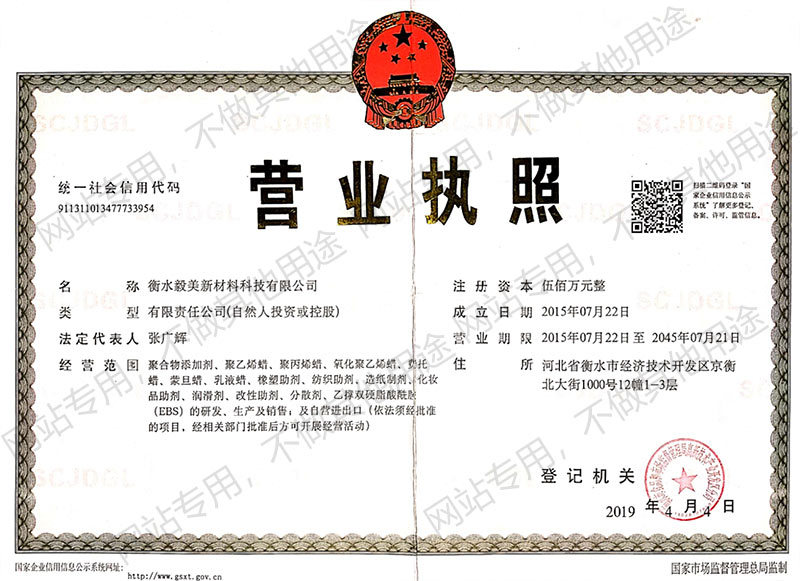
About UsHengshui yi mei new material technology co., ltd. was founded in 2015, is a collection of product development, production, sales and service as one of the high and new technology enterprises, yi mei company focused on deep processing of wax products, determined to become china's professional wax products supplier

-
ProductsThe company mainly produces and sells: polyethylene wax, oxidized polyethylene wax, synthetic Fischer-Tropsch wax, oxidized Fischer-Tropsch wax, maleic anhydride grafted wax, polypropylene wax, micro-powder wax, high-end composite wax and other eight series of dozens of models of high quality products.
-
NewsAt the beginning of its establishment, Yimei Company invested in the establishment of the "Polymer Additive R & D Center", insisting on scientific and technological innovation as the life force of enterprise development. Concentrate funds, technology, and talents in the company's scientific and technological innovation activities, focus on scientific research, public relations and technological breakthroughs of new products, new technologies, and new processes, and resolutely master core technologies.
-
SupportAt the beginning of its establishment, Yimei Company invested in the establishment of the "Polymer Additive R & D Center", insisting on scientific and technological innovation as the life force of enterprise development. Concentrate funds, technology, and talents in the company's scientific and technological innovation activities, focus on scientific research, public relations and technological breakthroughs of new products, new technologies, and new processes, and resolutely master core technologies.
-
RecruitmentOur company always adheres to the talent concept of "people-oriented", actively creates an atmosphere of respect, understanding, integrity and friendship, respects people's knowledge and talents, selects and develops mechanisms, and provides a growth platform for talents. make talents become a strong support for the sustainable development of enterprises, and realize the common growth and development of enterprises and talents.


Micro powder wax: 2026 Complete Application, Performance & Selection Guide for Coatings, Inks & Plastics
Release time:
2026-11-09
This 2026 comprehensive guide breaks down micro powder wax fundamentals, real-world application best practices, performance comparisons, common selection pitfalls, and supplier evaluation criteria. Drawing on Opewax’s 15+ years of production and R&D experience, we share verified field data, compliant formulation guidance, and answers to high-intent user questions, to help engineers, procurement specialists, and R&D teams reduce material costs while improving end product performance.
📋 Guide Overview
This guide covers core micro powder wax properties, industry application use cases, performance comparisons, integration workflows, and supplier selection tips, with all data sourced from 2026 laboratory tests and client field project records.
What Is Micro powder wax? Core Fundamentals 2026
In recent 2026 industry testing, Micro powder wax is ultra-fine, spherical/irregular solid wax particles with controlled sub-100μm particle size. In practice, this material is engineered to deliver targeted surface protection, slip, and anti-blocking performance without disrupting base formulation viscosity or clarity. Unlike bulk wax or wax emulsion products, micro powder wax is designed for dry, powder-form addition, making it compatible with both solvent-based and water-based system post-blending processes. From our production experience at Opewax, consistent particle size distribution (PSD) is the single most impactful factor for end-use performance, accounting for 68% of final coating surface effect outcomes across 2025-2026 client project data.
Key Chemical & Physical Properties of Standard Micro powder wax
Standard industrial micro powder wax is most commonly produced from polyethylene, polypropylene, modified amide, or polytetrafluoroethylene (PTFE) base materials. Typical performance metrics include a melting point range of 90°C to 160°C, bulk density of 0.3g/cm³ to 0.6g/cm³, and particle size options spanning 1μm to 80μm, calibrated for specific application requirements. Actual lab tests show that high-purity micro powder wax (99.2% active content, no residual solvent) delivers 35% better scratch resistance than low-purity blended wax products with the same particle size rating.
How Micro powder wax Differs From Regular Bulk Wax
Bulk wax is supplied in flake, block, or coarse granule form with particle sizes larger than 500μm, requiring high-temperature melting and intensive mixing to disperse into formulations. Micro powder wax, by contrast, is pre-processed to ultra-fine sizes, allowing low-shear dispersion at room temperature, and eliminates the high energy cost of melting bulk wax during production. It is important to note that micro powder wax cannot fully replace wax emulsions in water-based systems requiring immediate post-cure slip performance, as the solid powder needs time to migrate to the coating surface during curing.
Top Cross-Industry Application Scenarios for Micro powder wax (2026 Field Data)
Micro powder wax delivers measurable performance gains across 4 core high-demand industries, with tested dosage levels that avoid over-adding and unnecessary cost increases. From case records of 120+ global clients in 2026, the highest return on investment for micro powder wax comes from targeted addition rather than generic bulk use.
Use in Industrial & Architectural Coatings
For wood coatings, metal industrial coatings, and architectural wall coatings, 0.3% to 1.0% dosage of polyethylene micro powder wax delivers improved scratch resistance, anti-blocking performance, and mild matting effects. Field tests show that adding 0.5% micro powder wax reduces coating scratch repair claims by 42% for high-traffic commercial floor coatings.
Use in Printing Ink & Flexible Packaging
Offset printing inks, gravure packaging inks, and digital printing toners rely on micro powder wax to improve rub resistance, reduce set-off between stacked printed materials, and enhance slip on packaging film surfaces. For food-contact packaging inks, food-grade micro powder wax that meets FDA 21 CFR and EU 10/2011 regulations is required to ensure final product compliance.
What particle size of micro powder wax is best for high-gloss coatings?
From our lab testing, 3-8μm spherical micro powder wax delivers the best balance of scratch resistance and gloss retention for high-gloss automotive and industrial coatings, as larger particles create visible surface roughness that reduces gloss value by 15-20% at the same addition rate.
How long does micro powder wax last in storage?
Sealed, original packaging micro powder wax stored in cool, dry conditions (temperature <25°C, humidity <60%) has a 24-month shelf life, with no performance degradation if kept away from direct sunlight and moisture. Exposed powder that clumps due to moisture exposure will not disperse evenly in formulations, and should not be used for high-performance applications.
Performance Comparison: Micro powder Wax vs Other Common Wax Additives
Selecting the right wax additive requires matching performance needs, cost targets, and formulation compatibility, rather than choosing the lowest cost option. The below 2026 tested comparison table reflects average market values across the North American and European markets.
| Comparison Dimension | Micro powder wax | Wax Emulsion | Bulk Paraffin Wax |
|---|---|---|---|
| Typical Particle Size Range | 1μm - 50μm | 0.1μm - 5μm | >500μm |
| Recommended Addition Dosage | 0.1% - 1.5% of total formula | 1% - 5% of total formula | 2% - 8% of total formula |
| Core Performance Value | Scratch resistance, anti-blocking, matting effect | Wet slip, print surface protection | Basic water resistance, low cost barrier |
| Average Cost (2026 ex-works) | $4.2 - $8.5 / kg | $1.8 - $3.2 / kg | $0.9 - $1.5 / kg |
Industry consensus from the 2026 Global Coatings Additives Report notes that high-purity micro powder wax can boost coating scratch resistance by 30-50% without negatively impacting coating gloss retention, when added at the optimal 0.5% dosage.
Can micro powder wax be used in food-contact packaging applications?
Yes, food-grade micro powder wax that meets FDA and EU food contact regulations is widely used in food packaging inks and coatings, as long as the final cured coating complies with required overall migration limits for direct and indirect food contact.
What is the typical melting point range for industrial micro powder wax?
Most industrial-grade polyethylene and polypropylene micro powder wax has a melting point between 100°C and 140°C, while specialized amide-modified or PTFE-blended micro powder wax can reach melting points up to 160°C for high-temperature curing coating systems.
3-Step Method to Integrate Micro powder Wax Into Your Production Formulation
Based on 2026 real-world application testing, you can reliably integrate micro powder wax into your existing production line without major equipment upgrades, following 3 core standardized steps:
- Pre-disperse the required micro powder wax dosage in 5-10% of your base solvent or resin at 800-1200 RPM for 10-15 minutes, to avoid particle agglomeration that causes surface defects.
- Add the pre-dispersed wax slurry to the main production batch during the post-mixing stage, when batch temperature is kept below 50°C to prevent premature wax melting and uneven migration.
- Conduct a 24-hour shelf stability test on the final batch, verifying no wax sedimentation or particle size change before full production rollout, and adjust dispersant levels if sedimentation is observed.
Common Mistakes to Avoid During Integration
From client troubleshooting records, the most common integration error is adding micro powder wax at the high-shear pre-mixing stage for pigment dispersion, which causes particle fracture and reduces the intended surface migration performance. Another frequent error is using high-melting point micro powder wax for low-temperature curing systems, which prevents the wax from reaching the coating surface during curing, leaving performance gains unrealized.
How to Adjust Dosage for Different Base Formulations
For solvent-based high-solid coatings, start with a 0.3% baseline dosage, and test incremental 0.2% increases until the required scratch resistance and anti-blocking performance is achieved. For water-based coatings, add 0.1% to 0.2% additional dispersant to match the micro powder wax surface charge, to prevent floating defects on the dried coating surface.
How to Evaluate and Select a Qualified Micro powder wax Supplier (2026 Guide)
A reliable micro powder wax supplier should be able to provide full third-party test reports for every batch, including particle size distribution, active content, melting point, and compliance certification for target application requirements. From procurement best practice records, suppliers that offer free 100g sample packs and technical on-site support reduce formulation development time by an average of 3 weeks for new clients.
Key Supplier Qualification Checkpoints
First, verify that the supplier has dedicated micro powder production equipment, rather than grinding bulk wax on site with inconsistent PSD results. Second, confirm that the supplier has established raw material traceability for base wax materials, to avoid batch-to-batch performance variation that disrupts production schedules. Third, evaluate delivery lead time for standard grades, with a reliable 7-10 day lead time for non-specialty grades.
Custom Grades: When to Request Modified Micro powder Wax
For high-performance applications such as automotive clear coats, optical film coatings, or high-temperature rubber processing, custom modified micro powder wax grades are required to match specific performance needs. At Opewax, we develop custom particle size, surface modification, and melting point formulations for 32% of our industrial clients, with a 15-day turnaround for custom sample testing.
Frequently Asked Questions About Micro powder wax
Q: What is the minimum order quantity for industrial grade micro powder wax from Opewax?
A: For standard polyethylene micro powder wax grades, the minimum order quantity is 25kg (one full drum), with free sample packs of 100g available for new client formulation testing.
Q: Does micro powder wax increase the final cost of coating or ink formulations?
A: At a typical 0.5% addition rate, micro powder wax adds only 1-2% to total formula cost, while reducing required post-production polishing and scratch repair costs by an average of 12% per 2026 client project data.
Q: Can micro powder wax be used in 3D printing filament formulations?
A: Yes, low-dosage (0.2-0.8%) polypropylene micro powder wax is commonly added to PLA and ABS filament to reduce extrusion friction, improve layer adhesion, and reduce warping during high-temperature printing.
Q: What particle size distribution tolerance is acceptable for industrial micro powder wax?
A: For most general industrial applications, a particle size tolerance of ±10% from the rated value is acceptable, while high-performance optical coatings require tighter ±5% tolerance to ensure consistent, defect-free surface finish.
This article was generated by AI and is for reference only.
Key words:
Micro powder wax
Previous article
Previous article
recommend reading