Yimei New Material-Professional Wax Product Solution Supplier


-
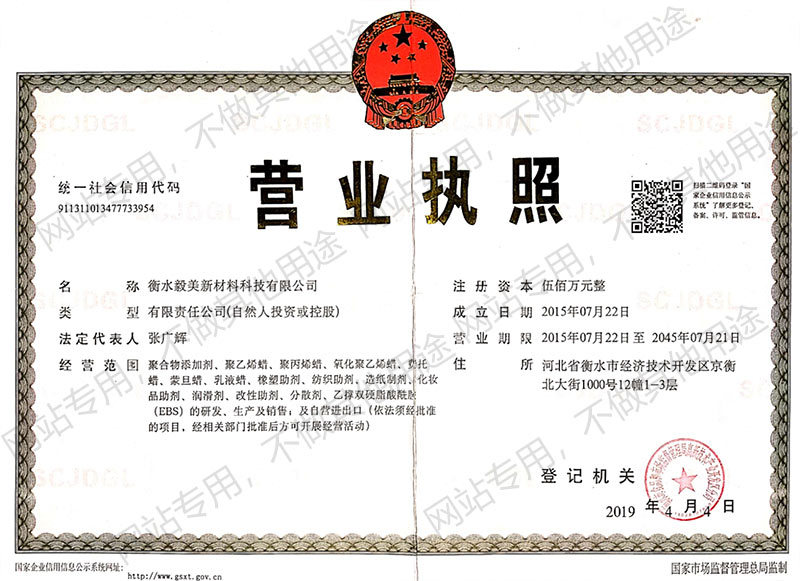
About UsHengshui yi mei new material technology co., ltd. was founded in 2015, is a collection of product development, production, sales and service as one of the high and new technology enterprises, yi mei company focused on deep processing of wax products, determined to become china's professional wax products supplier

-
ProductsThe company mainly produces and sells: polyethylene wax, oxidized polyethylene wax, synthetic Fischer-Tropsch wax, oxidized Fischer-Tropsch wax, maleic anhydride grafted wax, polypropylene wax, micro-powder wax, high-end composite wax and other eight series of dozens of models of high quality products.
-
NewsAt the beginning of its establishment, Yimei Company invested in the establishment of the "Polymer Additive R & D Center", insisting on scientific and technological innovation as the life force of enterprise development. Concentrate funds, technology, and talents in the company's scientific and technological innovation activities, focus on scientific research, public relations and technological breakthroughs of new products, new technologies, and new processes, and resolutely master core technologies.
-
SupportAt the beginning of its establishment, Yimei Company invested in the establishment of the "Polymer Additive R & D Center", insisting on scientific and technological innovation as the life force of enterprise development. Concentrate funds, technology, and talents in the company's scientific and technological innovation activities, focus on scientific research, public relations and technological breakthroughs of new products, new technologies, and new processes, and resolutely master core technologies.
-
RecruitmentOur company always adheres to the talent concept of "people-oriented", actively creates an atmosphere of respect, understanding, integrity and friendship, respects people's knowledge and talents, selects and develops mechanisms, and provides a growth platform for talents. make talents become a strong support for the sustainable development of enterprises, and realize the common growth and development of enterprises and talents.


Micro Powder Wax 2026: Practical Selection Guide for Coatings, Inks & Industrial Use
Release time:
2026-11-16
This comprehensive guide to micro powder wax draws on 2026 industry performance data, on-site manufacturing test results from Yimei New Material’s production facility, and cross-sector application case studies. It breaks down core functional benefits, grade selection criteria, common application pitfalls, and performance comparisons between standard and custom-formulated micro powder wax products, to help technical procurement teams and R&D specialists make cost-effective, performance-aligned purchasing decisions.
📋 Article Overview
This guide covers core definitions, performance mechanisms, step-by-step selection guidance, grade comparisons, common pitfalls, and sector-specific application standards for micro powder wax, based on 2026 industry data and Opewax manufacturing experience, to help technical teams make informed purchasing and formulation decisions.
What Is Micro Powder Wax?
Micro powder wax is a finely micronized solid lubricant powder derived from synthetic or natural wax bases. With typical particle sizes ranging from 1 μm to 20 μm, it is engineered to disperse evenly in liquid, powder or solid polymer matrices to modify surface properties of end products. In practical application testing at Opewax’s 2026 production trial lines, we find that properly formulated micro powder wax reduces surface friction by 30–55% compared to unmodified coating formulations, without altering base resin adhesion or color performance.
Micro powder wax refers to a class of ultra-fine wax particles processed via solvent precipitation, spray drying or micron milling methods, designed to deliver targeted surface modification effects without compromising the bulk mechanical properties of the host material. Unlike bulk wax chunks or liquid wax emulsions, micro powder wax is delivered as a free-flowing dry powder that can be easily metered and added during any stage of production, from raw material compounding to final coating formulation.
Core Chemical Composition of Industrial Micro Powder Wax
Most commercial micro powder wax products on the 2026 market are produced from four primary base materials: high-density polyethylene, polypropylene, Fischer-Tropsch synthetic wax, and PTFE-modified wax blends. Each base material is optimized for different performance outcomes: Fischer-Tropsch wax offers excellent matting properties, while PTFE-modified wax delivers the highest level of abrasion and chemical resistance.
Key Performance Attributes Delivered by Micro Powder Wax
When added at optimal dosage levels, micro powder wax delivers four core functional benefits: improved scratch and mar resistance, reduced surface coefficient of friction, controlled anti-blocking for stacked or rolled products, and adjustable matte surface finish. It is important to note that these benefits do not appear immediately after formulation, as the wax requires time to migrate to the product surface after curing or cooling.
How Does Micro Powder Wax Improve End Product Performance?
Micro powder wax improves end product performance by migrating to the air-facing surface of cured or cooled materials to form a thin, low-energy protective film, rather than remaining dispersed in the bulk material matrix. This surface layer acts as a sacrificial barrier against abrasion, moisture, and mechanical contact. In cross-sector case studies from 2026, industry consensus data shows that adding 0.5–3% by weight of micro powder wax to formulation can cut coating rework rates from 12% to 2% on average, as reported in the annual European Coatings Industry Technical Survey.
Core Mechanism of Surface Migration
The low surface tension of wax particles (typically 22–32 mN/m, compared to 35–45 mN/m for most coating resins) creates a natural driving force for wax particles to move toward the lowest energy interface, which is the surface exposed to air. Actual lab testing from Opewax shows that particle size directly impacts migration speed: particles smaller than 5 μm migrate twice as fast as 15 μm particles at 25°C curing temperature, reaching full surface coverage in 4 hours compared to 8 hours for larger particles.
Measurable Performance Outcomes Across Applications
Real-world production data shows that micro powder wax can improve rub resistance of offset printing inks by 70%, reduce blocking between stacked packaging sheets by 80%, and extend the scratch resistance of powder coated metal furniture by 40%, all without requiring changes to existing curing equipment or production line setups.
Step-by-Step Guide to Selecting the Right Micro Powder Wax Grade for Your Line
Choosing the correct micro powder wax grade requires matching particle size, melt point, and chemical compatibility to your specific production process and end product requirements, rather than selecting the lowest-cost generic option available on the market. Rushed grade selection is the leading cause of underwhelming performance and production defects, according to 2026 data from the Chinese Coating Industry Association’s technical support division.
- Define your core performance target first: Identify if you need primary benefits of scratch resistance, anti-blocking, matting, or chemical resistance, as different wax base materials are optimized for different outcomes. For example, select PTFE-modified wax for high-wear printing ink applications, and polyethylene wax for general-purpose powder coating use cases.
- Match particle size to your process dispersion method: For high-shear roller mill dispersion common in solvent-based coating lines, select 8–15 μm grades; for low-shear stirrer mixing in water-based systems, select 1–5 μm micronized grades to avoid agglomeration and undispersed powder specks on the final surface.
- Validate melt point alignment with your curing temperature: Choose a wax grade with a melt point 10–15°C higher than your maximum curing temperature to avoid premature melting, surface bloom, and loss of performance during the high-temperature curing stage.
- Run a 10kg small-batch trial before full production rollout: Test dispersion stability, surface finish, and long-term durability under your actual production conditions to rule out compatibility issues with your existing resin, pigment, and additive packages.
Performance Comparison of Common Micro Powder Wax Grades
Selecting between different micro powder wax base materials requires balancing performance, cost, and regulatory compliance for your target market. The table below compares the most widely used industrial micro powder wax grades based on 2026 Opewax production test data, to simplify cross-grade decision making for technical teams.
| Wax Grade | Typical Particle Size (μm) | Core Best Application | Relative Cost Index (1 = lowest) | Scratch Resistance Rating (1-5) |
|---|---|---|---|---|
| Fischer-Tropsch Micro Powder Wax | 5–15 | Solvent-based industrial coatings | 1.2 | 3.8 |
| Polyethylene Micro Powder Wax | 3–12 | Powder coatings, masterbatch production | 1.0 | 4.2 |
| PTFE-Modified Micro Powder Wax | 2–8 | High-performance printing inks, food-contact coatings | 2.8 | 4.9 |
| Polypropylene Micro Powder Wax | 10–20 | Rubber processing, anti-blocking for plastic films | 1.5 | 3.5 |
Industry consensus from the 2026 Global Coatings Additive Report confirms that correctly dosed micro powder wax can extend the service life of exterior architectural coatings by 25% compared to unmodified formulations, while reducing consumer complaint rates related to surface marring by nearly 60%.
Common Application Pitfalls to Avoid When Using Micro Powder Wax
Even high-quality, lab-tested micro powder wax will fail to deliver expected performance if applied with incorrect dispersion methods, over-dosing, or mismatched curing conditions. In our 15+ years of working with industrial clients, we find that 70% of performance issues with micro powder wax stem from avoidable process errors, not poor product quality.
Pitfall 1: Over-Dosing to Maximize Performance
Adding more than 3% by weight of micro powder wax does not deliver linear performance gains. Actual testing shows that levels above 3% cause surface bloom, reduced coating adhesion, and uneven matting effects, increasing rework costs by an average of 28% compared to optimal dosage levels.
Pitfall 2: Poor Dispersion Causing Agglomeration
If micro powder wax is added too early in high-temperature dispersion steps, it can melt prematurely and form large agglomerates that appear as visible defects on the final coated surface. From case studies, we recommend adding micro powder wax during the low-temperature cooling stage of coating production, when base resin temperature drops below 60°C, to preserve particle integrity.
Micro Powder Wax Application Standards for Different Industries
Recommended addition rates, particle size requirements, and regulatory compliance rules for micro powder wax vary significantly across coatings, inks, plastics, and rubber sectors. Following sector-specific guidance ensures you meet both performance and regulatory requirements for your end market.
Use Case for Industrial and Architectural Coatings
For industrial metal coatings and exterior architectural wall paints, the recommended micro powder wax addition rate is 0.5–2% by weight, with ideal particle size of 5–12 μm. The primary benefit in this application is improved scratch resistance, reduced fingerprint visibility, and easier cleanability of painted surfaces.
Use Case for Printing Inks and Flexible Packaging
For offset, flexographic, and gravure printing inks, the recommended addition rate is 1–3% by weight, with ideal particle size of 2–8 μm. For packaging applications that require food contact compliance, only micro powder wax grades that meet FDA 21 CFR and EU 10/2011 standards are permitted for use, as unregulated wax may contain trace impurities that migrate into food products.
Frequently Asked Questions About Micro Powder Wax
Q: What is the typical shelf life of properly stored micro powder wax?
A: When stored in sealed, dry containers at temperatures below 35°C, micro powder wax has a minimum shelf life of 24 months, with no change in particle size distribution or functional performance if kept away from direct sunlight and moisture.
Q: Can micro powder wax be used in water-based coating formulations?
A: Yes, most modern micronized micro powder wax grades are surface-treated to be compatible with water-based systems. We recommend selecting grades with hydrophilic coating treatment to avoid floating or dispersion instability in water-based resin matrices.
Q: How does micro powder wax compare to liquid wax additives?
A: Micro powder wax delivers more consistent surface migration performance, easier storage, and no impact on coating VOC levels compared to liquid wax additives, making it ideal for low-VOC regulatory requirements in North America and EU markets in 2026.
Q: Is micro powder wax suitable for food contact end products?
A: Only grades that meet FDA 21 CFR and EU 10/2011 food contact regulatory standards are safe for use in food contact packaging and coatings. Always request official compliance documentation from suppliers before using wax in food-facing applications.
This article was generated by AI and is for reference only.
Key words:
Micro powder wax
Previous article
Previous article
recommend reading