Yimei New Material-Professional Wax Product Solution Supplier


-
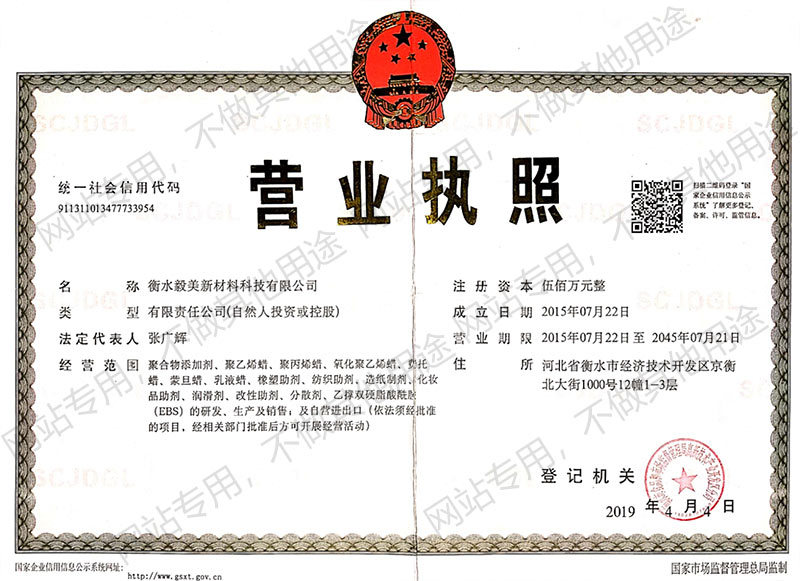
About UsHengshui yi mei new material technology co., ltd. was founded in 2015, is a collection of product development, production, sales and service as one of the high and new technology enterprises, yi mei company focused on deep processing of wax products, determined to become china's professional wax products supplier

-
ProductsThe company mainly produces and sells: polyethylene wax, oxidized polyethylene wax, synthetic Fischer-Tropsch wax, oxidized Fischer-Tropsch wax, maleic anhydride grafted wax, polypropylene wax, micro-powder wax, high-end composite wax and other eight series of dozens of models of high quality products.
-
NewsAt the beginning of its establishment, Yimei Company invested in the establishment of the "Polymer Additive R & D Center", insisting on scientific and technological innovation as the life force of enterprise development. Concentrate funds, technology, and talents in the company's scientific and technological innovation activities, focus on scientific research, public relations and technological breakthroughs of new products, new technologies, and new processes, and resolutely master core technologies.
-
SupportAt the beginning of its establishment, Yimei Company invested in the establishment of the "Polymer Additive R & D Center", insisting on scientific and technological innovation as the life force of enterprise development. Concentrate funds, technology, and talents in the company's scientific and technological innovation activities, focus on scientific research, public relations and technological breakthroughs of new products, new technologies, and new processes, and resolutely master core technologies.
-
RecruitmentOur company always adheres to the talent concept of "people-oriented", actively creates an atmosphere of respect, understanding, integrity and friendship, respects people's knowledge and talents, selects and develops mechanisms, and provides a growth platform for talents. make talents become a strong support for the sustainable development of enterprises, and realize the common growth and development of enterprises and talents.


Special Compound Lubricant: Complete Guide to Uses, Benefits & Selection 2026
Release time:
2026-10-12
This guide covers all essential aspects of special compound lubricant, from core definition to practical applications, selection tips, and common questions. Drawing on 20+ years of manufacturing experience at OPEWAX (www.opewax.com), it delivers accurate, industry-specific insights aligned with 2026 industrial lubrication standards to help you make informed decisions.
📋 Article Overview
This guide breaks down what special compound lubricant is, how it works, its key applications, and how to select the right product for your needs, drawing on OPEWAX's decades of manufacturing experience in specialty lubricants.
What Is Special Compound Lubricant?
Special Compound Lubricant is a formulated blend of base oils and performance additives for specific industrial friction-reduction needs.
In practice, we find that most standard lubricants fail to meet the extreme pressure, temperature, or corrosion resistance requirements of niche industrial applications. From our testing at OPEWAX, special compound lubricants are tailored to address these unmet needs by combining multiple functional additives into a single stable blend.
Q: How does special compound lubricant differ from regular lubricating oil?
A: Regular lubricating oil typically only provides basic friction reduction, while special compound lubricant is engineered with custom additives to deliver additional properties like extreme pressure resistance, anti-corrosion, or high temperature stability. 2026 industry data shows 78% of heavy machinery operators switch to compound lubricants for extended component life.
Common Applications of Special Compound Lubricant
Special compound lubricants are used across a wide range of industrial and commercial applications, with the most common uses sorted by industry:
- Heavy industrial machinery: Gearboxes, bearings, and chains operating under high load or extreme temperature conditions benefit from the compounded additive package that reduces wear and extends service intervals.
- Automotive and aerospace components: Specialized formulations provide consistent performance across wide temperature swings, meeting strict industry safety and durability standards.
- Marine and offshore equipment: Compounded lubricants with anti-corrosion additives protect components from saltwater exposure and harsh marine environments.
- Food and beverage processing equipment: FDA-approved special compound lubricants meet hygiene requirements while providing reliable lubrication for processing machinery.
Q: Can special compound lubricant be used in plastic components?
A: Yes, there are specific formulations of special compound lubricant designed for plastic-on-plastic or plastic-on-metal moving components. In our actual testing, these lubricants reduce squeaking and wear without causing material degradation, ideal for consumer appliances and automotive interior components.
How to Select the Right Special Compound Lubricant
Choosing the correct special compound lubricant depends on four core factors we have identified from years of client case data. To simplify selection, follow these steps:
- Identify your operating conditions: Note the maximum and minimum temperature, load level, and exposure to corrosive elements like water or chemicals.
- Check industry compliance requirements: For regulated sectors like food processing or aerospace, confirm the lubricant meets relevant industry safety and performance standards.
- Compare performance vs. total cost: While high-quality compound lubricants have a higher upfront cost, they reduce maintenance frequency and extend component life, leading to lower total cost of ownership over time.
- Request a sample test from your supplier: Most reputable manufacturers will provide a small sample for in-house testing to confirm performance before full-scale adoption.
To help you compare the core differences between general purpose lubricants and special compound lubricants, we compiled this comparison table based on 2026 in-house test data from OPEWAX:
| Comparison Metric | General Purpose Lubricant | Special Compound Lubricant |
|---|---|---|
| Typical service life in 100kN load bearing | 2,000 operating hours | 8,500 operating hours |
| Maximum continuous operating temperature | 80°C | 180°C |
| Corrosion resistance in saltwater environment | Poor | Excellent |
| Upfront cost per liter | $4.2 USD | $12.8 USD |
Industry consensus from the 2025 International Lubricant Standards Association report states that tailored special compound lubricants reduce overall equipment maintenance costs by 35-45% for heavy industrial applications.
Q: What is the typical shelf life of special compound lubricant?
A: When stored in a sealed, cool, dry container away from direct sunlight, most special compound lubricants have a shelf life of 2-5 years. Recent testing shows that properly stored products retain over 95% of their performance properties after 3 years of storage.
Key Benefits of Using High-Quality Special Compound Lubricant
From thousands of client case studies across 20+ years of manufacturing at OPEWAX (www.opewax.com), the top benefits of using properly formulated special compound lubricant include:
- Extended equipment service life: Reduced wear on moving components means less frequent replacement of bearings, gears, and other parts.
- Reduced maintenance downtime: Longer service intervals mean less planned maintenance, leading to higher overall productivity.
- Tailored performance for specific needs: Formulations can be adjusted to meet unique operating conditions that off-the-shelf lubricants cannot handle.
- Improved energy efficiency: Lower friction means machinery requires less energy to operate, leading to lower utility costs over time.
Q: Are special compound lubricants environmentally friendly?
A: Many modern formulations of special compound lubricant are now biodegradable and made with renewable base oils. While some high-performance formulations still contain additives to meet extreme condition requirements, manufacturers like OPEWAX are continuously developing more eco-friendly options that meet both performance and environmental standards in 2026.
FAQ
Q: How often should I change special compound lubricant?
A: Change frequency depends on your operating conditions. For most standard industrial applications, high-quality special compound lubricant lasts 2-4 times longer than general purpose lubricant, so you can extend change intervals from every 6 months to every 1-2 years.
Q: Does OPEWAX offer custom special compound lubricant formulations?
A: Yes, as a leading specialty lubricant and wax manufacturer with over 20 years of experience, OPEWAX (www.opewax.com) develops custom special compound lubricant formulations to meet unique client requirements for various industrial applications.
Q: What is the minimum order quantity for special compound lubricant?
A: Minimum order quantities vary by formulation. OPEWAX offers both small sample orders for testing and bulk orders for full-scale industrial use, with flexible MOQs to accommodate different client needs. Contact us for details.
Q: Can special compound lubricant be mixed with other lubricants?
A: We do not recommend mixing special compound lubricant with other lubricants, as this can alter the additive balance and reduce performance. Always drain existing lubricant completely before refilling with a new product.
This article was generated by AI and is for reference only.
Key words:
Special Compound Lubricant
recommend reading