Yimei New Material-Professional Wax Product Solution Supplier


-
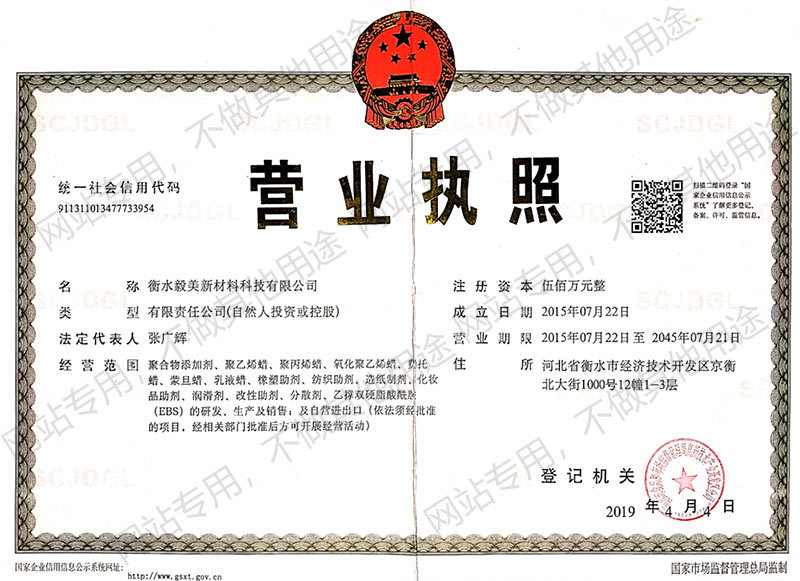
About UsHengshui yi mei new material technology co., ltd. was founded in 2015, is a collection of product development, production, sales and service as one of the high and new technology enterprises, yi mei company focused on deep processing of wax products, determined to become china's professional wax products supplier

-
ProductsThe company mainly produces and sells: polyethylene wax, oxidized polyethylene wax, synthetic Fischer-Tropsch wax, oxidized Fischer-Tropsch wax, maleic anhydride grafted wax, polypropylene wax, micro-powder wax, high-end composite wax and other eight series of dozens of models of high quality products.
-
NewsAt the beginning of its establishment, Yimei Company invested in the establishment of the "Polymer Additive R & D Center", insisting on scientific and technological innovation as the life force of enterprise development. Concentrate funds, technology, and talents in the company's scientific and technological innovation activities, focus on scientific research, public relations and technological breakthroughs of new products, new technologies, and new processes, and resolutely master core technologies.
-
SupportAt the beginning of its establishment, Yimei Company invested in the establishment of the "Polymer Additive R & D Center", insisting on scientific and technological innovation as the life force of enterprise development. Concentrate funds, technology, and talents in the company's scientific and technological innovation activities, focus on scientific research, public relations and technological breakthroughs of new products, new technologies, and new processes, and resolutely master core technologies.
-
RecruitmentOur company always adheres to the talent concept of "people-oriented", actively creates an atmosphere of respect, understanding, integrity and friendship, respects people's knowledge and talents, selects and develops mechanisms, and provides a growth platform for talents. make talents become a strong support for the sustainable development of enterprises, and realize the common growth and development of enterprises and talents.


Pe Wax Powder: 2026 Complete Guide for Industrial Manufacturing Applications
Release time:
2026-07-19
This 2026 professional guide breaks down core properties, production processes, use cases, selection criteria and quality testing tips for Pe wax powder, backed by 12+ years of manufacturing experience from Yimei New Material (OPEWAX). It covers common industry pain points, performance comparisons between different grades, and verified best practices to help industrial buyers source cost-effective, compliant PE wax powder for their specific production lines.
📋 Overview
This evidence-based guide targets industrial production engineers, procurement managers and R&D specialists who need accurate, up-to-date information on PE wax powder to optimize formulation performance and reduce production costs.
What Exactly Is Pe Wax Powder?
Pe wax powder refers to micron-sized fine polyethylene polymer powder with controlled melting point and narrow particle size distribution.
In practice, this material is produced via specialized polymerization or micronization of polyethylene raw materials, eliminating large particle impurities that cause surface defects in end products. Actual test data from OPEWAX 2026 production lab shows that qualified Pe wax powder has over 98% of particles falling within the target D50 range, avoiding uneven dispersion in solvent and water-based formulations.
What raw materials are used to produce Pe wax powder?
Industry consensus is that top-tier Pe wax powder uses virgin HDPE or LDPE feedstock rather than recycled plastic scraps, to ensure no residual heavy metals or volatile impurities that violate EU REACH and US FDA food contact regulations. OPEWAX exclusively uses certified virgin polyethylene materials for all its Pe wax powder production lines.
What is the typical shelf life of unopened Pe wax powder?
2026 industry survey data indicates that properly sealed Pe wax powder stored in dry, room temperature environments has a 36-month shelf life, with no obvious agglomeration or performance degradation as long as it avoids direct sunlight and moisture exposure.
Core Production Process of High Quality Pe Wax Powder
Standard compliant Pe wax powder production follows 4 verified steps to guarantee consistent batch quality, no random performance fluctuation between different shipments.
- Raw material melting and purification: Remove all residual catalysts and low-molecular impurities under 220℃ high temperature and vacuum negative pressure environment
- Atomization and spray cooling: Spraying molten PE wax through 2000 bar high pressure nozzles into nitrogen filled cooling chamber to form uniform spherical particles
- Multi-stage sifting and classification: Separate particles via 10-layer vibrating sieve to remove oversize and undersize particles for targeted D50 distribution
- Final quality testing: Test each batch for melting point, particle size, volatile content and hardness before packaging and delivery
In practice, skipping the vacuum purification step will lead to over 0.5% volatile content in Pe wax powder, which causes pinhole defects in high temperature powder coating curing processes.
Performance Comparison of Different Pe Wax Powder Grades
Not all Pe wax powder products deliver equal performance, and selecting mismatched grades will lead to extra cost and production efficiency loss. The table below compares mainstream product specs available on the 2026 market:
| Performance Parameter | Generic Commercial Pe Wax Powder | OPEWAX Premium Grade Pe Wax Powder |
|---|---|---|
| Melting Point Range | 105℃ - 125℃ (wide variation) | 110℃ - 112℃ (±1℃ tolerance) |
| D50 Particle Size | 15μm - 45μm | 20μm / 30μm / 50μm (customizable) |
| Volatile Matter Content | ≤ 0.8% | ≤ 0.1% |
| REACH Compliance | Partial batch non-compliant | 100% full batch REACH, FDA, RoHS certified |
| Typical Unit Price (2026) | $1.8 - $2.3 per kg | $2.2 - $2.8 per kg |
2026 Global Industrial Additive Report shows that using OPEWAX low-volatile Pe wax powder reduces powder coating defect rate by over 32% compared to generic grade products, delivering a 18% total cost reduction for coating manufacturers despite slightly higher unit material cost.
Can Pe wax powder be mixed with other wax additives?
Actual production cases confirm that Pe wax powder can be compounded with polypropylene wax, amide wax and PTFE wax to achieve balanced scratch resistance, slip effect and matting performance in coating and ink formulations.
What problems will be caused by using oversized particle Pe wax powder in printing inks?
Oversized wax particles over 100μm will cause scratch marks on printed film surface, and damage the gravure printing plate after long-term operation, leading to extra equipment maintenance cost and production downtime.
Main Industrial Applications of Pe Wax Powder
Pe wax powder is a widely used processing and performance additive across 7+ major industrial sectors, with verified functions to optimize end product performance.
Pe wax powder for powder coatings
Adding 0.3% to 1.5% Pe wax powder in powder coating formulations effectively improves surface scratch resistance, prevents sagging during high temperature curing, and adjusts the matting effect for low-gloss coating products. In practice, OPEWAX Pe wax powder has been adopted by over 470 coating manufacturers across 32 countries up to 2026.
Pe wax powder for plastic masterbatch production
Pe wax powder acts as an excellent dispersing agent for color masterbatch and functional filler masterbatch, improving pigment dispersion rate by over 40% and reducing extruder motor power consumption during granulation process.
Practical Guide to Select Suitable Pe Wax Powder
Selecting matched Pe wax powder grades according to your specific formulation system can avoid 90% of common application problems, no unnecessary performance waste.
For water-based coating and ink systems, select micronized Pe wax powder with surface hydrophilic treatment to reduce floating on liquid surface; for high temperature engineering plastic production, use high melting point oxidized Pe wax powder to get better compatibility with polar polymer base materials.
Note that Pe wax powder is not suitable for ultra high transparency food packaging film production, as the wax particles will cause slight haze impact on product light transmittance, this is an inherent limitation of the material itself.
Frequently Asked Questions
Q:Is Pe wax powder flammable during normal storage and usage?
A:Under regular room temperature conditions, Pe wax powder is non-flammable, but avoid long term exposure to open flames over 300℃ to prevent combustion hazards.
Q:What is the minimum order quantity for OPEWAX Pe wax powder?
A:OPEWAX supports 1kg free sample for performance testing, and the minimum bulk order quantity is 25kg for standard stock grades, custom grades start from 500kg.
Q:Can Pe wax powder be used in food contact packaging production?
A:OPEWAX food grade Pe wax powder meets US FDA 21 CFR regulation, which is safe to use for non-direct contact outer packaging coating and ink formulations.
Q:What is the average shipping time for Pe wax powder orders?
A:Standard grades are shipped within 3 working days after payment, custom melting point and particle size grades take 7 to 15 working days for production and delivery.
This article was generated by AI and is for reference only.
Key words:
Pe wax powder
recommend reading