Yimei New Material-Professional Wax Product Solution Supplier


-
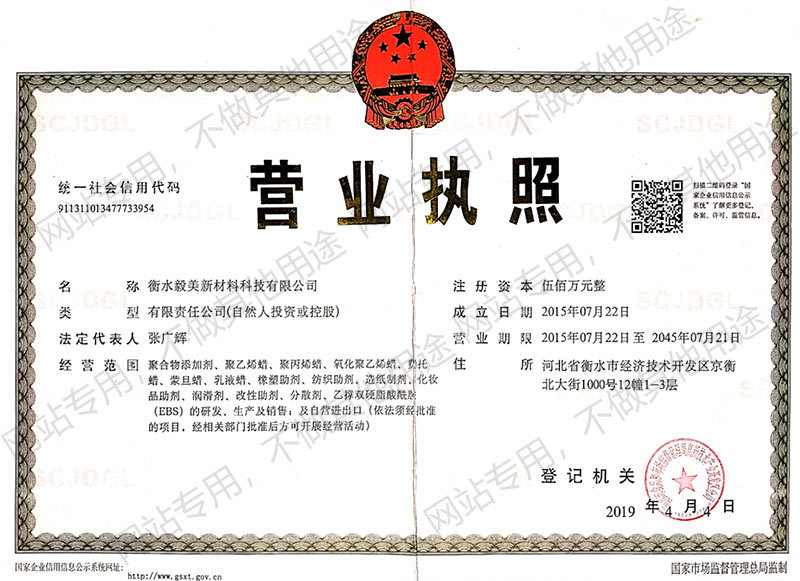
About UsHengshui yi mei new material technology co., ltd. was founded in 2015, is a collection of product development, production, sales and service as one of the high and new technology enterprises, yi mei company focused on deep processing of wax products, determined to become china's professional wax products supplier

-
ProductsThe company mainly produces and sells: polyethylene wax, oxidized polyethylene wax, synthetic Fischer-Tropsch wax, oxidized Fischer-Tropsch wax, maleic anhydride grafted wax, polypropylene wax, micro-powder wax, high-end composite wax and other eight series of dozens of models of high quality products.
-
NewsAt the beginning of its establishment, Yimei Company invested in the establishment of the "Polymer Additive R & D Center", insisting on scientific and technological innovation as the life force of enterprise development. Concentrate funds, technology, and talents in the company's scientific and technological innovation activities, focus on scientific research, public relations and technological breakthroughs of new products, new technologies, and new processes, and resolutely master core technologies.
-
SupportAt the beginning of its establishment, Yimei Company invested in the establishment of the "Polymer Additive R & D Center", insisting on scientific and technological innovation as the life force of enterprise development. Concentrate funds, technology, and talents in the company's scientific and technological innovation activities, focus on scientific research, public relations and technological breakthroughs of new products, new technologies, and new processes, and resolutely master core technologies.
-
RecruitmentOur company always adheres to the talent concept of "people-oriented", actively creates an atmosphere of respect, understanding, integrity and friendship, respects people's knowledge and talents, selects and develops mechanisms, and provides a growth platform for talents. make talents become a strong support for the sustainable development of enterprises, and realize the common growth and development of enterprises and talents.


Understanding PVC Lead Compound Stabilizers: Essential Knowledge for the Chemical Industry
Release time:
2024-10-14
PVC (polyvinyl chloride) is one of the most widely used synthetic plastic polymers, and the role of stabilizers in its formulation is crucial. One such category of stabilizers is the PVC lead compound stabilizers. These stabilizers enhance the thermal stability of PVC during processing and use, preventing degradation that can lead to discoloration, loss of mechanical properties, and compromised pe
PVC (polyvinyl chloride) is one of the most widely used synthetic plastic polymers, and the role of stabilizers in its formulation is crucial. One such category of stabilizers is the PVC lead compound stabilizers. These stabilizers enhance the thermal stability of PVC during processing and use, preventing degradation that can lead to discoloration, loss of mechanical properties, and compromised performance.
Lead-based stabilizers have been traditionally used in the production of PVC due to their effectiveness in providing long-lasting stability. They work by absorbing heat generated during processing, allowing the PVC to maintain its integrity. However, it is essential to note that with rising environmental concerns and health regulations, the use of lead stabilizers has been scrutinized. Many manufacturers are now seeking alternative stabilizers that can offer similar benefits without the adverse effects associated with lead.
In terms of applications, PVC lead compound stabilizers are widely used in various products, including pipes, fittings, and insulation materials. These products require durability and resistance to heat, making lead stabilizers an attractive choice in the past. Moreover, they play a vital role in extending the lifespan of PVC products, which is particularly important in outdoor applications where UV exposure and harsh weather conditions can lead to premature failure.
However, the industry's shift towards environmentally friendly solutions means that manufacturers are increasingly exploring non-lead stabilizers, such as calcium-zinc or organotin compounds. These alternatives provide adequate thermal stability while addressing safety and environmental concerns.
When considering PVC lead compound stabilizers, it is important to evaluate the regulatory framework in your region. Many countries have implemented strict guidelines regarding the use of lead in consumer products, impacting how companies formulate their PVC products. Staying informed about these regulations is crucial for compliance and market acceptance.
In conclusion, while PVC lead compound stabilizers have played a significant role in the performance of PVC materials, it is vital for manufacturers and stakeholders in the chemical industry to stay abreast of the evolving landscape regarding safety, health, and environmental regulations. Exploring alternative stabilizers can help ensure that PVC products remain efficient, durable, and compliant with modern standards. Understanding the implications of using PVC lead compound stabilizers can empower businesses to make informed decisions that align with current trends and consumer expectations.
Key words:
PVC Lead compound stabilizer
recommend reading