Yimei New Material-Professional Wax Product Solution Supplier


-
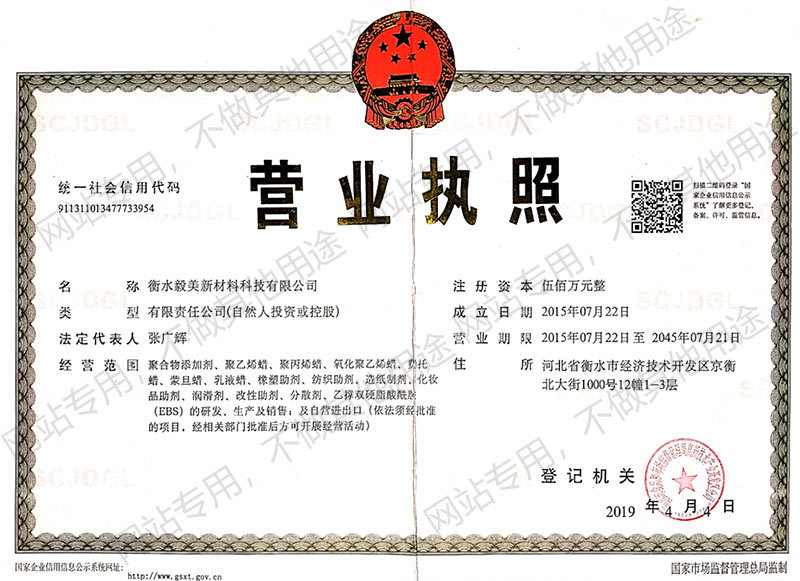
About UsHengshui yi mei new material technology co., ltd. was founded in 2015, is a collection of product development, production, sales and service as one of the high and new technology enterprises, yi mei company focused on deep processing of wax products, determined to become china's professional wax products supplier

-
ProductsThe company mainly produces and sells: polyethylene wax, oxidized polyethylene wax, synthetic Fischer-Tropsch wax, oxidized Fischer-Tropsch wax, maleic anhydride grafted wax, polypropylene wax, micro-powder wax, high-end composite wax and other eight series of dozens of models of high quality products.
-
NewsAt the beginning of its establishment, Yimei Company invested in the establishment of the "Polymer Additive R & D Center", insisting on scientific and technological innovation as the life force of enterprise development. Concentrate funds, technology, and talents in the company's scientific and technological innovation activities, focus on scientific research, public relations and technological breakthroughs of new products, new technologies, and new processes, and resolutely master core technologies.
-
SupportAt the beginning of its establishment, Yimei Company invested in the establishment of the "Polymer Additive R & D Center", insisting on scientific and technological innovation as the life force of enterprise development. Concentrate funds, technology, and talents in the company's scientific and technological innovation activities, focus on scientific research, public relations and technological breakthroughs of new products, new technologies, and new processes, and resolutely master core technologies.
-
RecruitmentOur company always adheres to the talent concept of "people-oriented", actively creates an atmosphere of respect, understanding, integrity and friendship, respects people's knowledge and talents, selects and develops mechanisms, and provides a growth platform for talents. make talents become a strong support for the sustainable development of enterprises, and realize the common growth and development of enterprises and talents.


Balancing Performance and Safety with PVC Lead Compound Stabilizers: An In-Depth Analysis
Release time:
2024-10-15
In the realm of industrial chemistry, achieving the right balance between performance and safety is paramount. PVC (polyvinyl chloride) is one of the most widely used synthetic plastics globally, and its effectiveness is often enhanced through the use of lead compound stabilizers. These stabilizers serve to improve the processing and durability of PVC products. However, the use of lead-based formulations comes with significant safety concerns that must be thoroughly addressed.
In the realm of industrial chemistry, achieving the right balance between performance and safety is paramount. PVC (polyvinyl chloride) is one of the most widely used synthetic plastics globally, and its effectiveness is often enhanced through the use of lead compound stabilizers. These stabilizers serve to improve the processing and durability of PVC products. However, the use of lead-based formulations comes with significant safety concerns that must be thoroughly addressed.
PVC lead compound stabilizers are additives incorporated into PVC formulations to enhance thermal stability and prevent degradation during processing and application. Composed primarily of lead salts, these stabilizers effectively inhibit the breakdown of PVC by neutralizing hydrochloric acid released during thermal degradation. This critical function extends the lifespan and performance of PVC products, making them suitable for various applications, from construction materials to electrical cables.
The role of stabilizers in PVC cannot be overstated. When PVC is exposed to heat during the manufacturing process, it can break down, leading to discoloration, loss of mechanical properties, and the release of hazardous gases. Lead compound stabilizers are crucial in mitigating these risks, ensuring that the material retains its integrity and functionality throughout its lifespan.
Lead stabilizers significantly improve the thermal stability of PVC, allowing it to withstand higher temperatures during processing without degrading. This property is vital for applications that involve heat exposure, such as electrical insulation.
One of the most desirable features of PVC products is their appearance. Lead stabilizers help maintain the color stability of PVC, preventing yellowing and discoloration over time. This quality is particularly important in consumer products where aesthetics matter.
While PVC lead compound stabilizers provide numerous benefits, there are significant safety concerns associated with their use. Lead is a toxic heavy metal that can pose health risks to humans and the environment. As a result, many countries and regulatory bodies have implemented strict guidelines governing the use of lead in industrial applications.
In the European Union, the Restriction of Hazardous Substances (RoHS) directive limits the amount of lead allowed in electronic and electrical equipment. Similarly, the U.S. Environmental Protection Agency (EPA) regulates lead exposure through various acts, including the Toxic Substances Control Act (TSCA).
Exposure to lead can result in severe health issues, including neurological damage, developmental delays in children, and various organ dysfunctions. Manufacturers must prioritize safety and compliance by properly managing the use of lead stabilizers in their processes.
Calcium-zinc stabilizers are non-toxic and environmentally friendly alternatives that offer similar performance benefits to lead stabilizers. They are widely used in applications where safety and sustainability are priorities.
Organic stabilizers, such as those based on fatty acids or esters, are gaining popularity due to their lower environmental impact. While they may not offer the same level of performance as lead stabilizers, advancements in technology are continuously improving their efficacy.
In the construction sector, PVC lead compounds are commonly used in pipes, siding, and window frames. Their durability and stability under various environmental conditions make them ideal for these applications.
Lead-based stabilizers are integral to the production of electrical cables and insulation materials. Their ability to withstand high temperatures and resist degradation ensures safe and reliable electrical systems.
As the industry evolves, so do the methods for stabilizing PVC. The future of PVC stabilization technology may see innovations that blend performance with environmental responsibility.
Ongoing research into safer and more effective stabilizers is critical. This includes the exploration of bio-based alternatives and the development of hybrid stabilizer systems that can deliver optimal performance without the associated risks of lead.
Sustainability is becoming a driving force in the chemical industry. Manufacturers are increasingly seeking ways to minimize their environmental footprint, including the transition away from lead stabilizers in favor of greener options.
Balancing performance and safety when using PVC lead compound stabilizers is a complex challenge that requires careful consideration and strategic decision-making. While these stabilizers provide significant benefits in terms of thermal stability, color retention, and product longevity, their associated health risks cannot be overlooked.
As we navigate the future of PVC stabilization technology, the industry must prioritize safety and compliance alongside performance. By embracing innovative solutions and alternative stabilizers, we can safeguard the health of consumers and the environment while continuing to leverage the advantages of PVC in various applications.
Key words:
PVC Lead compound stabilizer
recommend reading