Yimei New Material-Professional Wax Product Solution Supplier


-
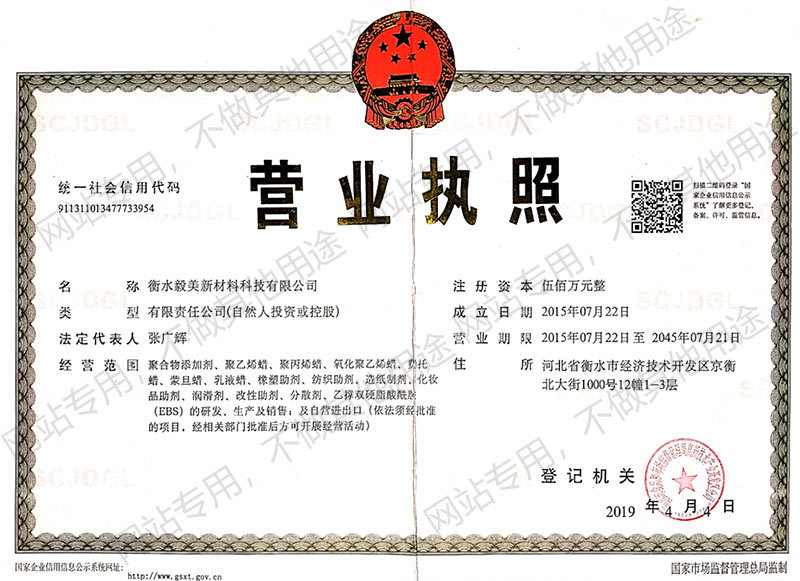
About UsHengshui yi mei new material technology co., ltd. was founded in 2015, is a collection of product development, production, sales and service as one of the high and new technology enterprises, yi mei company focused on deep processing of wax products, determined to become china's professional wax products supplier

-
ProductsThe company mainly produces and sells: polyethylene wax, oxidized polyethylene wax, synthetic Fischer-Tropsch wax, oxidized Fischer-Tropsch wax, maleic anhydride grafted wax, polypropylene wax, micro-powder wax, high-end composite wax and other eight series of dozens of models of high quality products.
-
NewsAt the beginning of its establishment, Yimei Company invested in the establishment of the "Polymer Additive R & D Center", insisting on scientific and technological innovation as the life force of enterprise development. Concentrate funds, technology, and talents in the company's scientific and technological innovation activities, focus on scientific research, public relations and technological breakthroughs of new products, new technologies, and new processes, and resolutely master core technologies.
-
SupportAt the beginning of its establishment, Yimei Company invested in the establishment of the "Polymer Additive R & D Center", insisting on scientific and technological innovation as the life force of enterprise development. Concentrate funds, technology, and talents in the company's scientific and technological innovation activities, focus on scientific research, public relations and technological breakthroughs of new products, new technologies, and new processes, and resolutely master core technologies.
-
RecruitmentOur company always adheres to the talent concept of "people-oriented", actively creates an atmosphere of respect, understanding, integrity and friendship, respects people's knowledge and talents, selects and develops mechanisms, and provides a growth platform for talents. make talents become a strong support for the sustainable development of enterprises, and realize the common growth and development of enterprises and talents.


Innovative Uses of Lead Stearate for Enhanced Manufacturing Processes
Release time:
2024-10-23
Lead stearate is a versatile compound that plays a significant role in various manufacturing processes. As a lead salt of stearic acid, this organic compound is primarily used as a lubricant and stabilizer. Its unique properties make it essential for improving the quality and efficiency of processes across multiple industries, particularly in plastics, coatings, and rubber manufacturing.
Lead stearate is a versatile compound that plays a significant role in various manufacturing processes. As a lead salt of stearic acid, this organic compound is primarily used as a lubricant and stabilizer. Its unique properties make it essential for improving the quality and efficiency of processes across multiple industries, particularly in plastics, coatings, and rubber manufacturing.
In recent years, the need for innovative materials that enhance production efficiency while maintaining product quality has surged. Lead stearate meets these demands, allowing manufacturers to optimize their processes. This article explores the innovative uses of lead stearate and how it can improve manufacturing outcomes.
Lead stearate demonstrates excellent thermal stability, making it suitable for processes that involve high temperatures. This property ensures that products maintain their integrity during manufacturing.
As a lubricant, lead stearate reduces friction between materials, improving the flow of various products during processing. This characteristic is particularly valuable in plastic molding and extrusion.
Lead stearate is compatible with a variety of polymers and resins, allowing for seamless integration into various formulations. This compatibility enhances the overall performance of the final product.
Lead stearate's unique properties enable it to find a wide range of applications within the manufacturing sector. The following sections detail some of its most significant uses:
In the plastics industry, lead stearate serves multiple functions. It acts as a lubricant in the extrusion and molding processes, ensuring smooth material flow and reducing wear on machinery. Additionally, it helps in stabilizing various plastic formulations, enhancing their durability and performance.
The incorporation of lead stearate in the manufacturing of polyvinyl chloride (PVC) products is particularly noteworthy. By acting as a heat stabilizer, it prevents the degradation of PVC during processing, leading to improved product quality and longevity.
Lead stearate is extensively used in coatings, where its properties contribute to enhancing the performance of paints and varnishes. It acts as a dispersing agent, ensuring uniform distribution of pigments and additives. This results in coatings with improved adhesion, durability, and resistance to weathering.
Moreover, lead stearate aids in reducing the viscosity of coating formulations, allowing for easier application. This property is particularly beneficial in spray applications, where a consistent flow is essential for achieving a smooth finish.
In rubber manufacturing, lead stearate is utilized as a processing aid and a lubricant. It helps reduce friction during the mixing and molding processes, which can improve the efficiency of production lines. Furthermore, it enhances the release properties of rubber products, facilitating easier demolding from molds.
Additionally, lead stearate contributes to the overall performance of rubber compounds by improving their heat stability and aging resistance. This is particularly crucial in applications where rubber products are exposed to extreme temperatures or environmental conditions.
The use of lead stearate often leads to higher-quality end products. By ensuring even dispersion of materials and enhancing thermal stability, manufacturers can produce goods that meet stringent quality standards.
By acting as a lubricant and processing aid, lead stearate can significantly improve manufacturing efficiency. Reduced friction and smoother material flow lead to shorter production cycles and lower energy consumption.
While the initial investment in lead stearate may seem significant, the long-term savings in production costs often outweigh this expense. Enhanced efficiency and reduced material waste contribute to a more cost-effective manufacturing process.
As with any chemical compound, the environmental impact of lead stearate must be considered. While it offers numerous benefits, manufacturers must also be aware of potential risks associated with lead exposure.
Manufacturers using lead stearate must ensure compliance with relevant regulations regarding lead usage. This includes adhering to safety standards and guidelines set forth by organizations such as OSHA and EPA.
In light of environmental concerns, many manufacturers are exploring alternative compounds that can provide similar benefits without the risks associated with lead. Ongoing research and innovation in this area are crucial for the future of manufacturing.
As industries strive for higher performance standards, the demand for materials like lead stearate is likely to rise. Manufacturers will continue to seek innovative solutions to enhance product quality and efficiency.
Ongoing research into the applications of lead stearate will likely yield new insights and advancements. The exploration of its compatibility with emerging materials could open doors to novel uses in various sectors.
Lead stearate has proven to be a transformative compound in the manufacturing sector, offering numerous benefits that enhance product quality and production efficiency. As manufacturers continue to seek innovative materials to meet evolving industry demands, the applications of lead stearate will likely expand. While it is essential to consider environmental and regulatory factors associated with its use, the advantages it brings to manufacturing processes are significant. By embracing lead stearate's potential, industries can achieve superior results and maintain a competitive edge in a rapidly changing market.
Key words:
Lead Stearate
recommend reading