Yimei New Material-Professional Wax Product Solution Supplier


-
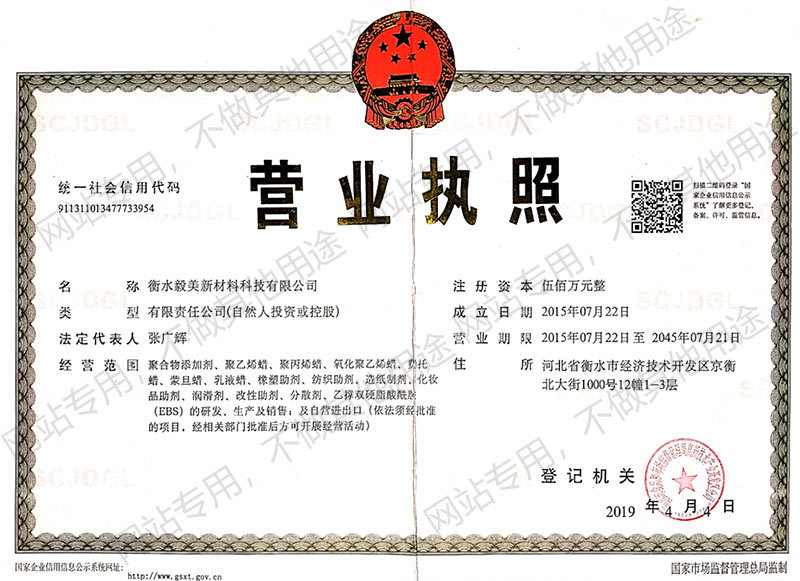
About UsHengshui yi mei new material technology co., ltd. was founded in 2015, is a collection of product development, production, sales and service as one of the high and new technology enterprises, yi mei company focused on deep processing of wax products, determined to become china's professional wax products supplier

-
ProductsThe company mainly produces and sells: polyethylene wax, oxidized polyethylene wax, synthetic Fischer-Tropsch wax, oxidized Fischer-Tropsch wax, maleic anhydride grafted wax, polypropylene wax, micro-powder wax, high-end composite wax and other eight series of dozens of models of high quality products.
-
NewsAt the beginning of its establishment, Yimei Company invested in the establishment of the "Polymer Additive R & D Center", insisting on scientific and technological innovation as the life force of enterprise development. Concentrate funds, technology, and talents in the company's scientific and technological innovation activities, focus on scientific research, public relations and technological breakthroughs of new products, new technologies, and new processes, and resolutely master core technologies.
-
SupportAt the beginning of its establishment, Yimei Company invested in the establishment of the "Polymer Additive R & D Center", insisting on scientific and technological innovation as the life force of enterprise development. Concentrate funds, technology, and talents in the company's scientific and technological innovation activities, focus on scientific research, public relations and technological breakthroughs of new products, new technologies, and new processes, and resolutely master core technologies.
-
RecruitmentOur company always adheres to the talent concept of "people-oriented", actively creates an atmosphere of respect, understanding, integrity and friendship, respects people's knowledge and talents, selects and develops mechanisms, and provides a growth platform for talents. make talents become a strong support for the sustainable development of enterprises, and realize the common growth and development of enterprises and talents.


A Comprehensive Guide to Lead Stearate: Properties, Applications, and Benefits
Release time:
2024-10-24
Lead Stearate is a chemical compound extensively utilized in various applications due to its unique properties. As a lead salt of stearic acid, it exhibits valuable characteristics such as thermal stability, lubricating properties, and compatibility with numerous materials. These attributes make Lead Stearate a preferred choice in several industries, particularly in the production of plastics, rub
Lead Stearate is a chemical compound extensively utilized in various applications due to its unique properties. As a lead salt of stearic acid, it exhibits valuable characteristics such as thermal stability, lubricating properties, and compatibility with numerous materials. These attributes make Lead Stearate a preferred choice in several industries, particularly in the production of plastics, rubber, and other specialized chemical formulations.
One of the key applications of Lead Stearate lies in the field of polyvinyl chloride (PVC) processing. It serves as a heat stabilizer, ensuring the thermal stability of PVC during production. By preventing the degradation of PVC at elevated temperatures, Lead Stearate enhances the durability and longevity of the final product. Moreover, this compound helps to improve the flow characteristics of PVC, facilitating easier processing and molding.
In addition to its role in PVC, Lead Stearate is also utilized as a lubricant in the production of various plastic products. It reduces friction between particles during the manufacturing process, leading to smoother operations and improved equipment efficiency. As a lubricant, Lead Stearate contributes to enhancing the surface finish of molded articles, providing a more aesthetically pleasing final product.
Another significant application of Lead Stearate is in the rubber industry. It acts as a processing aid and lubricant, facilitating the mixing of rubber compounds. By enhancing the flow properties of the rubber, Lead Stearate helps manufacturers achieve better dispersion of fillers and reinforcements, ultimately improving the mechanical properties of the resulting rubber products.
Furthermore, Lead Stearate is also employed in the production of paints, coatings, and inks. It serves as a stabilizer, ensuring a consistent and uniform dispersion of pigments and additives. This capability is crucial for achieving the desired color and performance characteristics in various applications. Additionally, it can help to improve the gloss and smoothness of coatings, leading to enhanced aesthetic quality.
While Lead Stearate offers numerous benefits, it is essential to handle it with care due to its lead content. Adhering to safety regulations and guidelines is crucial to ensure the well-being of workers and the environment. When used responsibly, Lead Stearate can significantly enhance the performance of products across multiple applications.
In conclusion, Lead Stearate is a versatile compound with valuable properties that make it an essential component in various industrial applications. From its role as a stabilizer in PVC processing to its lubricating properties in rubber manufacturing, understanding the benefits and uses of Lead Stearate can help professionals in the chemical industry optimize their processes and improve product quality.
Key words:
Lead Stearate
recommend reading