Yimei New Material-Professional Wax Product Solution Supplier


-
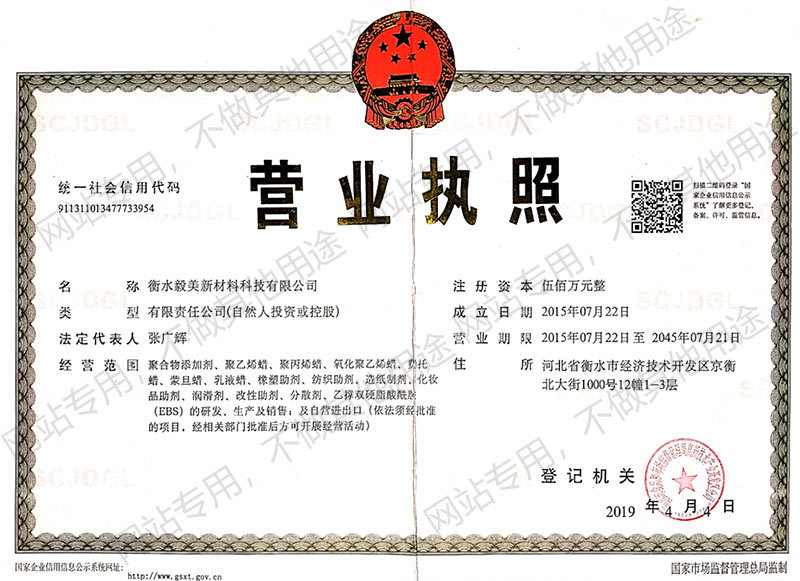
About UsHengshui yi mei new material technology co., ltd. was founded in 2015, is a collection of product development, production, sales and service as one of the high and new technology enterprises, yi mei company focused on deep processing of wax products, determined to become china's professional wax products supplier

-
ProductsThe company mainly produces and sells: polyethylene wax, oxidized polyethylene wax, synthetic Fischer-Tropsch wax, oxidized Fischer-Tropsch wax, maleic anhydride grafted wax, polypropylene wax, micro-powder wax, high-end composite wax and other eight series of dozens of models of high quality products.
-
NewsAt the beginning of its establishment, Yimei Company invested in the establishment of the "Polymer Additive R & D Center", insisting on scientific and technological innovation as the life force of enterprise development. Concentrate funds, technology, and talents in the company's scientific and technological innovation activities, focus on scientific research, public relations and technological breakthroughs of new products, new technologies, and new processes, and resolutely master core technologies.
-
SupportAt the beginning of its establishment, Yimei Company invested in the establishment of the "Polymer Additive R & D Center", insisting on scientific and technological innovation as the life force of enterprise development. Concentrate funds, technology, and talents in the company's scientific and technological innovation activities, focus on scientific research, public relations and technological breakthroughs of new products, new technologies, and new processes, and resolutely master core technologies.
-
RecruitmentOur company always adheres to the talent concept of "people-oriented", actively creates an atmosphere of respect, understanding, integrity and friendship, respects people's knowledge and talents, selects and develops mechanisms, and provides a growth platform for talents. make talents become a strong support for the sustainable development of enterprises, and realize the common growth and development of enterprises and talents.


Understanding Composite Lubricants: A Comprehensive Guide
Release time:
2024-10-26
Composite lubricants are specialized materials designed to reduce friction and wear between interacting surfaces, playing a critical role in various mechanical systems. Unlike traditional lubricants, composite lubricants often combine multiple components to enhance performance characteristics, such as temperature resistance, load-bearing capacity, and longevity. Their unique formulation makes them
Composite lubricants are specialized materials designed to reduce friction and wear between interacting surfaces, playing a critical role in various mechanical systems. Unlike traditional lubricants, composite lubricants often combine multiple components to enhance performance characteristics, such as temperature resistance, load-bearing capacity, and longevity. Their unique formulation makes them suitable for a wide range of applications across different industries, including automotive, aerospace, and manufacturing.
One of the primary advantages of composite lubricants is their ability to withstand extreme operating conditions. Many composite lubricants are engineered to function effectively at high temperatures, making them ideal for applications where conventional lubricants might fail. This thermal stability ensures continuous protection of machinery components, thereby minimizing the risk of damage and prolonging equipment lifespan.
In addition to thermal resistance, composite lubricants often exhibit excellent load-carrying properties. This means they can support heavy loads without breaking down or losing effectiveness. Such features are particularly beneficial in applications involving heavy machinery, where traditional lubricants may struggle to provide adequate protection under high pressure. The formulation of composite lubricants typically includes solid lubricants, such as graphite or molybdenum disulfide, which contribute to their superior load-bearing capabilities.
Another important aspect of composite lubricants is their adaptability. They can be customized to meet specific requirements for different environments and applications. For instance, some composite lubricants are designed to resist water washout, making them suitable for use in wet conditions or environments where contact with water is common. Others may be formulated to provide excellent adhesion to surfaces, ensuring that the lubricant remains in place even under challenging operational conditions.
Moreover, the environmental impact of lubricants is a growing concern in many industries. Composite lubricants can offer eco-friendly alternatives, as many are designed to be biodegradable or less harmful to the environment compared to traditional petroleum-based lubricants. This shift towards environmentally responsible solutions is not only beneficial for the planet but can also enhance a company's reputation and compliance with environmental regulations.
In conclusion, composite lubricants serve as a vital component in enhancing the efficiency and reliability of mechanical systems. Their unique properties, including high-temperature stability, exceptional load-bearing capacity, and adaptability, make them a preferred choice for various applications. By understanding the benefits and options available within the realm of composite lubricants, businesses can make informed decisions that contribute to improved performance and sustainability in their operations.
Key words:
Composite lubricant
recommend reading