Yimei New Material-Professional Wax Product Solution Supplier


-
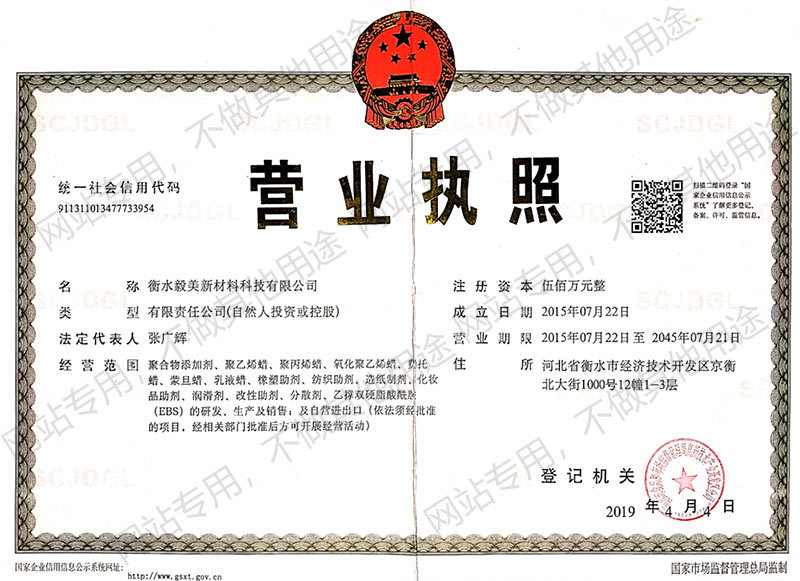
About UsHengshui yi mei new material technology co., ltd. was founded in 2015, is a collection of product development, production, sales and service as one of the high and new technology enterprises, yi mei company focused on deep processing of wax products, determined to become china's professional wax products supplier

-
ProductsThe company mainly produces and sells: polyethylene wax, oxidized polyethylene wax, synthetic Fischer-Tropsch wax, oxidized Fischer-Tropsch wax, maleic anhydride grafted wax, polypropylene wax, micro-powder wax, high-end composite wax and other eight series of dozens of models of high quality products.
-
NewsAt the beginning of its establishment, Yimei Company invested in the establishment of the "Polymer Additive R & D Center", insisting on scientific and technological innovation as the life force of enterprise development. Concentrate funds, technology, and talents in the company's scientific and technological innovation activities, focus on scientific research, public relations and technological breakthroughs of new products, new technologies, and new processes, and resolutely master core technologies.
-
SupportAt the beginning of its establishment, Yimei Company invested in the establishment of the "Polymer Additive R & D Center", insisting on scientific and technological innovation as the life force of enterprise development. Concentrate funds, technology, and talents in the company's scientific and technological innovation activities, focus on scientific research, public relations and technological breakthroughs of new products, new technologies, and new processes, and resolutely master core technologies.
-
RecruitmentOur company always adheres to the talent concept of "people-oriented", actively creates an atmosphere of respect, understanding, integrity and friendship, respects people's knowledge and talents, selects and develops mechanisms, and provides a growth platform for talents. make talents become a strong support for the sustainable development of enterprises, and realize the common growth and development of enterprises and talents.


Exploring the Benefits of Composite Lubricant in Chemical Manufacturing
Release time:
2024-10-27
In the ever-evolving landscape of chemical manufacturing, efficiency and reliability are paramount. The introduction of composite lubricants has marked a significant advancement in this field, offering superior solutions that address various manufacturing challenges. As industries strive to optimize operations while minimizing costs, understanding the benefits of composite lubricants becomes increasingly important.
In the ever-evolving landscape of chemical manufacturing, efficiency and reliability are paramount. The introduction of composite lubricants has marked a significant advancement in this field, offering superior solutions that address various manufacturing challenges. As industries strive to optimize operations while minimizing costs, understanding the benefits of composite lubricants becomes increasingly important.
Composite lubricants are specialized formulations designed to improve lubrication under extreme conditions. They typically consist of a blend of different base oils, additives, and solid lubricants, providing a unique combination of properties. Unlike traditional lubricants, which may fail under high stress or temperature, composite lubricants maintain their performance and protect equipment, thereby extending the lifespan of machinery.
The chemical manufacturing industry is characterized by high temperatures, pressures, and the presence of various aggressive chemicals. In such environments, the choice of lubricant can significantly impact equipment performance and overall production efficiency. Composite lubricants are integral to this sector because they offer:
Enhanced Protection: They reduce friction and wear, leading to lower maintenance costs.
Improved Efficiency: By minimizing energy loss, composite lubricants help achieve optimal operational efficiency.
Versatility: Their formulation allows them to be used across a wide range of applications and conditions.
Composite lubricants are engineered to perform exceptionally well in demanding environments. They provide a stable lubricant film that resists breakdown, ensuring consistent performance even under high load conditions. This enhanced performance translates to smoother operations and fewer unexpected failures.
One of the most significant advantages of composite lubricants is their ability to reduce wear and tear on machinery. By forming a protective barrier between moving parts, these lubricants minimize direct contact, thereby preventing metal-to-metal interactions that lead to damage and costly downtime.
Chemical manufacturing often involves processes that generate considerable heat. Composite lubricants boast excellent thermal stability, allowing them to maintain their viscosity and protective properties even at elevated temperatures. This characteristic is vital for maintaining equipment performance and preventing overheating.
As industries become more environmentally conscious, the demand for sustainable solutions has risen. Composite lubricants can be formulated to be less harmful to the environment compared to traditional options. Utilizing bio-based ingredients and minimizing hazardous substances makes these lubricants a more eco-friendly choice for chemical manufacturing.
The future of composite lubricants in chemical manufacturing looks promising as innovation continues to drive the industry. Key trends to watch include:
Smart Lubrication Solutions: The integration of IoT technology to monitor lubricant performance and optimize usage in real-time.
Bio-Based Formulations: Increased focus on sustainability is leading to the development of bio-based composite lubricants that maintain performance without compromising environmental safety.
Advanced Additives: The use of nanotechnology and other advanced materials to enhance the properties of composite lubricants further.
These trends indicate a shift towards more efficient, sustainable, and intelligent lubrication solutions in chemical manufacturing.
The adoption of composite lubricants in chemical manufacturing is a game-changer, offering a wide array of benefits that address the industry's unique challenges. From enhanced performance and reduced wear to environmental sustainability, these lubricants are poised to revolutionize manufacturing processes. As we look to the future, the potential for innovation in composite lubricant formulations and applications will continue to drive efficiency and reliability in chemical manufacturing. Embracing these advancements will not only optimize operations but also contribute to a more sustainable industry overall.
Key words:
Composite lubricant
Previous article
Previous article
recommend reading