Yimei New Material-Professional Wax Product Solution Supplier


-
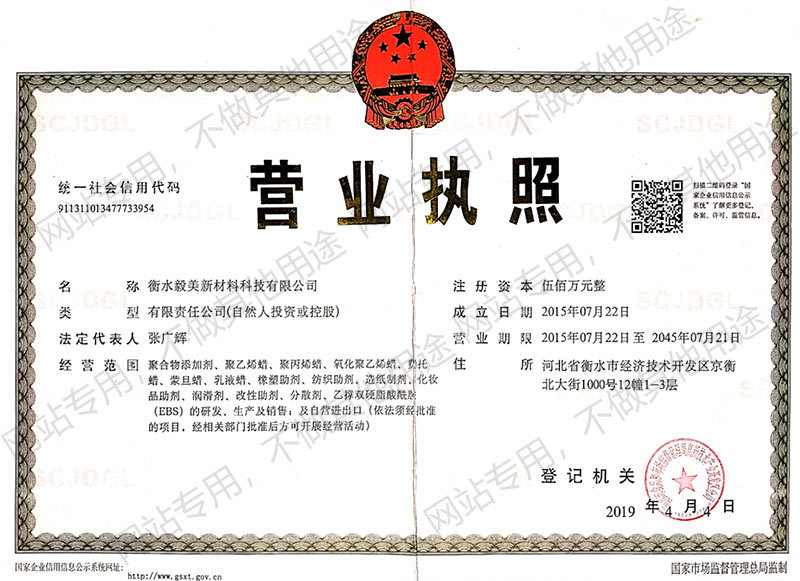
About UsHengshui yi mei new material technology co., ltd. was founded in 2015, is a collection of product development, production, sales and service as one of the high and new technology enterprises, yi mei company focused on deep processing of wax products, determined to become china's professional wax products supplier

-
ProductsThe company mainly produces and sells: polyethylene wax, oxidized polyethylene wax, synthetic Fischer-Tropsch wax, oxidized Fischer-Tropsch wax, maleic anhydride grafted wax, polypropylene wax, micro-powder wax, high-end composite wax and other eight series of dozens of models of high quality products.
-
NewsAt the beginning of its establishment, Yimei Company invested in the establishment of the "Polymer Additive R & D Center", insisting on scientific and technological innovation as the life force of enterprise development. Concentrate funds, technology, and talents in the company's scientific and technological innovation activities, focus on scientific research, public relations and technological breakthroughs of new products, new technologies, and new processes, and resolutely master core technologies.
-
SupportAt the beginning of its establishment, Yimei Company invested in the establishment of the "Polymer Additive R & D Center", insisting on scientific and technological innovation as the life force of enterprise development. Concentrate funds, technology, and talents in the company's scientific and technological innovation activities, focus on scientific research, public relations and technological breakthroughs of new products, new technologies, and new processes, and resolutely master core technologies.
-
RecruitmentOur company always adheres to the talent concept of "people-oriented", actively creates an atmosphere of respect, understanding, integrity and friendship, respects people's knowledge and talents, selects and develops mechanisms, and provides a growth platform for talents. make talents become a strong support for the sustainable development of enterprises, and realize the common growth and development of enterprises and talents.


Understanding Composite Lubricants: A Guide for Professionals
Release time:
2024-10-28
Composite lubricants have emerged as a vital component in the world of chemical products, particularly in scenarios where traditional lubricants may fall short. These specialized lubricants are formulated to combine the properties of various lubrication substances, offering enhanced performance in diverse applications. Understanding the intricacies of composite lubricants can significantly benefit
Composite lubricants have emerged as a vital component in the world of chemical products, particularly in scenarios where traditional lubricants may fall short. These specialized lubricants are formulated to combine the properties of various lubrication substances, offering enhanced performance in diverse applications. Understanding the intricacies of composite lubricants can significantly benefit professionals in various industries, especially in the chemical sector.
One of the primary advantages of composite lubricants is their ability to withstand extreme conditions. They are often engineered to perform effectively across a wide range of temperatures and pressures, making them suitable for both high-load and high-speed applications. This versatility not only helps in reducing friction and wear but also extends the lifespan of machinery components.
Moreover, composite lubricants typically feature a unique blend of solid lubricants and liquid carriers. This combination allows for improved load-carrying capacity and reduced friction, leading to enhanced efficiency in machinery operations. The solid lubricants, such as graphite or molybdenum disulfide, can provide a protective layer that minimizes direct contact between surfaces, thereby decreasing wear and tear.
In addition to their mechanical benefits, composite lubricants are often designed to offer superior protection against corrosion and oxidation. This is particularly important in industries where equipment is exposed to harsh environmental conditions. By providing a protective barrier, composite lubricants help in maintaining the integrity of machinery, reducing the need for frequent maintenance and downtime.
Another key aspect of composite lubricants is their compatibility with various materials. Whether dealing with metals, plastics, or elastomers, composite lubricants can often be formulated to ensure compatibility, thus preventing degradation of components and ensuring optimal performance.
When selecting a composite lubricant, it is important to consider the specific requirements of your application. Factors such as operating temperature, load conditions, and the materials involved should all be taken into account. Conducting thorough testing and evaluation can help in identifying the most suitable lubricant for your needs, ensuring maximum efficiency and reliability.
In summary, composite lubricants represent a crucial innovation in lubrication technology, offering enhanced performance, protection, and longevity for industrial machinery. By understanding their properties and applications, professionals can make informed decisions that contribute to improved operational efficiency and reduced maintenance costs. Embracing the advantages of composite lubricants can lead to significant benefits in productivity and equipment longevity, making them an invaluable asset in any industrial setting.
Key words:
Composite lubricant
recommend reading