Yimei New Material-Professional Wax Product Solution Supplier


-
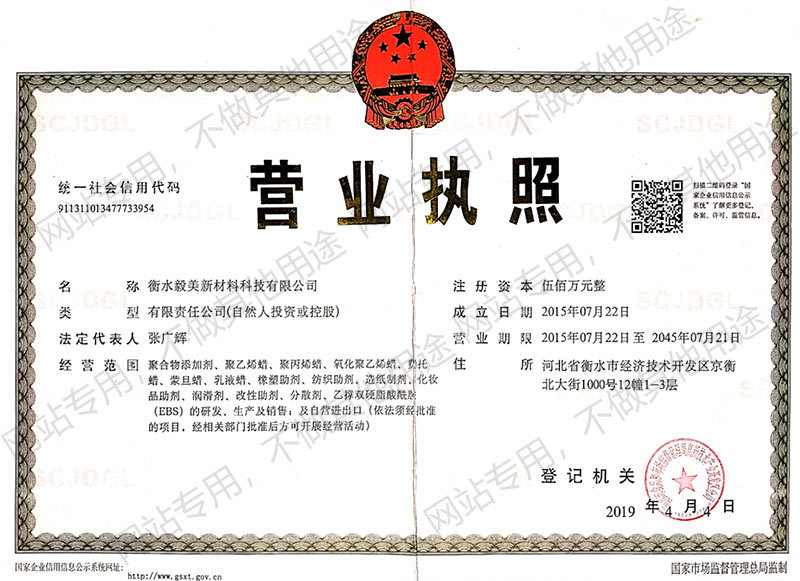
About UsHengshui yi mei new material technology co., ltd. was founded in 2015, is a collection of product development, production, sales and service as one of the high and new technology enterprises, yi mei company focused on deep processing of wax products, determined to become china's professional wax products supplier

-
ProductsThe company mainly produces and sells: polyethylene wax, oxidized polyethylene wax, synthetic Fischer-Tropsch wax, oxidized Fischer-Tropsch wax, maleic anhydride grafted wax, polypropylene wax, micro-powder wax, high-end composite wax and other eight series of dozens of models of high quality products.
-
NewsAt the beginning of its establishment, Yimei Company invested in the establishment of the "Polymer Additive R & D Center", insisting on scientific and technological innovation as the life force of enterprise development. Concentrate funds, technology, and talents in the company's scientific and technological innovation activities, focus on scientific research, public relations and technological breakthroughs of new products, new technologies, and new processes, and resolutely master core technologies.
-
SupportAt the beginning of its establishment, Yimei Company invested in the establishment of the "Polymer Additive R & D Center", insisting on scientific and technological innovation as the life force of enterprise development. Concentrate funds, technology, and talents in the company's scientific and technological innovation activities, focus on scientific research, public relations and technological breakthroughs of new products, new technologies, and new processes, and resolutely master core technologies.
-
RecruitmentOur company always adheres to the talent concept of "people-oriented", actively creates an atmosphere of respect, understanding, integrity and friendship, respects people's knowledge and talents, selects and develops mechanisms, and provides a growth platform for talents. make talents become a strong support for the sustainable development of enterprises, and realize the common growth and development of enterprises and talents.


Understanding FT Wax: Properties, Applications, and Benefits in the Chemical Industry
Release time:
2025-02-21
FT wax, short for Fischer-Tropsch wax, is a synthetic wax produced through the Fischer-Tropsch synthesis process, which converts carbon monoxide and hydrogen into hydrocarbons. This process involves various catalysts and operates under specific conditions to yield long-chain hydrocarbons, which are further refined into wax. FT wax boasts a range of beneficial properties that make it an essential c
FT wax, short for Fischer-Tropsch wax, is a synthetic wax produced through the Fischer-Tropsch synthesis process, which converts carbon monoxide and hydrogen into hydrocarbons. This process involves various catalysts and operates under specific conditions to yield long-chain hydrocarbons, which are further refined into wax. FT wax boasts a range of beneficial properties that make it an essential component in multiple applications within the chemical industry.
One of the standout characteristics of FT wax is its high melting point and excellent thermal stability, which makes it suitable for use in high-temperature applications. Unlike natural waxes, FT wax exhibits a more controlled structure, resulting in uniform consistency and performance. This consistency is particularly beneficial in industries that require precise formulations and reliable outcomes.
Another significant advantage of FT wax is its versatility. It can be used as a base for various formulations, including coatings, adhesives, and sealants. The wax provides a smooth finish and enhances the durability of these products. Additionally, FT wax serves as an excellent lubricant, reducing friction and wear in mechanical applications. Its low volatility contributes to the stability of formulations, ensuring they maintain their integrity over time.
In the realm of cosmetics, FT wax is also gaining recognition for its role as a thickening agent and film former. It can help create products that have a desirable texture and enhance the formulation's longevity. This aspect is particularly appealing to manufacturers seeking to create high-performing cosmetic products that cater to consumer demands for quality and effectiveness.
Moreover, the environmental impact of FT wax production is worth noting. As it is derived from synthetic processes, FT wax can be produced with a lower carbon footprint compared to traditional waxes sourced from petrochemical feedstocks. This sustainable approach is increasingly important for companies looking to align with eco-friendly practices and reduce their overall environmental impact.
In conclusion, FT wax stands out in the chemical industry for its unique properties, versatility, and potential for sustainable production. Its applications span across various sectors, making it a valuable material for manufacturers seeking high-quality solutions. Understanding the characteristics and benefits of FT wax can enhance your product development processes and contribute to successful outcomes in your industry endeavors.
One of the standout characteristics of FT wax is its high melting point and excellent thermal stability, which makes it suitable for use in high-temperature applications. Unlike natural waxes, FT wax exhibits a more controlled structure, resulting in uniform consistency and performance. This consistency is particularly beneficial in industries that require precise formulations and reliable outcomes.
Another significant advantage of FT wax is its versatility. It can be used as a base for various formulations, including coatings, adhesives, and sealants. The wax provides a smooth finish and enhances the durability of these products. Additionally, FT wax serves as an excellent lubricant, reducing friction and wear in mechanical applications. Its low volatility contributes to the stability of formulations, ensuring they maintain their integrity over time.
In the realm of cosmetics, FT wax is also gaining recognition for its role as a thickening agent and film former. It can help create products that have a desirable texture and enhance the formulation's longevity. This aspect is particularly appealing to manufacturers seeking to create high-performing cosmetic products that cater to consumer demands for quality and effectiveness.
Moreover, the environmental impact of FT wax production is worth noting. As it is derived from synthetic processes, FT wax can be produced with a lower carbon footprint compared to traditional waxes sourced from petrochemical feedstocks. This sustainable approach is increasingly important for companies looking to align with eco-friendly practices and reduce their overall environmental impact.
In conclusion, FT wax stands out in the chemical industry for its unique properties, versatility, and potential for sustainable production. Its applications span across various sectors, making it a valuable material for manufacturers seeking high-quality solutions. Understanding the characteristics and benefits of FT wax can enhance your product development processes and contribute to successful outcomes in your industry endeavors.
Key words:
FT wax
Previous article
Previous article
recommend reading