Yimei New Material-Professional Wax Product Solution Supplier


-
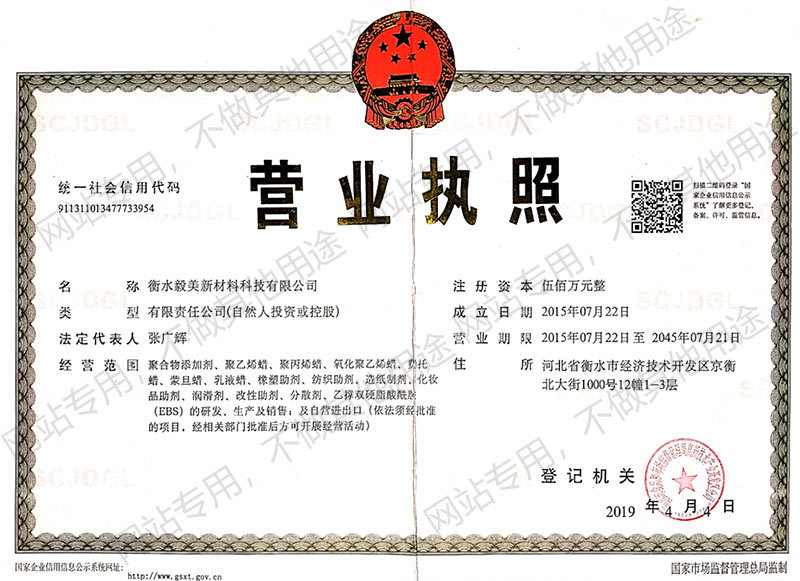
About UsHengshui yi mei new material technology co., ltd. was founded in 2015, is a collection of product development, production, sales and service as one of the high and new technology enterprises, yi mei company focused on deep processing of wax products, determined to become china's professional wax products supplier

-
ProductsThe company mainly produces and sells: polyethylene wax, oxidized polyethylene wax, synthetic Fischer-Tropsch wax, oxidized Fischer-Tropsch wax, maleic anhydride grafted wax, polypropylene wax, micro-powder wax, high-end composite wax and other eight series of dozens of models of high quality products.
-
NewsAt the beginning of its establishment, Yimei Company invested in the establishment of the "Polymer Additive R & D Center", insisting on scientific and technological innovation as the life force of enterprise development. Concentrate funds, technology, and talents in the company's scientific and technological innovation activities, focus on scientific research, public relations and technological breakthroughs of new products, new technologies, and new processes, and resolutely master core technologies.
-
SupportAt the beginning of its establishment, Yimei Company invested in the establishment of the "Polymer Additive R & D Center", insisting on scientific and technological innovation as the life force of enterprise development. Concentrate funds, technology, and talents in the company's scientific and technological innovation activities, focus on scientific research, public relations and technological breakthroughs of new products, new technologies, and new processes, and resolutely master core technologies.
-
RecruitmentOur company always adheres to the talent concept of "people-oriented", actively creates an atmosphere of respect, understanding, integrity and friendship, respects people's knowledge and talents, selects and develops mechanisms, and provides a growth platform for talents. make talents become a strong support for the sustainable development of enterprises, and realize the common growth and development of enterprises and talents.


Polyethylene Wax: A Key Ingredient for Industrial Applications
Release time:
2025-02-18
Polyethylene Wax: A Key Ingredient for Industrial Applications Table of Contents 1. Introduction to Polyethylene Wax 2. Chemical Properties of Polyethylene Wax 3. The Manufacturing Process of Polyethylene Wax 4. Applications of Polyethylene Wax in Various Industries 5. Benefits of Using Polyethylene Wax 6. Comparison with Other Waxes 7. Sustainability and Environmental
Polyethylene Wax: A Key Ingredient for Industrial Applications
Table of Contents
- 1. Introduction to Polyethylene Wax
- 2. Chemical Properties of Polyethylene Wax
- 3. The Manufacturing Process of Polyethylene Wax
- 4. Applications of Polyethylene Wax in Various Industries
- 5. Benefits of Using Polyethylene Wax
- 6. Comparison with Other Waxes
- 7. Sustainability and Environmental Impact
- 8. Frequently Asked Questions (FAQs)
- 9. Conclusion
1. Introduction to Polyethylene Wax
Polyethylene wax, a versatile and widely used chemical product, plays a crucial role in numerous industrial applications. As a polymer derived from ethylene, it is characterized by its waxy texture and excellent chemical resistance. Its unique properties make it an ideal additive for various formulations, enhancing the performance and efficiency of products in industries ranging from coatings to plastics.
2. Chemical Properties of Polyethylene Wax
Polyethylene wax is a low molecular weight polymer, typically characterized by a melting point between **80°C and 130°C**. Its chemical structure consists of long hydrocarbon chains, which impart several significant properties:
2.1. Low Viscosity
One of the most notable characteristics of polyethylene wax is its low viscosity when melted. This property allows for easy incorporation into formulations, facilitating uniform distribution throughout the matrix.
2.2. High Chemical Resistance
Polyethylene wax exhibits excellent resistance to various chemicals, making it suitable for use in harsh industrial environments where exposure to solvents, acids, and bases is common.
2.3. Compatibility
This wax is compatible with a wide range of resins, oils, and additives, which enhances its versatility in different applications. Its ability to blend seamlessly with other materials ensures optimal performance in formulations.
3. The Manufacturing Process of Polyethylene Wax
The production of polyethylene wax involves several steps, primarily focusing on polymerization. Ethylene gas undergoes a polymerization process in the presence of catalysts to form polyethylene. Following this, the polymer is subjected to specific processes to achieve the desired molecular weight and properties.
3.1. Polymerization Techniques
There are various polymerization techniques utilized to manufacture polyethylene wax, including:
- **Ziegler-Natta Polymerization**: This method allows for the production of high-density polyethylene, resulting in wax with excellent properties.
- **Radical Polymerization**: This technique can produce low molecular weight polyethylene wax, suitable for specific applications.
3.2. Purification and Processing
After polymerization, the wax undergoes purification processes to remove any unreacted monomers and catalysts. This ensures a high-quality end product that meets industry standards.
4. Applications of Polyethylene Wax in Various Industries
Polyethylene wax finds extensive use across several industries due to its beneficial properties. Here are some of the primary applications:
4.1. Coatings and Inks
In the coatings industry, polyethylene wax serves as a slip agent and anti-blocking agent, improving the finish and durability of paints and inks. It enhances the performance of coatings by providing better scratch resistance and gloss.
4.2. Plastics
Polyethylene wax is often used as a processing aid in plastic formulations. It helps to reduce friction during processing, improving the flow of materials and enhancing the final product's surface finish.
4.3. Adhesives
In adhesive formulations, polyethylene wax acts as a modifier, improving the adhesion properties and providing better heat resistance. This ensures stronger bonding in various applications.
4.4. Textiles
In the textile industry, polyethylene wax is utilized as a lubricant and finishing agent, enhancing the fabric's properties and processing efficiency.
4.5. Rubber
Polyethylene wax is incorporated into rubber compounds to improve processing characteristics and enhance the overall performance of rubber products.
5. Benefits of Using Polyethylene Wax
The numerous benefits offered by polyethylene wax make it a preferred choice for many industrial applications:
5.1. Enhanced Performance
Polyethylene wax contributes to improved product performance, ensuring higher durability and resistance to wear and tear, particularly in coatings and adhesives.
5.2. Cost-Effectiveness
With its multifunctional properties, polyethylene wax can reduce the need for multiple additives, leading to cost savings in formulations.
5.3. Versatility
Its compatibility with various materials makes polyethylene wax an adaptable choice, suitable for a wide array of applications across different industries.
5.4. Improved Processing
Incorporating polyethylene wax into formulations can enhance processing efficiency, reducing energy consumption and improving throughput.
6. Comparison with Other Waxes
When considering polyethylene wax for industrial applications, it is essential to compare it with other types of waxes, such as paraffin wax and carnauba wax.
6.1. Polyethylene Wax vs. Paraffin Wax
While both types of wax offer benefits, polyethylene wax is often preferred for its superior chemical resistance and lower viscosity, making it ideal for high-performance applications.
6.2. Polyethylene Wax vs. Carnauba Wax
Carnauba wax, a natural wax, is known for its high gloss finish. However, polyethylene wax outperforms it in terms of thermal stability and processing efficiency, making it more suitable for industrial applications.
7. Sustainability and Environmental Impact
As industries increasingly focus on sustainability, it is important to consider the environmental impact of materials used in manufacturing. Polyethylene wax is derived from ethylene, a byproduct of natural gas and petroleum. However, advancements in bio-based polyethylene wax production are emerging, offering a more sustainable alternative.
7.1. Recycling Potential
Polyethylene wax can be recycled, contributing to a circular economy and reducing waste in industrial applications.
7.2. Environmental Regulations
Manufacturers are adopting eco-friendly practices to comply with environmental regulations, and polyethylene wax is becoming a popular choice due to its lower environmental impact compared to other synthetic waxes.
8. Frequently Asked Questions (FAQs)
8.1. What is polyethylene wax used for?
Polyethylene wax is used in various applications, including coatings, plastics, adhesives, textiles, and rubber, due to its beneficial properties.
8.2. Is polyethylene wax biodegradable?
Polyethylene wax is not biodegradable, but it can be recycled, contributing to sustainability efforts.
8.3. How does polyethylene wax improve coatings?
It enhances the durability, scratch resistance, and gloss of coatings, providing a superior finish.
8.4. Can polyethylene wax be used in food packaging?
Certain grades of polyethylene wax are food-safe and can be used in food packaging applications.
8.5. What are the alternatives to polyethylene wax?
Alternatives include paraffin wax, carnauba wax, and other synthetic waxes, but polyethylene wax often offers superior performance in many applications.
9. Conclusion
Polyethylene wax is undeniably a key ingredient in various industrial applications, offering unique properties that enhance product performance and processing efficiency. Its versatility, chemical resistance, and compatibility with other materials make it a preferred choice across multiple industries. As we move toward a more sustainable future, the advancements in polyethylene wax production and its recycling potential will further solidify its position as an essential component in modern manufacturing processes. Understanding its benefits and applications can help businesses leverage polyethylene wax to achieve superior results in their products.
Key words:
polyethylene wax
recommend reading