Yimei New Material-Professional Wax Product Solution Supplier


-
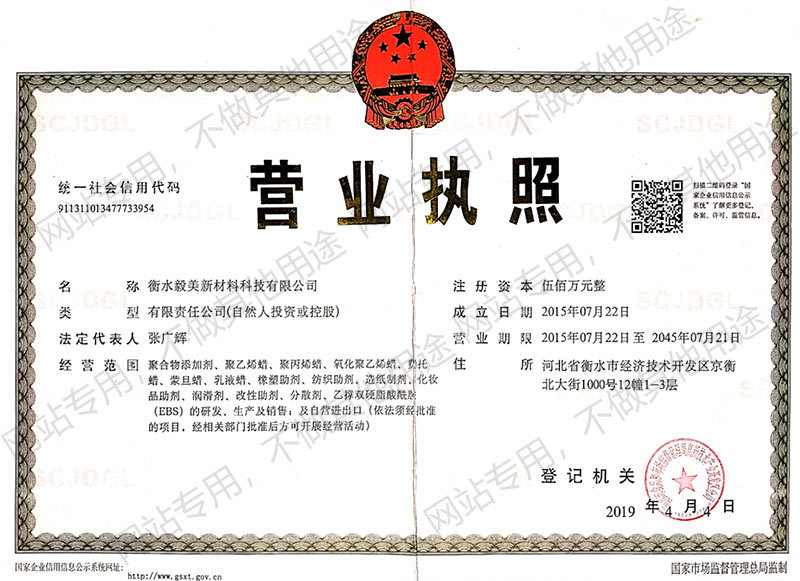
About UsHengshui yi mei new material technology co., ltd. was founded in 2015, is a collection of product development, production, sales and service as one of the high and new technology enterprises, yi mei company focused on deep processing of wax products, determined to become china's professional wax products supplier

-
ProductsThe company mainly produces and sells: polyethylene wax, oxidized polyethylene wax, synthetic Fischer-Tropsch wax, oxidized Fischer-Tropsch wax, maleic anhydride grafted wax, polypropylene wax, micro-powder wax, high-end composite wax and other eight series of dozens of models of high quality products.
-
NewsAt the beginning of its establishment, Yimei Company invested in the establishment of the "Polymer Additive R & D Center", insisting on scientific and technological innovation as the life force of enterprise development. Concentrate funds, technology, and talents in the company's scientific and technological innovation activities, focus on scientific research, public relations and technological breakthroughs of new products, new technologies, and new processes, and resolutely master core technologies.
-
SupportAt the beginning of its establishment, Yimei Company invested in the establishment of the "Polymer Additive R & D Center", insisting on scientific and technological innovation as the life force of enterprise development. Concentrate funds, technology, and talents in the company's scientific and technological innovation activities, focus on scientific research, public relations and technological breakthroughs of new products, new technologies, and new processes, and resolutely master core technologies.
-
RecruitmentOur company always adheres to the talent concept of "people-oriented", actively creates an atmosphere of respect, understanding, integrity and friendship, respects people's knowledge and talents, selects and develops mechanisms, and provides a growth platform for talents. make talents become a strong support for the sustainable development of enterprises, and realize the common growth and development of enterprises and talents.


Maximizing Efficiency: FT Wax for Other Chemical Applications
Release time:
2025-02-24
Maximizing Efficiency: FT Wax for Other Chemical Applications Table of Contents 1. Introduction to FT Wax 2. What is FT Wax? 3. Diverse Applications of FT Wax in the Chemical Industry 3.1 Coatings and Adhesives 3.2 Plastics and Polymers 3.3 Personal Care Products 4. Benefits of Using FT Wax 5. Optimizing the Use of FT Wax 5.1 Best Practices for FT
Maximizing Efficiency: FT Wax for Other Chemical Applications
Table of Contents
- 1. Introduction to FT Wax
- 2. What is FT Wax?
- 3. Diverse Applications of FT Wax in the Chemical Industry
- 4. Benefits of Using FT Wax
- 5. Optimizing the Use of FT Wax
- 6. Case Studies: Successful FT Wax Implementations
- 7. Challenges in Utilizing FT Wax and Their Solutions
- 8. Future Trends in FT Wax Applications
- 9. Conclusion
- 10. Frequently Asked Questions (FAQs)
1. Introduction to FT Wax
In the world of chemical applications, **efficiency** and **performance** are critical. FT Wax (Fischer-Tropsch Wax) has emerged as a game-changing ingredient that enhances a wide array of products. Its unique properties allow manufacturers to achieve superior results across various sectors, including **coatings**, **plastics**, and **personal care**. This article delves deeply into the multifaceted applications of FT Wax, highlighting its benefits and offering strategies for optimizing its use.
2. What is FT Wax?
FT Wax is a synthetic wax derived from the Fischer-Tropsch synthesis process. This method involves converting carbon monoxide and hydrogen into liquid hydrocarbons, which are then refined into various wax products. FT Wax is known for its **high melting point**, **purity**, and **chemical stability**, making it an excellent choice for industrial applications. Unlike traditional natural waxes, FT Wax is consistent in quality, ensuring reliable performance in demanding conditions.
3. Diverse Applications of FT Wax in the Chemical Industry
FT Wax's versatility allows it to be used in multiple applications, enhancing product quality and operational efficiency. Below, we explore some key sectors where FT Wax is making a significant impact.
3.1 Coatings and Adhesives
In the coatings industry, FT Wax serves as a crucial additive that improves the **durability** and **water resistance** of paints and coatings. By incorporating FT Wax, manufacturers can achieve better scratch resistance and gloss, enhancing the overall aesthetic and functional performance of their products. Additionally, FT Wax can be utilized in adhesives, providing better thermal stability and adhesion properties.
3.2 Plastics and Polymers
The use of FT Wax in the plastics industry can enhance the **processing** and **end-use properties** of polymers. FT Wax acts as an excellent lubricant, reducing friction during processing and improving the flow properties of plastic materials. This results in better mold filling and can significantly reduce production times and costs.
3.3 Personal Care Products
In personal care formulations, FT Wax offers emollient properties, making it a valuable ingredient in lotions, creams, and lip balms. Its ability to provide a smooth texture and improve the skin feel makes it highly sought after in the cosmetic industry. Additionally, FT Wax can enhance the stability of formulations, ensuring longer shelf life and better performance for consumers.
4. Benefits of Using FT Wax
Implementing FT Wax in chemical applications presents numerous advantages:
- **Enhanced Performance:** FT Wax improves the performance of products by increasing durability and resistance to elements like water and heat.
- **Cost-Effectiveness:** By streamlining manufacturing processes, FT Wax can contribute to lower production costs, making it an economically viable option.
- **Consistency and Quality:** The synthetic nature of FT Wax ensures uniform quality and performance, reducing variability in end products.
- **Versatility:** Its multifaceted uses across various industries make it a valuable asset for manufacturers looking to innovate.
5. Optimizing the Use of FT Wax
To maximize the benefits of FT Wax in various applications, it is essential to implement best practices and assess effectiveness.
5.1 Best Practices for FT Wax Implementation
- **Quality Assessment:** Always source FT Wax from reputable suppliers to ensure high quality and consistent performance.
- **Formulation Testing:** Conduct thorough testing to determine the optimal concentration of FT Wax in your formulations for maximum efficiency.
- **Process Monitoring:** Continuously monitor production processes to ensure the effective integration of FT Wax, adapting as necessary to achieve desired results.
5.2 Measuring Effectiveness in Applications
Establish metrics to measure the effectiveness of FT Wax in your products. This could include evaluating physical properties, customer feedback, and overall product performance in the market. Utilizing these data points will help refine formulations and processes continuously.
6. Case Studies: Successful FT Wax Implementations
Examining real-world applications can provide deeper insights into the benefits of FT Wax.
**Case Study 1: Automotive Paints**
A leading automotive manufacturer incorporated FT Wax into their paint formulations, resulting in a 30% increase in scratch resistance and a 20% improvement in gloss retention.
**Case Study 2: Polyethylene Production**
A plastics company utilized FT Wax as a processing aid, which significantly reduced cycle times by 25%, leading to higher throughput and lower production costs.
7. Challenges in Utilizing FT Wax and Their Solutions
While FT Wax offers numerous benefits, some challenges may arise in its application.
- **Challenge:** Variability in Wax Quality
**Solution:** Establish rigorous quality control protocols with suppliers to ensure consistent FT Wax quality.
- **Challenge:** Compatibility with Other Ingredients
**Solution:** Conduct compatibility studies to determine the best formulation mixtures to maximize the benefits of FT Wax.
8. Future Trends in FT Wax Applications
The future of FT Wax in the chemical industry looks promising, with emerging trends focused on **sustainability** and **innovation**. As industries look for greener alternatives, the development of bio-based FT Wax could become a major area of research and investment. Additionally, advancements in technology may lead to more efficient production methods, further enhancing the appeal of FT Wax.
9. Conclusion
FT Wax stands out as a versatile and efficient solution in various chemical applications. Its unique properties offer significant advantages across multiple industries, from coatings to personal care products. By understanding its full potential and implementing best practices for its use, manufacturers can enhance product quality, streamline processes, and achieve cost savings. As the industry evolves, the future of FT Wax looks bright, promising even greater innovations and applications.
10. Frequently Asked Questions (FAQs)
**Q1: What are the main properties of FT Wax?**
A1: FT Wax is characterized by its high melting point, chemical purity, and stability, making it suitable for various industrial applications.
**Q2: How is FT Wax produced?**
A2: FT Wax is produced through the Fischer-Tropsch synthesis process, which converts carbon monoxide and hydrogen into liquid hydrocarbons.
**Q3: Can FT Wax be used in food applications?**
A3: FT Wax is generally not approved for food applications; however, it is safe for use in various other industrial products.
**Q4: What is the typical usage level of FT Wax in formulations?**
A4: The usage level can vary widely depending on the application; however, it typically ranges from 1% to 10% of the total formulation.
**Q5: How can manufacturers measure the effectiveness of FT Wax in their products?**
A5: Manufacturers can assess effectiveness through performance testing, customer feedback, and analysis of physical properties like scratch resistance and gloss.
By leveraging the insights and strategies outlined in this article, companies can truly maximize the efficiency of their chemical applications with FT Wax, ensuring they remain competitive in an ever-evolving market.
Key words:
FT wax
recommend reading