Yimei New Material-Professional Wax Product Solution Supplier


-
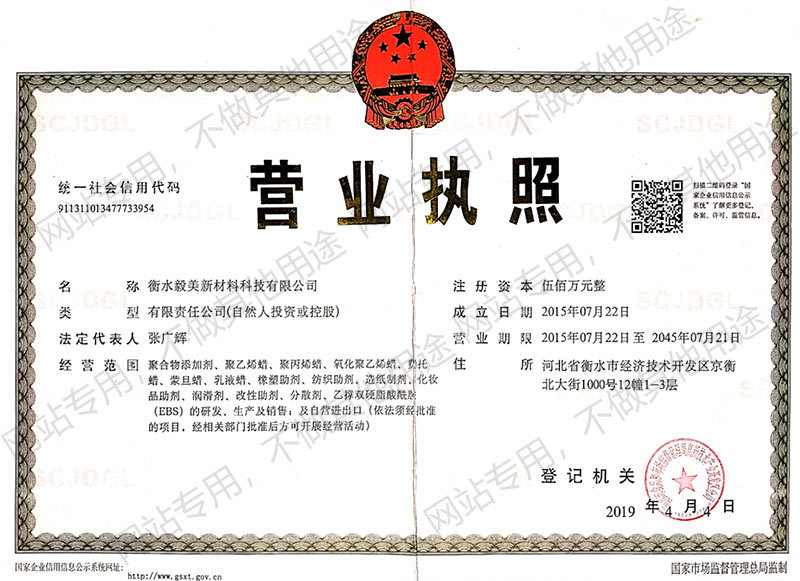
About UsHengshui yi mei new material technology co., ltd. was founded in 2015, is a collection of product development, production, sales and service as one of the high and new technology enterprises, yi mei company focused on deep processing of wax products, determined to become china's professional wax products supplier

-
ProductsThe company mainly produces and sells: polyethylene wax, oxidized polyethylene wax, synthetic Fischer-Tropsch wax, oxidized Fischer-Tropsch wax, maleic anhydride grafted wax, polypropylene wax, micro-powder wax, high-end composite wax and other eight series of dozens of models of high quality products.
-
NewsAt the beginning of its establishment, Yimei Company invested in the establishment of the "Polymer Additive R & D Center", insisting on scientific and technological innovation as the life force of enterprise development. Concentrate funds, technology, and talents in the company's scientific and technological innovation activities, focus on scientific research, public relations and technological breakthroughs of new products, new technologies, and new processes, and resolutely master core technologies.
-
SupportAt the beginning of its establishment, Yimei Company invested in the establishment of the "Polymer Additive R & D Center", insisting on scientific and technological innovation as the life force of enterprise development. Concentrate funds, technology, and talents in the company's scientific and technological innovation activities, focus on scientific research, public relations and technological breakthroughs of new products, new technologies, and new processes, and resolutely master core technologies.
-
RecruitmentOur company always adheres to the talent concept of "people-oriented", actively creates an atmosphere of respect, understanding, integrity and friendship, respects people's knowledge and talents, selects and develops mechanisms, and provides a growth platform for talents. make talents become a strong support for the sustainable development of enterprises, and realize the common growth and development of enterprises and talents.


Optimizing PVC Processing: The Role of Processing Aids
Release time:
2024-11-07
--- Polyvinyl Chloride (PVC) is one of the most widely used thermoplastic materials in various industries due to its versatility, durability, and cost-effectiveness. However, the processing of PVC can present challenges such as poor flow characteristics, thermal stability issues, and the tendency to degrade under processing conditions. This is where PVC processing aids come into play, offering sol
---
Polyvinyl Chloride (PVC) is one of the most widely used thermoplastic materials in various industries due to its versatility, durability, and cost-effectiveness. However, the processing of PVC can present challenges such as poor flow characteristics, thermal stability issues, and the tendency to degrade under processing conditions. This is where PVC processing aids come into play, offering solutions that enhance the manufacturing efficiency and performance of PVC products.
PVC processing aids are additives that significantly improve the processing characteristics of PVC resins. These aids help in achieving better melt flow, reducing viscosity, and enhancing the overall processing performance during extrusion and molding. One of the primary functions of these aids is to improve the flow properties of PVC, enabling easier handling and shaping of the material. This is crucial for manufacturers aiming to produce high-quality PVC products with consistent dimensions and surface finishes.
In addition to improving flow characteristics, PVC processing aids also provide benefits in terms of thermal stability. During processing, PVC can be subjected to high temperatures, which may lead to degradation and discoloration. Processing aids are designed to stabilize the polymer matrix, helping to maintain the integrity and color of the final product. This is particularly important for applications where aesthetics and durability are paramount, such as in the production of consumer goods and building materials.
Another significant advantage of using PVC processing aids is their ability to enhance the mechanical properties of the final product. Properly formulated processing aids can contribute to improved impact resistance, tensile strength, and flexibility, making the end products more functional and appealing to consumers. This enhancement can open up new applications for PVC, allowing manufacturers to explore markets that demand high-performance materials.
Furthermore, the use of PVC processing aids can lead to more sustainable manufacturing processes. By optimizing the processing conditions and reducing waste, manufacturers can minimize their environmental footprint. Many processing aids are now being developed with a focus on eco-friendliness, aligning with global trends toward sustainable production practices.
In conclusion, PVC processing aids play an essential role in the efficient and effective manufacturing of PVC products. By improving flow properties, enhancing thermal stability, and boosting mechanical performance, these additives help manufacturers overcome challenges associated with PVC processing. As the industry continues to evolve, the optimization of processes through the use of processing aids will remain a critical focus for achieving high-quality, sustainable products in the chemical sector. Emphasizing the importance of these aids can assist professionals in making informed decisions, ultimately leading to improved product outcomes and customer satisfaction.
Polyvinyl Chloride (PVC) is one of the most widely used thermoplastic materials in various industries due to its versatility, durability, and cost-effectiveness. However, the processing of PVC can present challenges such as poor flow characteristics, thermal stability issues, and the tendency to degrade under processing conditions. This is where PVC processing aids come into play, offering solutions that enhance the manufacturing efficiency and performance of PVC products.
PVC processing aids are additives that significantly improve the processing characteristics of PVC resins. These aids help in achieving better melt flow, reducing viscosity, and enhancing the overall processing performance during extrusion and molding. One of the primary functions of these aids is to improve the flow properties of PVC, enabling easier handling and shaping of the material. This is crucial for manufacturers aiming to produce high-quality PVC products with consistent dimensions and surface finishes.
In addition to improving flow characteristics, PVC processing aids also provide benefits in terms of thermal stability. During processing, PVC can be subjected to high temperatures, which may lead to degradation and discoloration. Processing aids are designed to stabilize the polymer matrix, helping to maintain the integrity and color of the final product. This is particularly important for applications where aesthetics and durability are paramount, such as in the production of consumer goods and building materials.
Another significant advantage of using PVC processing aids is their ability to enhance the mechanical properties of the final product. Properly formulated processing aids can contribute to improved impact resistance, tensile strength, and flexibility, making the end products more functional and appealing to consumers. This enhancement can open up new applications for PVC, allowing manufacturers to explore markets that demand high-performance materials.
Furthermore, the use of PVC processing aids can lead to more sustainable manufacturing processes. By optimizing the processing conditions and reducing waste, manufacturers can minimize their environmental footprint. Many processing aids are now being developed with a focus on eco-friendliness, aligning with global trends toward sustainable production practices.
In conclusion, PVC processing aids play an essential role in the efficient and effective manufacturing of PVC products. By improving flow properties, enhancing thermal stability, and boosting mechanical performance, these additives help manufacturers overcome challenges associated with PVC processing. As the industry continues to evolve, the optimization of processes through the use of processing aids will remain a critical focus for achieving high-quality, sustainable products in the chemical sector. Emphasizing the importance of these aids can assist professionals in making informed decisions, ultimately leading to improved product outcomes and customer satisfaction.
Key words:
PVC Processing Aids
recommend reading