Yimei New Material-Professional Wax Product Solution Supplier


-
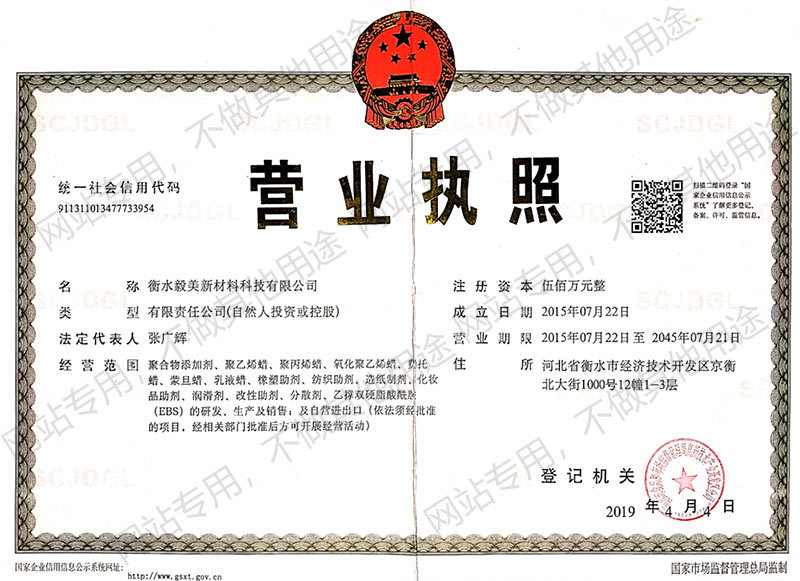
About UsHengshui yi mei new material technology co., ltd. was founded in 2015, is a collection of product development, production, sales and service as one of the high and new technology enterprises, yi mei company focused on deep processing of wax products, determined to become china's professional wax products supplier

-
ProductsThe company mainly produces and sells: polyethylene wax, oxidized polyethylene wax, synthetic Fischer-Tropsch wax, oxidized Fischer-Tropsch wax, maleic anhydride grafted wax, polypropylene wax, micro-powder wax, high-end composite wax and other eight series of dozens of models of high quality products.
-
NewsAt the beginning of its establishment, Yimei Company invested in the establishment of the "Polymer Additive R & D Center", insisting on scientific and technological innovation as the life force of enterprise development. Concentrate funds, technology, and talents in the company's scientific and technological innovation activities, focus on scientific research, public relations and technological breakthroughs of new products, new technologies, and new processes, and resolutely master core technologies.
-
SupportAt the beginning of its establishment, Yimei Company invested in the establishment of the "Polymer Additive R & D Center", insisting on scientific and technological innovation as the life force of enterprise development. Concentrate funds, technology, and talents in the company's scientific and technological innovation activities, focus on scientific research, public relations and technological breakthroughs of new products, new technologies, and new processes, and resolutely master core technologies.
-
RecruitmentOur company always adheres to the talent concept of "people-oriented", actively creates an atmosphere of respect, understanding, integrity and friendship, respects people's knowledge and talents, selects and develops mechanisms, and provides a growth platform for talents. make talents become a strong support for the sustainable development of enterprises, and realize the common growth and development of enterprises and talents.


Advancements and Innovations in PVC Lead Based Compound Stabilizers: A Comprehensive Overview
Release time:
2024-11-05
Advancements and Innovations in PVC Lead Based Compound Stabilizers Table of Contents 1. Introduction to PVC Lead Based Compound Stabilizers 2. Importance of Stabilizers in PVC Compounding 3. Understanding Lead Based Stabilizers 4. Recent Advancements in PVC Lead Based Stabilizers 5. Innovations in Formulation and Application 6. Environmental Impact of Lead Based Stabilize
Advancements and Innovations in PVC Lead Based Compound Stabilizers
Table of Contents
- 1. Introduction to PVC Lead Based Compound Stabilizers
- 2. Importance of Stabilizers in PVC Compounding
- 3. Understanding Lead Based Stabilizers
- 4. Recent Advancements in PVC Lead Based Stabilizers
- 5. Innovations in Formulation and Application
- 6. Environmental Impact of Lead Based Stabilizers
- 7. Regulatory Standards and Compliance
- 8. Future Trends in PVC Lead Based Stabilizers
- 9. Conclusion
- 10. Frequently Asked Questions
1. Introduction to PVC Lead Based Compound Stabilizers
Polyvinyl Chloride (PVC) is one of the most widely used synthetic plastics in the world. Among the various additives utilized in PVC formulations, **lead-based compound stabilizers** are prominent for enhancing the performance and longevity of PVC products. This article dives deep into the advancements and innovations surrounding these stabilizers, highlighting their significance in manufacturing and their evolving nature in response to regulatory and environmental challenges.
2. Importance of Stabilizers in PVC Compounding
Stabilizers play a crucial role in the **compounding process of PVC**. They are necessary to prevent degradation during processing and end-use applications. Without these stabilizers, PVC can undergo discoloration and loss of mechanical properties when exposed to heat and UV light. Utilizing lead-based stabilizers, manufacturers can achieve desired processing characteristics while ensuring the durability and performance of the final product.
3. Understanding Lead Based Stabilizers
Lead-based stabilizers, particularly lead salts, are effective in providing thermal stability and enhancing the processing characteristics of PVC. They are primarily classified into:
- **Lead Stearate**: This is one of the most common lead-based stabilizers, offering excellent thermal stability.
- **Lead Phosphate**: Known for its ability to improve the heat stability of PVC.
- **Mixed Metal Stabilizers**: These include combinations of lead with other metals to enhance performance and reduce environmental impact.
Despite their effectiveness, lead-based stabilizers have come under scrutiny due to safety and environmental concerns. This has led to significant **research and development** in creating safer alternatives.
4. Recent Advancements in PVC Lead Based Stabilizers
The chemical industry has witnessed several advancements in the formulation of PVC lead-based stabilizers. Recent developments focus on improving their functionalities while minimizing health risks. Key advancements include:
- **Improved Stability Formulations**: New formulations are designed to enhance the compatibility of lead-based stabilizers with various PVC resins, improving their efficiency.
- **Co-stabilizers**: The introduction of co-stabilizers, such as tin and barium, helps to achieve better performance without solely relying on lead.
- **Nanotechnology Applications**: Utilizing nanomaterials in stabilizer formulations has shown promising results in enhancing the thermal stability of PVC.
These innovations not only improve performance but also address environmental and health concerns associated with lead usage.
5. Innovations in Formulation and Application
Innovations in PVC lead-based compound stabilizers have transformed their formulation and application processes. Some notable innovations include:
- **Sustainable Sourcing**: Manufacturers are exploring renewable sources for stabilizers, reducing reliance on traditional lead-based compounds.
- **Functional Additives**: The incorporation of functional additives allows for tailored properties specific to applications, such as flame resistance or UV stabilization.
- **Advanced Processing Techniques**: New processing techniques, such as reactive extrusion, enhance the incorporation of stabilizers, improving the overall performance of PVC products.
These innovations are crucial in meeting the demands of various industries, including construction, automotive, and consumer goods.
6. Environmental Impact of Lead Based Stabilizers
The environmental impact of lead-based stabilizers has been a significant concern, prompting industries to seek alternatives. Lead is classified as a hazardous substance, and its presence in PVC products can lead to significant health and environmental risks. The following points highlight the environmental considerations of PVC lead-based stabilizers:
- **Soil and Water Contamination**: Improper disposal of lead-containing products can lead to soil and water contamination, posing risks to ecosystems and human health.
- **Regulatory Pressure**: Increasing regulations aimed at reducing lead's impact have pushed manufacturers to innovate and seek safer alternatives.
- **Public Awareness**: Growing public concern about health risks associated with lead exposure has led to a demand for safer, lead-free products.
These factors are driving the industry towards more sustainable practices and alternative stabilizers.
7. Regulatory Standards and Compliance
Regulatory standards governing the use of lead in PVC stabilizers continue to evolve. Key standards and regulations include:
- **REACH (Registration, Evaluation, Authorisation, and Restriction of Chemicals)**: This European Union regulation seeks to manage chemical substances responsibly and limits the use of hazardous substances, including lead.
- **EPA Guidelines**: The U.S. Environmental Protection Agency has set stringent guidelines for lead use and disposal to protect human health and the environment.
Compliance with these regulations is critical for manufacturers to ensure the safety of their products and maintain market competitiveness.
8. Future Trends in PVC Lead Based Stabilizers
The future of PVC lead-based compound stabilizers is marked by several emerging trends:
- **Shift Towards Non-Lead Alternatives**: Research is increasingly focusing on non-lead stabilizers that offer similar benefits without the associated health risks.
- **Increased Focus on Sustainability**: There is a growing emphasis on sustainable practices, leading to the development of biodegradable and renewable stabilizers.
- **Technological Advancements**: Innovations in polymer science and material engineering will continue to shape the future of stabilizers, allowing for enhanced performance and safety.
Manufacturers that adapt to these trends will be better positioned to meet market demands and regulatory requirements.
9. Conclusion
Innovations and advancements in PVC lead-based compound stabilizers are crucial to the ongoing evolution of the chemical industry. As health and environmental concerns continue to shape regulatory landscapes, manufacturers must embrace innovation and sustainability. Through research, development, and a commitment to safety, the future of PVC stabilizers is bright, promising enhanced product performance and reduced environmental impact.
10. Frequently Asked Questions
What are PVC lead-based compound stabilizers?
PVC lead-based compound stabilizers are additives used in PVC formulations to prevent degradation during processing and in end-use applications. They enhance the thermal stability and durability of PVC products.
Are there alternatives to lead-based stabilizers?
Yes, there are several alternatives to lead-based stabilizers, including tin, barium, and other non-toxic stabilizers that provide similar benefits without health risks.
What are the environmental impacts of lead-based stabilizers?
Lead-based stabilizers pose risks of soil and water contamination, affecting ecosystems and human health. Regulatory pressures are prompting a shift towards safer alternatives.
How do regulatory standards affect lead-based stabilizers?
Regulatory standards such as REACH and EPA guidelines impose restrictions on lead usage, pushing manufacturers to develop compliant and safer alternatives.
What trends are shaping the future of PVC stabilizers?
Future trends include a shift towards non-lead alternatives, increased focus on sustainability, and technological advancements in polymer science that enhance performance and safety.
Key words:
PVC Lead Based Compound Stabilizer
recommend reading