Yimei New Material-Professional Wax Product Solution Supplier


-
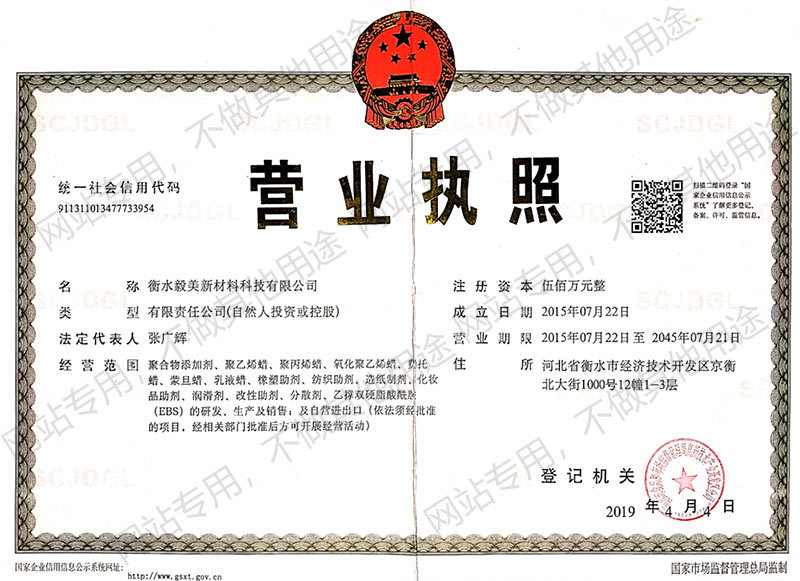
About UsHengshui yi mei new material technology co., ltd. was founded in 2015, is a collection of product development, production, sales and service as one of the high and new technology enterprises, yi mei company focused on deep processing of wax products, determined to become china's professional wax products supplier

-
ProductsThe company mainly produces and sells: polyethylene wax, oxidized polyethylene wax, synthetic Fischer-Tropsch wax, oxidized Fischer-Tropsch wax, maleic anhydride grafted wax, polypropylene wax, micro-powder wax, high-end composite wax and other eight series of dozens of models of high quality products.
-
NewsAt the beginning of its establishment, Yimei Company invested in the establishment of the "Polymer Additive R & D Center", insisting on scientific and technological innovation as the life force of enterprise development. Concentrate funds, technology, and talents in the company's scientific and technological innovation activities, focus on scientific research, public relations and technological breakthroughs of new products, new technologies, and new processes, and resolutely master core technologies.
-
SupportAt the beginning of its establishment, Yimei Company invested in the establishment of the "Polymer Additive R & D Center", insisting on scientific and technological innovation as the life force of enterprise development. Concentrate funds, technology, and talents in the company's scientific and technological innovation activities, focus on scientific research, public relations and technological breakthroughs of new products, new technologies, and new processes, and resolutely master core technologies.
-
RecruitmentOur company always adheres to the talent concept of "people-oriented", actively creates an atmosphere of respect, understanding, integrity and friendship, respects people's knowledge and talents, selects and develops mechanisms, and provides a growth platform for talents. make talents become a strong support for the sustainable development of enterprises, and realize the common growth and development of enterprises and talents.


Understanding FT Wax: A Comprehensive Guide for Industry Professionals
Release time:
2024-09-28
FT wax, or Fischer-Tropsch wax, is a synthetic wax produced through the Fischer-Tropsch synthesis process, which converts carbon monoxide and hydrogen into liquid hydrocarbons. This unique production method yields a wax that exhibits various beneficial properties, making it a favored choice in several industrial applications. One of the most notable characteristics of FT wax is its excellent ther
FT wax, or Fischer-Tropsch wax, is a synthetic wax produced through the Fischer-Tropsch synthesis process, which converts carbon monoxide and hydrogen into liquid hydrocarbons. This unique production method yields a wax that exhibits various beneficial properties, making it a favored choice in several industrial applications.
One of the most notable characteristics of FT wax is its excellent thermal stability. This makes it suitable for high-temperature applications, where traditional waxes might fail. Due to its high melting point, FT wax can maintain integrity under heat, making it ideal for formulations requiring durability and resilience.
In addition to thermal stability, FT wax possesses outstanding clarity and low odor. These properties are particularly advantageous in applications where aesthetic qualities are paramount, such as in candles, coatings, and cosmetics. The clarity of FT wax ensures that products maintain a visually appealing appearance, while the low odor allows for the creation of fragrance-free items or blends where scent neutrality is desired.
Another significant advantage of FT wax is its versatility. It can be employed in a wide range of products, including lubricants, sealants, and emulsions. Its ability to improve product texture and enhance performance makes it an invaluable ingredient in various formulations. For instance, in the cosmetics industry, FT wax can be used as a thickener or stabilizer, providing a desirable consistency and feel to creams and lotions.
Moreover, FT wax is recognized for its compatibility with numerous other materials. It can easily blend with oils, resins, and other waxes, enabling formulators to create customized products tailored to specific needs. This compatibility enhances its application potential across diverse industries, allowing for innovative product development.
From a sustainability perspective, FT wax offers an eco-friendlier option compared to conventional waxes derived from petroleum. Its production process emits fewer pollutants, and as a synthetic product, it can be derived from renewable resources, making it an appealing choice for companies aiming to enhance their sustainability profile.
In conclusion, FT wax stands out as a high-performance material in the chemical industry, offering superior thermal stability, clarity, and compatibility with various formulations. Its versatility and eco-friendly properties make it an essential ingredient for businesses looking to innovate and satisfy market demands. Understanding the applications and benefits of FT wax can help industry professionals leverage this material effectively, ensuring the development of high-quality products that meet consumer needs.
One of the most notable characteristics of FT wax is its excellent thermal stability. This makes it suitable for high-temperature applications, where traditional waxes might fail. Due to its high melting point, FT wax can maintain integrity under heat, making it ideal for formulations requiring durability and resilience.
In addition to thermal stability, FT wax possesses outstanding clarity and low odor. These properties are particularly advantageous in applications where aesthetic qualities are paramount, such as in candles, coatings, and cosmetics. The clarity of FT wax ensures that products maintain a visually appealing appearance, while the low odor allows for the creation of fragrance-free items or blends where scent neutrality is desired.
Another significant advantage of FT wax is its versatility. It can be employed in a wide range of products, including lubricants, sealants, and emulsions. Its ability to improve product texture and enhance performance makes it an invaluable ingredient in various formulations. For instance, in the cosmetics industry, FT wax can be used as a thickener or stabilizer, providing a desirable consistency and feel to creams and lotions.
Moreover, FT wax is recognized for its compatibility with numerous other materials. It can easily blend with oils, resins, and other waxes, enabling formulators to create customized products tailored to specific needs. This compatibility enhances its application potential across diverse industries, allowing for innovative product development.
From a sustainability perspective, FT wax offers an eco-friendlier option compared to conventional waxes derived from petroleum. Its production process emits fewer pollutants, and as a synthetic product, it can be derived from renewable resources, making it an appealing choice for companies aiming to enhance their sustainability profile.
In conclusion, FT wax stands out as a high-performance material in the chemical industry, offering superior thermal stability, clarity, and compatibility with various formulations. Its versatility and eco-friendly properties make it an essential ingredient for businesses looking to innovate and satisfy market demands. Understanding the applications and benefits of FT wax can help industry professionals leverage this material effectively, ensuring the development of high-quality products that meet consumer needs.
Key words:
FT wax
Previous article
Previous article
recommend reading