Yimei New Material-Professional Wax Product Solution Supplier


-
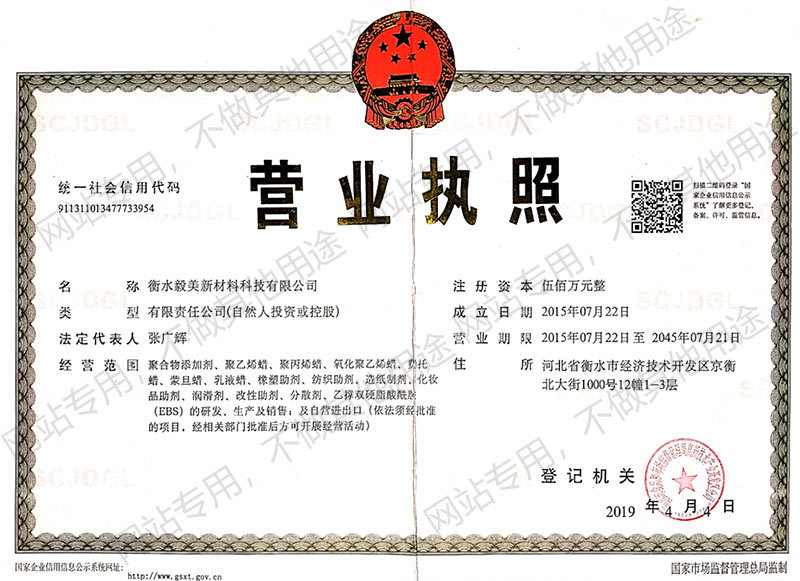
About UsHengshui yi mei new material technology co., ltd. was founded in 2015, is a collection of product development, production, sales and service as one of the high and new technology enterprises, yi mei company focused on deep processing of wax products, determined to become china's professional wax products supplier

-
ProductsThe company mainly produces and sells: polyethylene wax, oxidized polyethylene wax, synthetic Fischer-Tropsch wax, oxidized Fischer-Tropsch wax, maleic anhydride grafted wax, polypropylene wax, micro-powder wax, high-end composite wax and other eight series of dozens of models of high quality products.
-
NewsAt the beginning of its establishment, Yimei Company invested in the establishment of the "Polymer Additive R & D Center", insisting on scientific and technological innovation as the life force of enterprise development. Concentrate funds, technology, and talents in the company's scientific and technological innovation activities, focus on scientific research, public relations and technological breakthroughs of new products, new technologies, and new processes, and resolutely master core technologies.
-
SupportAt the beginning of its establishment, Yimei Company invested in the establishment of the "Polymer Additive R & D Center", insisting on scientific and technological innovation as the life force of enterprise development. Concentrate funds, technology, and talents in the company's scientific and technological innovation activities, focus on scientific research, public relations and technological breakthroughs of new products, new technologies, and new processes, and resolutely master core technologies.
-
RecruitmentOur company always adheres to the talent concept of "people-oriented", actively creates an atmosphere of respect, understanding, integrity and friendship, respects people's knowledge and talents, selects and develops mechanisms, and provides a growth platform for talents. make talents become a strong support for the sustainable development of enterprises, and realize the common growth and development of enterprises and talents.


Understanding HDPE Wax: Applications and Benefits in the Chemical Industry
Release time:
2024-08-17
HDPE wax, or high-density polyethylene wax, is a polyethylene derivative known for its unique characteristics and versatility in various industrial applications. This type of wax is produced through the polymerization of ethylene and has gained popularity in the chemical industry due to its excellent properties, including high molecular weight, thermal stability, and low viscosity. These attribute
HDPE wax, or high-density polyethylene wax, is a polyethylene derivative known for its unique characteristics and versatility in various industrial applications. This type of wax is produced through the polymerization of ethylene and has gained popularity in the chemical industry due to its excellent properties, including high molecular weight, thermal stability, and low viscosity. These attributes make HDPE wax an invaluable component in numerous formulations.
One of the primary applications of HDPE wax is in the manufacturing of coatings. Its exceptional film-forming properties enhance the durability and gloss of paints and coatings, providing excellent scratch resistance and water repellency. Additionally, HDPE wax can act as a lubricant, improving the flow of materials during production and application processes. This makes it particularly useful in the automotive and construction industries, where surface protection is critical.
Moreover, HDPE wax is widely used in the production of adhesives and sealants. Its inclusion in these formulations enhances their performance by providing better adhesion, flexibility, and resistance to environmental factors. The wax also helps to control the viscosity of these products, ensuring easy application and optimal performance.
In addition to coatings and adhesives, HDPE wax plays a significant role in the manufacturing of plastics. It is often used as an additive in polymer compounding, where it acts as a processing aid. The wax improves the flow and dispersion of pigments and fillers, resulting in a more homogeneous product. Furthermore, it can enhance the surface properties of plastics, making them more aesthetically appealing and functional.
Another notable advantage of HDPE wax is its compatibility with a wide range of other materials. This property allows it to be easily integrated into various formulations without compromising performance. As a result, manufacturers can create tailored solutions that meet specific requirements while benefiting from the advantageous characteristics of HDPE wax.
Sustainability is becoming increasingly important in the chemical industry, and HDPE wax aligns well with this trend. It is often derived from renewable resources and can be recycled, making it a more environmentally friendly option compared to traditional waxes. This factor is particularly appealing to companies seeking to reduce their environmental footprint and adopt more sustainable practices.
In conclusion, HDPE wax is a vital material in the chemical industry, offering numerous benefits across various applications. Its properties contribute to enhanced performance in coatings, adhesives, plastics, and other formulations. Understanding the potential of HDPE wax allows professionals in the industry to make informed decisions regarding its use, ultimately leading to improved product quality and performance.
One of the primary applications of HDPE wax is in the manufacturing of coatings. Its exceptional film-forming properties enhance the durability and gloss of paints and coatings, providing excellent scratch resistance and water repellency. Additionally, HDPE wax can act as a lubricant, improving the flow of materials during production and application processes. This makes it particularly useful in the automotive and construction industries, where surface protection is critical.
Moreover, HDPE wax is widely used in the production of adhesives and sealants. Its inclusion in these formulations enhances their performance by providing better adhesion, flexibility, and resistance to environmental factors. The wax also helps to control the viscosity of these products, ensuring easy application and optimal performance.
In addition to coatings and adhesives, HDPE wax plays a significant role in the manufacturing of plastics. It is often used as an additive in polymer compounding, where it acts as a processing aid. The wax improves the flow and dispersion of pigments and fillers, resulting in a more homogeneous product. Furthermore, it can enhance the surface properties of plastics, making them more aesthetically appealing and functional.
Another notable advantage of HDPE wax is its compatibility with a wide range of other materials. This property allows it to be easily integrated into various formulations without compromising performance. As a result, manufacturers can create tailored solutions that meet specific requirements while benefiting from the advantageous characteristics of HDPE wax.
Sustainability is becoming increasingly important in the chemical industry, and HDPE wax aligns well with this trend. It is often derived from renewable resources and can be recycled, making it a more environmentally friendly option compared to traditional waxes. This factor is particularly appealing to companies seeking to reduce their environmental footprint and adopt more sustainable practices.
In conclusion, HDPE wax is a vital material in the chemical industry, offering numerous benefits across various applications. Its properties contribute to enhanced performance in coatings, adhesives, plastics, and other formulations. Understanding the potential of HDPE wax allows professionals in the industry to make informed decisions regarding its use, ultimately leading to improved product quality and performance.
Key words:
HDPE wax
recommend reading