Yimei New Material-Professional Wax Product Solution Supplier


-
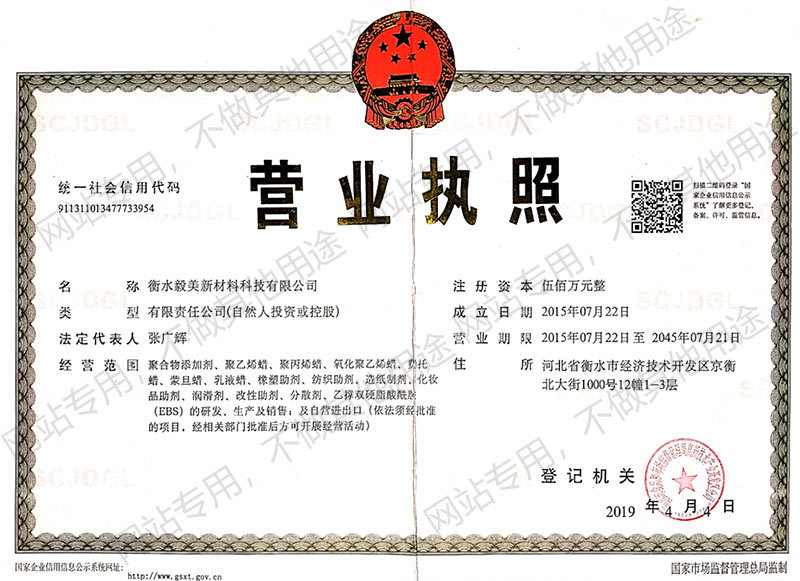
About UsHengshui yi mei new material technology co., ltd. was founded in 2015, is a collection of product development, production, sales and service as one of the high and new technology enterprises, yi mei company focused on deep processing of wax products, determined to become china's professional wax products supplier

-
ProductsThe company mainly produces and sells: polyethylene wax, oxidized polyethylene wax, synthetic Fischer-Tropsch wax, oxidized Fischer-Tropsch wax, maleic anhydride grafted wax, polypropylene wax, micro-powder wax, high-end composite wax and other eight series of dozens of models of high quality products.
-
NewsAt the beginning of its establishment, Yimei Company invested in the establishment of the "Polymer Additive R & D Center", insisting on scientific and technological innovation as the life force of enterprise development. Concentrate funds, technology, and talents in the company's scientific and technological innovation activities, focus on scientific research, public relations and technological breakthroughs of new products, new technologies, and new processes, and resolutely master core technologies.
-
SupportAt the beginning of its establishment, Yimei Company invested in the establishment of the "Polymer Additive R & D Center", insisting on scientific and technological innovation as the life force of enterprise development. Concentrate funds, technology, and talents in the company's scientific and technological innovation activities, focus on scientific research, public relations and technological breakthroughs of new products, new technologies, and new processes, and resolutely master core technologies.
-
RecruitmentOur company always adheres to the talent concept of "people-oriented", actively creates an atmosphere of respect, understanding, integrity and friendship, respects people's knowledge and talents, selects and develops mechanisms, and provides a growth platform for talents. make talents become a strong support for the sustainable development of enterprises, and realize the common growth and development of enterprises and talents.


Enhance Your Production: The Benefits of HDPE Wax for Efficiency and Quality
Release time:
2024-08-16
Boost Efficiency and Quality with HDPE Wax: A Smart Choice Table of Contents 1. Introduction to HDPE Wax 2. What is HDPE Wax? 3. Key Benefits of Using HDPE Wax 4. Versatile Applications of HDPE Wax 5. How HDPE Wax Boosts Efficiency 6. Enhancing Quality with HDPE Wax 7. Environmental Considerations 8. Choosing the Right HDPE Wax for Your Needs 9. Frequently Aske
Boost Efficiency and Quality with HDPE Wax: A Smart Choice
Table of Contents
- 1. Introduction to HDPE Wax
- 2. What is HDPE Wax?
- 3. Key Benefits of Using HDPE Wax
- 4. Versatile Applications of HDPE Wax
- 5. How HDPE Wax Boosts Efficiency
- 6. Enhancing Quality with HDPE Wax
- 7. Environmental Considerations
- 8. Choosing the Right HDPE Wax for Your Needs
- 9. Frequently Asked Questions
- 10. Conclusion
1. Introduction to HDPE Wax
In today's competitive industrial landscape, enhancing operational efficiency while maintaining high product quality is crucial. **High-Density Polyethylene (HDPE) Wax** has emerged as a versatile solution across various sectors, helping manufacturers optimize processes and improve end-product characteristics. This article will explore the multifaceted benefits of HDPE Wax and why it should be an integral part of your production strategy.
2. What is HDPE Wax?
HDPE Wax is a type of synthetic wax created from the polymerization of ethylene, which results in a high molecular weight compound. This wax is characterized by its **low viscosity**, **excellent thermal stability**, and **high chemical resistance**. Its unique properties make it suitable for a wide range of applications, from additives in coatings and inks to formulations in plastics.
2.1 Chemical Composition and Properties
HDPE Wax consists primarily of linear chains of polyethylene, giving it a smooth texture and high melting point. Its **hydrophobic nature** makes it resistant to water, while its thermal properties allow it to withstand high temperatures without degrading. Such characteristics make HDPE Wax an attractive option in various industrial applications.
3. Key Benefits of Using HDPE Wax
Incorporating HDPE Wax into production processes offers numerous advantages:
3.1 Improved Processing Efficiency
The addition of HDPE Wax to formulations can significantly enhance the flow properties of materials, making them easier to process. This **reduced friction** leads to increased throughput and minimizes wear and tear on equipment.
3.2 Enhanced Surface Properties
HDPE Wax contributes to improved surface finish and tactile qualities of products. It provides a **smooth, glossy finish** that enhances aesthetic appeal while also improving scratch and abrasion resistance.
3.3 Compatibility with Other Materials
HDPE Wax is compatible with various polymers and additives, making it an ideal choice for blending. This versatility allows manufacturers to tailor formulations according to specific needs, ensuring optimal performance in end products.
4. Versatile Applications of HDPE Wax
The versatility of HDPE Wax extends across multiple industries:
4.1 Plastics and Polymers
In the plastic industry, HDPE Wax is often used as a lubricant and processing aid. It helps improve the flow during extrusion and injection molding, ensuring uniformity in final products.
4.2 Coatings and Inks
HDPE Wax is a popular additive in paints and inks, enhancing scratch resistance and improving the overall durability of coatings. Its presence can lead to smoother application and improved finish quality.
4.3 Cosmetics and Personal Care Products
In cosmetics, HDPE Wax acts as a thickening agent, providing stability and texture to creams and lotions. Its ability to retain moisture also enhances the overall efficacy of personal care formulations.
4.4 Adhesives and Sealants
In the adhesive sector, HDPE Wax improves bonding strength and reduces viscosity, making applications smoother and more efficient. It aids in the formulation of high-performance adhesives that withstand various environmental conditions.
5. How HDPE Wax Boosts Efficiency
Using HDPE Wax can streamline production processes in various ways:
5.1 Reducing Friction
The lubricating properties of HDPE Wax reduce friction between materials and equipment, leading to enhanced efficiency. This can result in less energy consumption and higher output rates.
5.2 Lowering Processing Temperatures
Due to its excellent thermal stability, incorporating HDPE Wax can lower the required processing temperatures for various materials, which not only saves energy but also prolongs the lifespan of machinery.
5.3 Minimizing Downtime
As HDPE Wax improves the flow and reduces wear on equipment, manufacturers can experience reduced downtime due to maintenance issues. This reliability leads to more consistent production schedules and higher profitability.
6. Enhancing Quality with HDPE Wax
Quality is paramount in manufacturing, and HDPE Wax plays a vital role in achieving superior product characteristics:
6.1 Improved Finish and Aesthetics
Products treated with HDPE Wax exhibit a premium finish that appeals to consumers. The smooth and glossy appearance enhances the perceived value of products, making them more competitive in the market.
6.2 Enhanced Durability
HDPE Wax contributes to the durability of products by providing resistance to scratching, abrasion, and general wear and tear. This longevity is essential for consumer satisfaction and brand loyalty.
6.3 Consistency in Quality
By effectively regulating the properties of materials, HDPE Wax ensures consistent quality across production batches. This uniformity is crucial for maintaining brand reputation and trust among consumers.
7. Environmental Considerations
As industries become more environmentally conscious, the choice of materials plays a significant role in sustainability.
7.1 Biodegradability and Recycling
While HDPE Wax itself is a synthetic product, it can be recycled within existing plastic recycling frameworks. This makes it a more sustainable option compared to traditional waxes, which may not be recyclable.
7.2 Reduced Emissions
Incorporating HDPE Wax can lead to lower emissions during production processes. By optimizing energy efficiency and reducing friction, manufacturers can contribute to a decrease in their carbon footprint.
8. Choosing the Right HDPE Wax for Your Needs
Selecting the appropriate type of HDPE Wax is crucial for maximizing benefits:
8.1 Understanding Your Requirements
Evaluate the specific needs of your application, including factors like temperature resistance, compatibility with other materials, and desired physical properties.
8.2 Consulting with Suppliers
Engage with reputable suppliers who can provide insights into the various grades of HDPE Wax available. Understanding the differences can help you make an informed decision that aligns with your production goals.
8.3 Testing and Prototyping
Before committing to large quantities, conduct tests and prototypes to assess the performance of HDPE Wax in your specific applications. This practical approach ensures that the chosen wax meets your quality and efficiency standards.
9. Frequently Asked Questions
9.1 What industries benefit most from HDPE Wax?
HDPE Wax is widely used in the plastics, coatings, cosmetics, and adhesives industries, offering benefits in processing efficiency and product quality.
9.2 Is HDPE Wax environmentally friendly?
While it is a synthetic product, HDPE Wax can be recycled, making it a more environmentally friendly choice compared to traditional waxes.
9.3 How does HDPE Wax improve surface properties?
HDPE Wax enhances surface smoothness, gloss, and resistance to scratching and abrasion, improving the overall aesthetic and durability of products.
9.4 Can HDPE Wax be used in food packaging?
Yes, HDPE Wax can be used in food packaging applications, but it's essential to ensure it meets regulatory standards for safety.
9.5 How can I determine the right grade of HDPE Wax for my application?
Consider factors such as temperature resistance, compatibility with other materials, and desired physical properties. Consulting with a supplier for guidance can be beneficial.
10. Conclusion
Incorporating **HDPE Wax** into production processes presents a strategic advantage for manufacturers seeking to enhance both efficiency and quality. Its unique properties make it a versatile additive suitable for various industries, contributing to improved processing, superior product aesthetics, and increased durability. By understanding the benefits and applications of HDPE Wax, businesses can make informed choices that drive innovation and success in an ever-evolving market. Embrace the smart choice of HDPE Wax and witness the transformative impact it can have on your production capabilities.
Key words:
HDPE wax
recommend reading