Yimei New Material-Professional Wax Product Solution Supplier


-
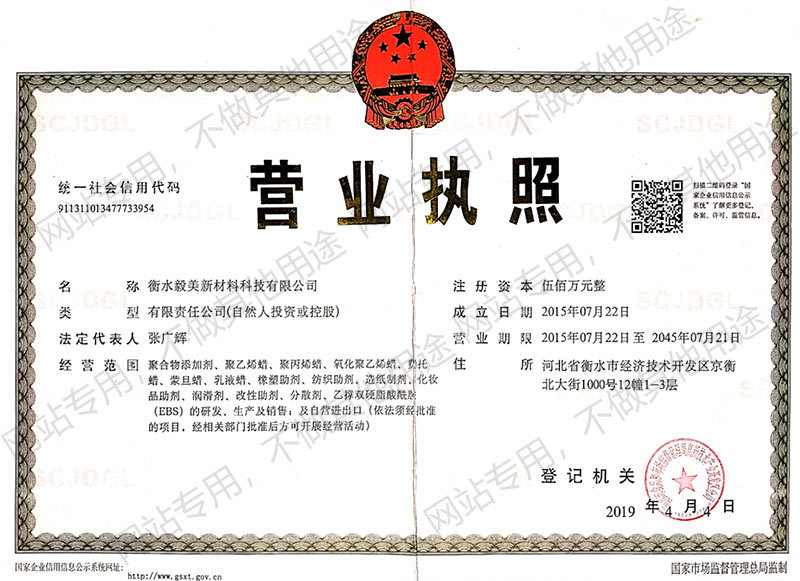
About UsHengshui yi mei new material technology co., ltd. was founded in 2015, is a collection of product development, production, sales and service as one of the high and new technology enterprises, yi mei company focused on deep processing of wax products, determined to become china's professional wax products supplier

-
ProductsThe company mainly produces and sells: polyethylene wax, oxidized polyethylene wax, synthetic Fischer-Tropsch wax, oxidized Fischer-Tropsch wax, maleic anhydride grafted wax, polypropylene wax, micro-powder wax, high-end composite wax and other eight series of dozens of models of high quality products.
-
NewsAt the beginning of its establishment, Yimei Company invested in the establishment of the "Polymer Additive R & D Center", insisting on scientific and technological innovation as the life force of enterprise development. Concentrate funds, technology, and talents in the company's scientific and technological innovation activities, focus on scientific research, public relations and technological breakthroughs of new products, new technologies, and new processes, and resolutely master core technologies.
-
SupportAt the beginning of its establishment, Yimei Company invested in the establishment of the "Polymer Additive R & D Center", insisting on scientific and technological innovation as the life force of enterprise development. Concentrate funds, technology, and talents in the company's scientific and technological innovation activities, focus on scientific research, public relations and technological breakthroughs of new products, new technologies, and new processes, and resolutely master core technologies.
-
RecruitmentOur company always adheres to the talent concept of "people-oriented", actively creates an atmosphere of respect, understanding, integrity and friendship, respects people's knowledge and talents, selects and develops mechanisms, and provides a growth platform for talents. make talents become a strong support for the sustainable development of enterprises, and realize the common growth and development of enterprises and talents.


Unleash the Power of HDPE Wax for Unparalleled Results in Chemical Applications
Release time:
2024-08-18
Unleash the Power of HDPE Wax for Unparalleled Results In the world of chemical products, the quality and performance of materials are paramount. Among the various options available, High-Density Polyethylene (HDPE) wax has emerged as a game-changer, presenting unparalleled advantages in numerous applications. This article delves deep into the multifaceted benefits and uses of HDPE wax, illustrati
Unleash the Power of HDPE Wax for Unparalleled Results
In the world of chemical products, the quality and performance of materials are paramount. Among the various options available, High-Density Polyethylene (HDPE) wax has emerged as a game-changer, presenting unparalleled advantages in numerous applications. This article delves deep into the multifaceted benefits and uses of HDPE wax, illustrating why it is a preferred choice for manufacturers in various sectors.
Table of Contents
- 1. What is HDPE Wax?
- 2. Properties of HDPE Wax
- 3. Applications of HDPE Wax in Various Industries
- 3.1 HDPE Wax in the Plastic Industry
- 3.2 HDPE Wax in Coatings and Sealants
- 3.3 HDPE Wax in Cosmetics and Personal Care
- 3.4 HDPE Wax in Adhesives and Inks
- 4. Key Advantages of Using HDPE Wax
- 5. How to Use HDPE Wax Effectively
- 6. Safety Considerations When Working with HDPE Wax
- 7. FAQs About HDPE Wax
- 8. Conclusion
1. What is HDPE Wax?
HDPE wax is a white, odorless, and tasteless wax derived from high-density polyethylene. It is often produced through the polymerization of ethylene, resulting in a substance that exhibits remarkable thermal stability and chemical resistance. Commonly used in various industrial applications, HDPE wax serves as an essential ingredient that enhances product performance both in manufacturing processes and end-use applications.
2. Properties of HDPE Wax
Understanding the properties of HDPE wax helps industries make informed choices about its use:
2.1 Thermal Stability
HDPE wax boasts excellent thermal stability, allowing it to withstand high temperatures without degrading. This property makes it ideal for applications requiring heat resistance.
2.2 Chemical Resistance
With its robust chemical resistance, HDPE wax can endure exposure to various solvents and chemicals, making it a reliable choice for industries that deal with harsh substances.
2.3 Low Viscosity
The low viscosity of HDPE wax allows for easy mixing and application in formulations, ensuring smooth processing and efficient results.
3. Applications of HDPE Wax in Various Industries
HDPE wax is incredibly versatile and finds applications across multiple sectors.
3.1 HDPE Wax in the Plastic Industry
In the plastic industry, HDPE wax is utilized as a lubricant and processing aid. It enhances the flow of materials during extrusion and injection molding, allowing for better surface finish and improved dimensional stability. Its use minimizes friction and wear in machinery, ultimately extending equipment life.
3.2 HDPE Wax in Coatings and Sealants
In coatings and sealants, HDPE wax is employed to improve hardness, gloss, and scratch resistance. It acts as a matting agent, providing a desirable finish while enhancing the overall durability of the coating. Manufacturers appreciate its ability to modify the surface properties of paints and varnishes.
3.3 HDPE Wax in Cosmetics and Personal Care
HDPE wax is widely used in the cosmetics industry for its emollient properties. It contributes to the smooth application of products like lipsticks, creams, and lotions. Its film-forming ability enhances the longevity of formulations, ensuring that they perform well on the skin.
3.4 HDPE Wax in Adhesives and Inks
In the production of adhesives and inks, HDPE wax improves adhesion and stability. Its inclusion helps optimize the viscosity of inks, enabling better flow and print quality. In adhesives, it enhances bond strength, ensuring reliable performance in various applications.
4. Key Advantages of Using HDPE Wax
When considering HDPE wax for industrial applications, several advantages stand out:
4.1 Cost-Effectiveness
HDPE wax offers a cost-effective solution without compromising on performance. Its availability in bulk allows manufacturers to keep production costs low while maintaining high-quality standards.
4.2 Eco-Friendly Properties
Derived from polyethylene, HDPE wax is a relatively eco-friendly option compared to other synthetic waxes. It is recyclable and can contribute to sustainable practices in various industries.
4.3 Versatility
With its adaptability across different applications, HDPE wax is suitable for countless industries, making it a versatile choice for manufacturers looking to streamline their processes.
5. How to Use HDPE Wax Effectively
For optimal results, it is essential to follow best practices when using HDPE wax:
5.1 Proper Dosage
Determining the right dosage is crucial for achieving the desired performance. Manufacturers should conduct trials to find the optimal concentration that works best for their specific application.
5.2 Mixing Techniques
Ensure comprehensive mixing of HDPE wax with other components. Utilizing suitable equipment can enhance compatibility and prevent phase separation.
5.3 Temperature Control
Monitoring temperature during processing is vital. Maintaining appropriate temperatures ensures that HDPE wax maintains its characteristics and functions effectively in formulations.
6. Safety Considerations When Working with HDPE Wax
While HDPE wax is generally safe to handle, precautions should still be taken:
6.1 Personal Protective Equipment (PPE)
Using appropriate PPE, such as gloves and goggles, can prevent skin and eye irritation during handling.
6.2 Proper Ventilation
Ensure adequate ventilation in workspaces to avoid inhaling any fumes that may be released during processing.
6.3 Safe Storage
Store HDPE wax in a cool, dry place away from direct sunlight and incompatible substances to maintain its quality and safety.
7. FAQs About HDPE Wax
7.1 What is the shelf life of HDPE wax?
The shelf life of HDPE wax typically ranges from 2 to 5 years when stored correctly in appropriate conditions.
7.2 Is HDPE wax biodegradable?
HDPE wax is not biodegradable but can be recycled, making it more environmentally friendly than many other synthetic waxes.
7.3 Can HDPE wax be used in food applications?
HDPE wax is not generally recommended for food applications unless specifically labeled as food-safe.
7.4 How does HDPE wax compare to paraffin wax?
HDPE wax offers better chemical resistance and thermal stability compared to paraffin wax, making it more suitable for demanding applications.
7.5 Where can I buy HDPE wax?
HDPE wax can be purchased from specialty chemical suppliers, distributors, and online marketplaces catering to industrial materials.
8. Conclusion
In conclusion, HDPE wax stands out as a powerful and versatile material that can enhance the performance of various products across multiple industries. Its unique properties, including thermal stability, chemical resistance, and adaptability, make it an invaluable asset in manufacturing processes. By harnessing the advantages of HDPE wax, businesses can improve the quality of their products while achieving cost-effectiveness and sustainability. As industries continue to innovate and evolve, incorporating HDPE wax into formulations will undoubtedly lead to unparalleled results.
Key words:
HDPE wax
recommend reading