Yimei New Material-Professional Wax Product Solution Supplier


-
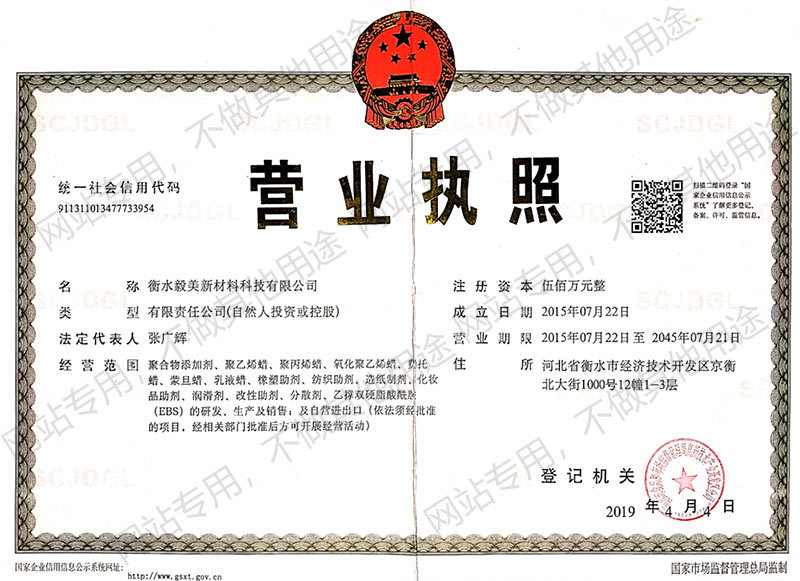
About UsHengshui yi mei new material technology co., ltd. was founded in 2015, is a collection of product development, production, sales and service as one of the high and new technology enterprises, yi mei company focused on deep processing of wax products, determined to become china's professional wax products supplier

-
ProductsThe company mainly produces and sells: polyethylene wax, oxidized polyethylene wax, synthetic Fischer-Tropsch wax, oxidized Fischer-Tropsch wax, maleic anhydride grafted wax, polypropylene wax, micro-powder wax, high-end composite wax and other eight series of dozens of models of high quality products.
-
NewsAt the beginning of its establishment, Yimei Company invested in the establishment of the "Polymer Additive R & D Center", insisting on scientific and technological innovation as the life force of enterprise development. Concentrate funds, technology, and talents in the company's scientific and technological innovation activities, focus on scientific research, public relations and technological breakthroughs of new products, new technologies, and new processes, and resolutely master core technologies.
-
SupportAt the beginning of its establishment, Yimei Company invested in the establishment of the "Polymer Additive R & D Center", insisting on scientific and technological innovation as the life force of enterprise development. Concentrate funds, technology, and talents in the company's scientific and technological innovation activities, focus on scientific research, public relations and technological breakthroughs of new products, new technologies, and new processes, and resolutely master core technologies.
-
RecruitmentOur company always adheres to the talent concept of "people-oriented", actively creates an atmosphere of respect, understanding, integrity and friendship, respects people's knowledge and talents, selects and develops mechanisms, and provides a growth platform for talents. make talents become a strong support for the sustainable development of enterprises, and realize the common growth and development of enterprises and talents.


Unlocking the Versatility of HDPE Wax in Various Industries
Release time:
2024-08-15
HDPE wax, or high-density polyethylene wax, is a versatile polymer that plays a significant role in various industries, particularly within the chemical sector. Its unique molecular structure offers a range of beneficial properties that make it an appealing choice for numerous applications. One of the primary characteristics of HDPE wax is its excellent thermal stability. This property ensures tha
HDPE wax, or high-density polyethylene wax, is a versatile polymer that plays a significant role in various industries, particularly within the chemical sector. Its unique molecular structure offers a range of beneficial properties that make it an appealing choice for numerous applications.
One of the primary characteristics of HDPE wax is its excellent thermal stability. This property ensures that products containing HDPE wax remain stable and effective even when exposed to high temperatures. This makes it particularly useful in applications such as coatings, adhesives, and sealants, where heat resistance is essential.
Another notable feature of HDPE wax is its low viscosity. This quality allows for easy incorporation into formulations, ensuring a smooth and uniform mixture. As a result, manufacturers can achieve consistent product quality and performance across different batches. Additionally, the low viscosity of HDPE wax aids in enhancing the flow properties of various products, making it easier to apply and manipulate.
HDPE wax is also known for its outstanding water repellency. This attribute makes it an ideal additive in products that require moisture resistance, such as paints and coatings. By incorporating HDPE wax into these formulations, manufacturers can enhance the durability and longevity of their products, making them more appealing to end users.
Furthermore, HDPE wax acts as a slip agent, reducing friction between surfaces. This property is particularly beneficial in the production of films and packaging materials, where it helps improve the handling and usability of the final products. By minimizing surface friction, HDPE wax contributes to a smoother product experience, which can be a significant selling point in competitive markets.
In terms of its environmental impact, HDPE wax is considered to be a more sustainable option compared to some other synthetic waxes. Its production typically involves using renewable resources, and it can be formulated to be biodegradable, which aligns with the growing demand for eco-friendly solutions in the market.
In conclusion, HDPE wax is an invaluable component in the chemical industry, providing a host of advantages that enhance product performance and user experience. Its thermal stability, low viscosity, water repellency, and slip properties make it a sought-after additive across various applications. As industries continue to seek innovative solutions and sustainable materials, HDPE wax is poised to play an even more prominent role in the future.
One of the primary characteristics of HDPE wax is its excellent thermal stability. This property ensures that products containing HDPE wax remain stable and effective even when exposed to high temperatures. This makes it particularly useful in applications such as coatings, adhesives, and sealants, where heat resistance is essential.
Another notable feature of HDPE wax is its low viscosity. This quality allows for easy incorporation into formulations, ensuring a smooth and uniform mixture. As a result, manufacturers can achieve consistent product quality and performance across different batches. Additionally, the low viscosity of HDPE wax aids in enhancing the flow properties of various products, making it easier to apply and manipulate.
HDPE wax is also known for its outstanding water repellency. This attribute makes it an ideal additive in products that require moisture resistance, such as paints and coatings. By incorporating HDPE wax into these formulations, manufacturers can enhance the durability and longevity of their products, making them more appealing to end users.
Furthermore, HDPE wax acts as a slip agent, reducing friction between surfaces. This property is particularly beneficial in the production of films and packaging materials, where it helps improve the handling and usability of the final products. By minimizing surface friction, HDPE wax contributes to a smoother product experience, which can be a significant selling point in competitive markets.
In terms of its environmental impact, HDPE wax is considered to be a more sustainable option compared to some other synthetic waxes. Its production typically involves using renewable resources, and it can be formulated to be biodegradable, which aligns with the growing demand for eco-friendly solutions in the market.
In conclusion, HDPE wax is an invaluable component in the chemical industry, providing a host of advantages that enhance product performance and user experience. Its thermal stability, low viscosity, water repellency, and slip properties make it a sought-after additive across various applications. As industries continue to seek innovative solutions and sustainable materials, HDPE wax is poised to play an even more prominent role in the future.
Key words:
HDPE wax
recommend reading