Yimei New Material-Professional Wax Product Solution Supplier


-
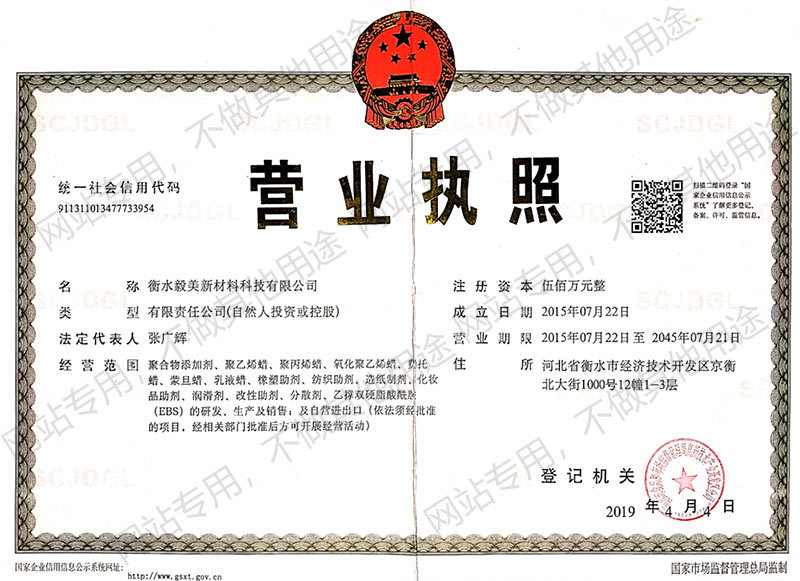
About UsHengshui yi mei new material technology co., ltd. was founded in 2015, is a collection of product development, production, sales and service as one of the high and new technology enterprises, yi mei company focused on deep processing of wax products, determined to become china's professional wax products supplier

-
ProductsThe company mainly produces and sells: polyethylene wax, oxidized polyethylene wax, synthetic Fischer-Tropsch wax, oxidized Fischer-Tropsch wax, maleic anhydride grafted wax, polypropylene wax, micro-powder wax, high-end composite wax and other eight series of dozens of models of high quality products.
-
NewsAt the beginning of its establishment, Yimei Company invested in the establishment of the "Polymer Additive R & D Center", insisting on scientific and technological innovation as the life force of enterprise development. Concentrate funds, technology, and talents in the company's scientific and technological innovation activities, focus on scientific research, public relations and technological breakthroughs of new products, new technologies, and new processes, and resolutely master core technologies.
-
SupportAt the beginning of its establishment, Yimei Company invested in the establishment of the "Polymer Additive R & D Center", insisting on scientific and technological innovation as the life force of enterprise development. Concentrate funds, technology, and talents in the company's scientific and technological innovation activities, focus on scientific research, public relations and technological breakthroughs of new products, new technologies, and new processes, and resolutely master core technologies.
-
RecruitmentOur company always adheres to the talent concept of "people-oriented", actively creates an atmosphere of respect, understanding, integrity and friendship, respects people's knowledge and talents, selects and develops mechanisms, and provides a growth platform for talents. make talents become a strong support for the sustainable development of enterprises, and realize the common growth and development of enterprises and talents.


The Role of LDPE Wax in Enhancing Chemical Formulations' Quality
Release time:
2024-08-14
The Role of LDPE Wax in Improving the Quality of Chemical Formulations The chemical industry continuously seeks innovative solutions to enhance the quality and functionality of its products. One such solution emerging in recent years is the use of **Low-Density Polyethylene (LDPE) Wax**. This versatile compound plays a crucial role in various chemical formulations, offering numerous advantages tha
The Role of LDPE Wax in Improving the Quality of Chemical Formulations
The chemical industry continuously seeks innovative solutions to enhance the quality and functionality of its products. One such solution emerging in recent years is the use of **Low-Density Polyethylene (LDPE) Wax**. This versatile compound plays a crucial role in various chemical formulations, offering numerous advantages that significantly improve performance and user experience. In this comprehensive article, we will explore the multifaceted roles of LDPE wax in enhancing chemical formulations, its benefits, applications, and the science behind its workings.
Table of Contents
- 1. Introduction to LDPE Wax
- 2. Unique Properties of LDPE Wax
- 3. Applications of LDPE Wax in Chemical Formulations
- 4. Benefits of Using LDPE Wax
- 5. Mechanism of Action: How LDPE Wax Enhances Quality
- 6. Case Studies: LDPE Wax in Action
- 7. Challenges and Considerations in Using LDPE Wax
- 8. The Future of LDPE Wax in the Chemical Industry
- 9. Frequently Asked Questions
- 10. Conclusion
1. Introduction to LDPE Wax
Low-Density Polyethylene (LDPE) wax is a type of polyethylene that has low molecular weight, which makes it distinct from high-density polyethylene (HDPE). Widely recognized for its versatility and adaptability, LDPE wax is increasingly utilized in various industries, particularly in the formulation of chemicals. Its non-toxic nature and excellent compatibility with different materials make it an attractive option for formulators looking to enhance the performance and quality of their products. Understanding the role of LDPE wax in chemical formulations is crucial for those aiming to innovate and improve product efficacy.
2. Unique Properties of LDPE Wax
LDPE wax exhibits several key properties that contribute to its effectiveness in chemical formulations:
- Low Viscosity: This characteristic allows LDPE wax to be easily incorporated into various formulations, ensuring a smooth and uniform consistency.
- Excellent Adhesion: LDPE wax improves adhesion properties in adhesives and coatings, enhancing the performance of these products.
- Water Resistance: Its hydrophobic nature helps in reducing water absorption, which is beneficial for various applications, particularly in coatings and sealants.
- Thermal Stability: LDPE wax maintains its properties across a wide temperature range, making it suitable for high-temperature applications.
- Flexibility: The flexibility of LDPE wax allows it to adapt to various substrate materials, making it a valuable addition to many formulations.
3. Applications of LDPE Wax in Chemical Formulations
LDPE wax finds application in a variety of chemical formulations, including but not limited to:
3.1 Adhesives and Sealants
In adhesives and sealants, LDPE wax is used to improve the bonding strength and flexibility of the product. It enhances the overall performance by providing better wetting properties and reducing tackiness, making it easier to apply.
3.2 Coatings and Paints
LDPE wax contributes to the formulation of coatings and paints by offering enhanced durability and water resistance. It helps achieve a smooth finish while providing protection against environmental factors.
3.3 Plastics and Polymers
In the plastics industry, LDPE wax is utilized as a processing aid to enhance the flow characteristics of polymers during manufacturing. This leads to improved mechanical properties and overall product quality.
3.4 Personal Care Products
LDPE wax is also found in personal care formulations, where it adds emollient properties, improves texture, and enhances the application of products such as creams and lotions.
4. Benefits of Using LDPE Wax
The incorporation of LDPE wax into chemical formulations brings numerous benefits, including:
4.1 Enhanced Performance
LDPE wax improves the performance of formulations by enhancing their mechanical and physical properties, leading to better end-user satisfaction.
4.2 Improved Consistency
By providing a uniform viscosity and texture, LDPE wax ensures that products maintain their quality over time, reducing the risk of separation or settling.
4.3 Cost-Effectiveness
LDPE wax can help reduce production costs by improving processing efficiency and minimizing waste during formulation.
4.4 Versatile Compatibility
Its compatibility with a wide range of materials makes LDPE wax a valuable additive in various formulations, allowing for greater flexibility in product design.
5. Mechanism of Action: How LDPE Wax Enhances Quality
Understanding the mechanism of action of LDPE wax is essential for formulators. When added to a formulation, LDPE wax interacts with other components to modify the physical properties of the product. Here’s how:
5.1 Dispersive Action
LDPE wax acts as a dispersant, helping to evenly distribute solid particles within a liquid matrix. This leads to improved stability and consistency in formulations.
5.2 Lubrication Properties
Its inherent lubrication properties reduce friction during the processing of formulations. This not only improves the efficiency of production but also enhances the final product's performance.
5.3 Barrier Formation
LDPE wax creates a barrier that protects formulations from moisture and other environmental factors, thereby extending the shelf life and effectiveness of the product.
6. Case Studies: LDPE Wax in Action
Real-world applications provide excellent insights into the benefits of LDPE wax. Here are a few case studies demonstrating its effectiveness:
6.1 Case Study 1: Automotive Coatings
A leading automotive manufacturer incorporated LDPE wax into their paint formulations. The result was a significant enhancement in water resistance and durability, leading to a marked decrease in warranty claims related to paint failure.
6.2 Case Study 2: Construction Adhesives
A construction adhesive company found that adding LDPE wax improved the adhesion properties of their products, allowing for better performance in high-humidity environments. This innovation led to increased market share and customer satisfaction.
7. Challenges and Considerations in Using LDPE Wax
Despite its numerous benefits, there are challenges associated with the use of LDPE wax:
7.1 Compatibility Issues
While LDPE wax is generally compatible with many materials, formulators must test each formulation to ensure optimal performance, as reactions can vary based on the specific chemical makeup of the formulation.
7.2 Cost Implications
The initial cost of incorporating LDPE wax may be higher than traditional additives, requiring careful consideration in budgeting and pricing strategies.
8. The Future of LDPE Wax in the Chemical Industry
The future of LDPE wax looks promising as demand for sustainable and high-performance materials grows. As research continues, we can expect advancements in the formulation techniques and applications of LDPE wax, further solidifying its position in the chemical industry.
9. Frequently Asked Questions
Q1: What is LDPE wax made from?
A1: LDPE wax is derived from low-density polyethylene, which is produced through the polymerization of ethylene gas.
Q2: Can LDPE wax be recycled?
A2: Yes, LDPE wax is recyclable, contributing to its appeal as a sustainable material in various applications.
Q3: How does LDPE wax improve paint formulations?
A3: LDPE wax enhances paint formulations by providing better water resistance, durability, and uniform consistency.
Q4: Is LDPE wax safe for use in personal care products?
A4: Yes, LDPE wax is non-toxic and safe for use in personal care products, making it a popular ingredient in cosmetics and lotions.
Q5: What industries benefit the most from LDPE wax?
A5: Industries such as automotive, construction, plastics, and personal care significantly benefit from the incorporation of LDPE wax in their formulations.
10. Conclusion
In conclusion, **Low-Density Polyethylene (LDPE) Wax** plays a pivotal role in enhancing the quality of chemical formulations across various industries. Its unique properties and versatile applications make it an invaluable additive for improving performance, consistency, and overall product quality. As the demand for innovative solutions continues to rise, LDPE wax is set to become an integral component in the formulation of high-quality chemical products, paving the way for a more efficient and sustainable future in the chemical industry.
Key words:
LDPE wax
Previous article
recommend reading