Yimei New Material-Professional Wax Product Solution Supplier


-
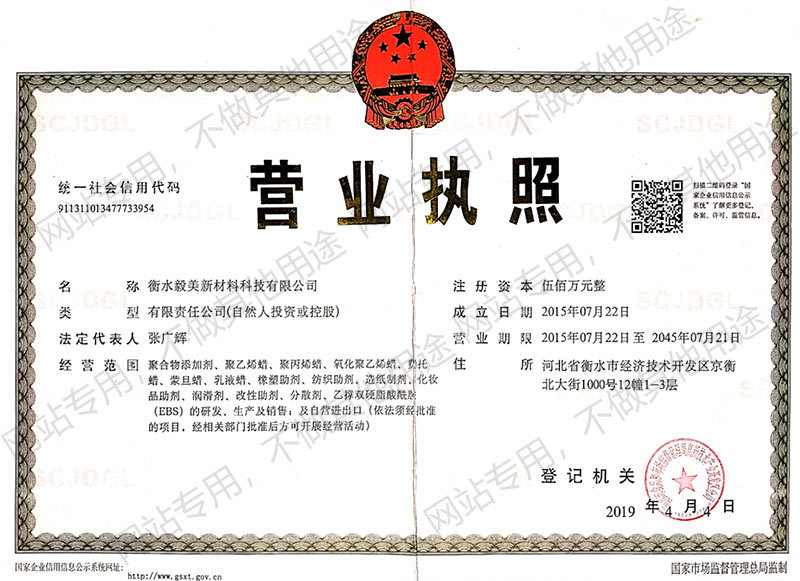
About UsHengshui yi mei new material technology co., ltd. was founded in 2015, is a collection of product development, production, sales and service as one of the high and new technology enterprises, yi mei company focused on deep processing of wax products, determined to become china's professional wax products supplier

-
ProductsThe company mainly produces and sells: polyethylene wax, oxidized polyethylene wax, synthetic Fischer-Tropsch wax, oxidized Fischer-Tropsch wax, maleic anhydride grafted wax, polypropylene wax, micro-powder wax, high-end composite wax and other eight series of dozens of models of high quality products.
-
NewsAt the beginning of its establishment, Yimei Company invested in the establishment of the "Polymer Additive R & D Center", insisting on scientific and technological innovation as the life force of enterprise development. Concentrate funds, technology, and talents in the company's scientific and technological innovation activities, focus on scientific research, public relations and technological breakthroughs of new products, new technologies, and new processes, and resolutely master core technologies.
-
SupportAt the beginning of its establishment, Yimei Company invested in the establishment of the "Polymer Additive R & D Center", insisting on scientific and technological innovation as the life force of enterprise development. Concentrate funds, technology, and talents in the company's scientific and technological innovation activities, focus on scientific research, public relations and technological breakthroughs of new products, new technologies, and new processes, and resolutely master core technologies.
-
RecruitmentOur company always adheres to the talent concept of "people-oriented", actively creates an atmosphere of respect, understanding, integrity and friendship, respects people's knowledge and talents, selects and develops mechanisms, and provides a growth platform for talents. make talents become a strong support for the sustainable development of enterprises, and realize the common growth and development of enterprises and talents.


Understanding LDPE Wax: Applications and Benefits in the Chemical Industry
Release time:
2024-08-13
LDPE wax, or low-density polyethylene wax, is a versatile polymer that has garnered significant attention in the chemical industry for its wide range of applications. Characterized by its low density and high flexibility, LDPE wax is produced through the polymerization of ethylene, resulting in a white, waxy solid that is typically non-toxic and environmentally friendly. One of the most notable p
LDPE wax, or low-density polyethylene wax, is a versatile polymer that has garnered significant attention in the chemical industry for its wide range of applications. Characterized by its low density and high flexibility, LDPE wax is produced through the polymerization of ethylene, resulting in a white, waxy solid that is typically non-toxic and environmentally friendly.
One of the most notable properties of LDPE wax is its excellent lubricating abilities. As a result, it is often incorporated into various formulations to improve the flow characteristics of products, such as coatings, inks, and plastics. By acting as a release agent, LDPE wax aids in the smooth processing of materials, reducing friction during manufacturing and enhancing the final product's performance.
In addition to its lubricating properties, LDPE wax exhibits remarkable moisture resistance, making it an ideal choice for applications where water repellency is crucial. This characteristic is particularly beneficial in packaging, where LDPE wax can help protect products from moisture-related damage, thereby extending their shelf life and maintaining quality.
Another significant advantage of LDPE wax is its compatibility with a wide range of additives and resins. This adaptability allows manufacturers to create customized formulations tailored to specific needs. For instance, LDPE wax can be blended with other polymers to enhance their processing capabilities, improve surface finish, or modify mechanical properties. This versatility makes LDPE wax an invaluable component in various industrial sectors, including automotive, construction, and consumer goods.
Moreover, LDPE wax is also recognized for its low melting point, which allows it to be easily processed in various applications. This property is particularly advantageous in hot melt adhesives, where the wax can be melted and applied quickly, providing strong adhesion while maintaining flexibility. Additionally, the low melting point facilitates easy incorporation into different formulations without the need for complex processing equipment.
Environmental considerations are vital in today’s industrial landscape, and LDPE wax presents a sustainable option for many manufacturers. As a recyclable material, it contributes to reducing waste and promoting eco-friendly practices within the chemical industry. By choosing LDPE wax, companies can align themselves with sustainability goals while still achieving high-quality product performance.
In conclusion, LDPE wax is a multifaceted material that plays a crucial role in enhancing the performance and efficiency of various products across multiple industries. Its unique properties, combined with its adaptability and environmental benefits, make it an essential component for manufacturers looking to innovate and improve their offerings. Understanding the applications and advantages of LDPE wax can help businesses leverage this material to meet their specific needs and drive success in the competitive chemical market.
One of the most notable properties of LDPE wax is its excellent lubricating abilities. As a result, it is often incorporated into various formulations to improve the flow characteristics of products, such as coatings, inks, and plastics. By acting as a release agent, LDPE wax aids in the smooth processing of materials, reducing friction during manufacturing and enhancing the final product's performance.
In addition to its lubricating properties, LDPE wax exhibits remarkable moisture resistance, making it an ideal choice for applications where water repellency is crucial. This characteristic is particularly beneficial in packaging, where LDPE wax can help protect products from moisture-related damage, thereby extending their shelf life and maintaining quality.
Another significant advantage of LDPE wax is its compatibility with a wide range of additives and resins. This adaptability allows manufacturers to create customized formulations tailored to specific needs. For instance, LDPE wax can be blended with other polymers to enhance their processing capabilities, improve surface finish, or modify mechanical properties. This versatility makes LDPE wax an invaluable component in various industrial sectors, including automotive, construction, and consumer goods.
Moreover, LDPE wax is also recognized for its low melting point, which allows it to be easily processed in various applications. This property is particularly advantageous in hot melt adhesives, where the wax can be melted and applied quickly, providing strong adhesion while maintaining flexibility. Additionally, the low melting point facilitates easy incorporation into different formulations without the need for complex processing equipment.
Environmental considerations are vital in today’s industrial landscape, and LDPE wax presents a sustainable option for many manufacturers. As a recyclable material, it contributes to reducing waste and promoting eco-friendly practices within the chemical industry. By choosing LDPE wax, companies can align themselves with sustainability goals while still achieving high-quality product performance.
In conclusion, LDPE wax is a multifaceted material that plays a crucial role in enhancing the performance and efficiency of various products across multiple industries. Its unique properties, combined with its adaptability and environmental benefits, make it an essential component for manufacturers looking to innovate and improve their offerings. Understanding the applications and advantages of LDPE wax can help businesses leverage this material to meet their specific needs and drive success in the competitive chemical market.
Key words:
LDPE wax
Previous article
recommend reading