Yimei New Material-Professional Wax Product Solution Supplier


-
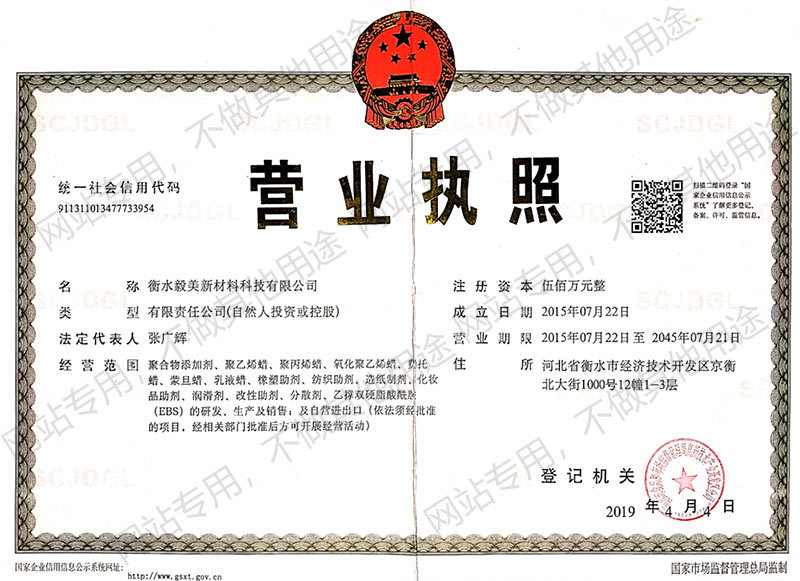
About UsHengshui yi mei new material technology co., ltd. was founded in 2015, is a collection of product development, production, sales and service as one of the high and new technology enterprises, yi mei company focused on deep processing of wax products, determined to become china's professional wax products supplier

-
ProductsThe company mainly produces and sells: polyethylene wax, oxidized polyethylene wax, synthetic Fischer-Tropsch wax, oxidized Fischer-Tropsch wax, maleic anhydride grafted wax, polypropylene wax, micro-powder wax, high-end composite wax and other eight series of dozens of models of high quality products.
-
NewsAt the beginning of its establishment, Yimei Company invested in the establishment of the "Polymer Additive R & D Center", insisting on scientific and technological innovation as the life force of enterprise development. Concentrate funds, technology, and talents in the company's scientific and technological innovation activities, focus on scientific research, public relations and technological breakthroughs of new products, new technologies, and new processes, and resolutely master core technologies.
-
SupportAt the beginning of its establishment, Yimei Company invested in the establishment of the "Polymer Additive R & D Center", insisting on scientific and technological innovation as the life force of enterprise development. Concentrate funds, technology, and talents in the company's scientific and technological innovation activities, focus on scientific research, public relations and technological breakthroughs of new products, new technologies, and new processes, and resolutely master core technologies.
-
RecruitmentOur company always adheres to the talent concept of "people-oriented", actively creates an atmosphere of respect, understanding, integrity and friendship, respects people's knowledge and talents, selects and develops mechanisms, and provides a growth platform for talents. make talents become a strong support for the sustainable development of enterprises, and realize the common growth and development of enterprises and talents.


Unlocking the Potential of Micronized Wax in Various Industries
Release time:
2024-08-07
Micronized wax is a finely ground wax that has gained traction across various industries due to its exceptional properties and versatility. This powdery form of wax is produced through a meticulous micronization process, which reduces the particle size, allowing it to blend seamlessly into different formulations. The result is a product that offers numerous benefits, making it an essential compone
Micronized wax is a finely ground wax that has gained traction across various industries due to its exceptional properties and versatility. This powdery form of wax is produced through a meticulous micronization process, which reduces the particle size, allowing it to blend seamlessly into different formulations. The result is a product that offers numerous benefits, making it an essential component in applications ranging from coatings to cosmetics.
One of the primary characteristics of micronized wax is its ability to improve the texture and feel of products. When incorporated into formulations, it enhances the sensory experience, providing a smoother finish and a more luxurious feel. This is particularly valuable in the cosmetic industry, where consumers are increasingly looking for products that not only perform well but also feel good on the skin.
In addition to its textural benefits, micronized wax serves as an excellent thickening agent. It can stabilize emulsions and improve the viscosity of various formulations, making it a popular choice in paints, coatings, and sealants. This property is especially advantageous because it helps to prevent sedimentation and ensures uniform consistency throughout the product, which is critical for both aesthetic appeal and performance.
Another noteworthy application of micronized wax is in the field of plastics and polymers. When added to plastic formulations, it acts as a lubricant, reducing friction during processing and improving the flow characteristics of molten materials. This leads to better mold filling and can enhance the overall durability of the final product.
Moreover, micronized wax possesses excellent water-repellent properties. This makes it an ideal additive for outdoor products, such as garden furniture and outdoor coatings, where moisture resistance is crucial. By incorporating micronized wax, manufacturers can significantly extend the lifespan of their products while maintaining their aesthetic appeal.
In terms of environmental impact, micronized wax is often derived from natural sources, making it a more sustainable option compared to synthetic alternatives. This aspect is increasingly important to consumers and industries aiming to reduce their ecological footprint.
In conclusion, micronized wax is not just a simple additive; it is a versatile ingredient that can enhance the performance and appeal of various products across multiple sectors. By understanding its benefits and applications, manufacturers can leverage micronized wax to create superior formulations that meet the demands of today's consumers. Whether in cosmetics, coatings, or plastics, the use of micronized wax can lead to innovative solutions that satisfy both functional and aesthetic requirements.
One of the primary characteristics of micronized wax is its ability to improve the texture and feel of products. When incorporated into formulations, it enhances the sensory experience, providing a smoother finish and a more luxurious feel. This is particularly valuable in the cosmetic industry, where consumers are increasingly looking for products that not only perform well but also feel good on the skin.
In addition to its textural benefits, micronized wax serves as an excellent thickening agent. It can stabilize emulsions and improve the viscosity of various formulations, making it a popular choice in paints, coatings, and sealants. This property is especially advantageous because it helps to prevent sedimentation and ensures uniform consistency throughout the product, which is critical for both aesthetic appeal and performance.
Another noteworthy application of micronized wax is in the field of plastics and polymers. When added to plastic formulations, it acts as a lubricant, reducing friction during processing and improving the flow characteristics of molten materials. This leads to better mold filling and can enhance the overall durability of the final product.
Moreover, micronized wax possesses excellent water-repellent properties. This makes it an ideal additive for outdoor products, such as garden furniture and outdoor coatings, where moisture resistance is crucial. By incorporating micronized wax, manufacturers can significantly extend the lifespan of their products while maintaining their aesthetic appeal.
In terms of environmental impact, micronized wax is often derived from natural sources, making it a more sustainable option compared to synthetic alternatives. This aspect is increasingly important to consumers and industries aiming to reduce their ecological footprint.
In conclusion, micronized wax is not just a simple additive; it is a versatile ingredient that can enhance the performance and appeal of various products across multiple sectors. By understanding its benefits and applications, manufacturers can leverage micronized wax to create superior formulations that meet the demands of today's consumers. Whether in cosmetics, coatings, or plastics, the use of micronized wax can lead to innovative solutions that satisfy both functional and aesthetic requirements.
Key words:
Micronized wax
Previous article
recommend reading