Yimei New Material-Professional Wax Product Solution Supplier


-
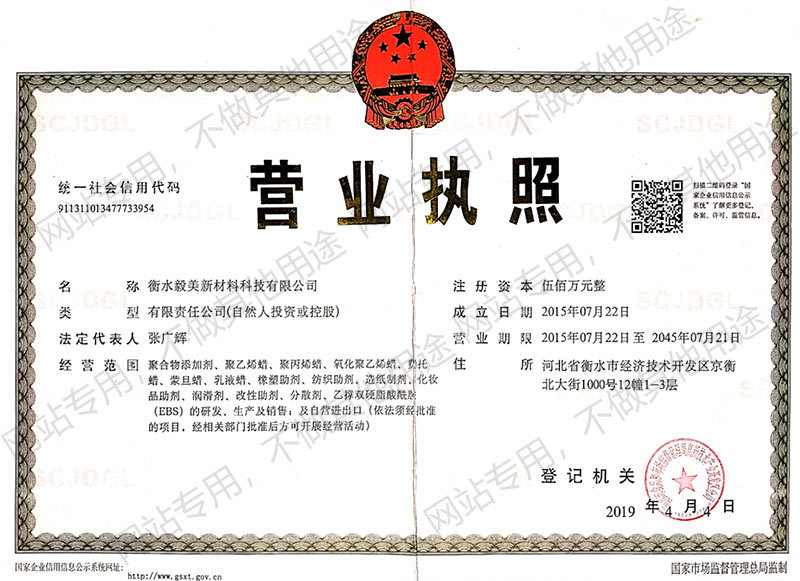
About UsHengshui yi mei new material technology co., ltd. was founded in 2015, is a collection of product development, production, sales and service as one of the high and new technology enterprises, yi mei company focused on deep processing of wax products, determined to become china's professional wax products supplier

-
ProductsThe company mainly produces and sells: polyethylene wax, oxidized polyethylene wax, synthetic Fischer-Tropsch wax, oxidized Fischer-Tropsch wax, maleic anhydride grafted wax, polypropylene wax, micro-powder wax, high-end composite wax and other eight series of dozens of models of high quality products.
-
NewsAt the beginning of its establishment, Yimei Company invested in the establishment of the "Polymer Additive R & D Center", insisting on scientific and technological innovation as the life force of enterprise development. Concentrate funds, technology, and talents in the company's scientific and technological innovation activities, focus on scientific research, public relations and technological breakthroughs of new products, new technologies, and new processes, and resolutely master core technologies.
-
SupportAt the beginning of its establishment, Yimei Company invested in the establishment of the "Polymer Additive R & D Center", insisting on scientific and technological innovation as the life force of enterprise development. Concentrate funds, technology, and talents in the company's scientific and technological innovation activities, focus on scientific research, public relations and technological breakthroughs of new products, new technologies, and new processes, and resolutely master core technologies.
-
RecruitmentOur company always adheres to the talent concept of "people-oriented", actively creates an atmosphere of respect, understanding, integrity and friendship, respects people's knowledge and talents, selects and develops mechanisms, and provides a growth platform for talents. make talents become a strong support for the sustainable development of enterprises, and realize the common growth and development of enterprises and talents.


A Comprehensive Guide to Understanding Micronized Wax and Its Uses
Release time:
2024-08-08
A Comprehensive Guide to Understanding Micronized Wax and Its Uses Table of Contents 1. What is Micronized Wax? 2. Properties of Micronized Wax 3. Types of Micronized Wax 4. Applications of Micronized Wax in Various Industries 5. Benefits of Using Micronized Wax 6. How is Micronized Wax Produced? 7. Safety and Regulatory Considerations 8. The Future of Micronized W
A Comprehensive Guide to Understanding Micronized Wax and Its Uses
Table of Contents
- 1. What is Micronized Wax?
- 2. Properties of Micronized Wax
- 3. Types of Micronized Wax
- 4. Applications of Micronized Wax in Various Industries
- 5. Benefits of Using Micronized Wax
- 6. How is Micronized Wax Produced?
- 7. Safety and Regulatory Considerations
- 8. The Future of Micronized Wax in Industry
- 9. Frequently Asked Questions
1. What is Micronized Wax?
Micronized wax refers to a fine particle size version of wax that has been ground down to a micron range, typically between 1 to 10 microns. This refinement process enhances its characteristics, making it suitable for various industrial applications. Micronized wax is primarily derived from natural sources like paraffin and carnauba, although synthetic options also exist. Its unique properties provide added functionality in formulations used in cosmetics, paints, coatings, and adhesives.
2. Properties of Micronized Wax
Micronized wax possesses several distinctive properties that make it a valuable ingredient in many formulations. Some of these properties include:
2.1 Fine Particle Size
The micronization process creates a powder with a large surface area relative to its volume, which enhances its dispersibility and effectiveness in applications.
2.2 Melting Point
Micronized wax typically has a higher melting point than its unprocessed counterparts, lending itself to applications that require stability at elevated temperatures.
2.3 Improved Gloss and Surface Finish
Micronized wax improves the gloss and surface texture of products, making it ideal for use in coatings and cosmetics.
2.4 Chemical Resistance
It exhibits resistance to various chemicals, ensuring the durability of the products in which it is incorporated.
2.5 Lubricating Properties
Micronized wax can act as a lubricant, reducing friction and wear in various applications, particularly in plastics and coatings.
3. Types of Micronized Wax
There are several types of micronized wax, each with its own unique set of characteristics and applications:
3.1 Paraffin Wax
Paraffin wax is derived from petroleum and is widely used due to its low cost and availability. It offers excellent gloss and moisture resistance.
3.2 Carnauba Wax
Derived from the leaves of the Copernicia prunifera palm, carnauba wax is known for its high melting point and brilliant shine. It is often used in cosmetics and food products.
3.3 Synthetic Wax
Synthetic waxes are engineered to deliver specific properties, such as enhanced durability or resistance to heat. They are often utilized in high-performance applications.
4. Applications of Micronized Wax in Various Industries
Micronized wax finds utility across diverse industries due to its unique properties. Its applications include:
4.1 Cosmetics and Personal Care
In cosmetics, micronized wax enhances texture, provides film-forming properties, and improves gloss in lipsticks, foundations, and creams.
4.2 Paints and Coatings
Micronized wax is used to improve scratch resistance, reduce surface gloss, and enhance the overall durability of paints and coatings.
4.3 Adhesives and Sealants
In adhesives, micronized wax acts as a lubricant, facilitating better flow properties and enhancing the adhesion of the final product.
4.4 Plastics and Polymers
Micronized wax is incorporated into plastics to improve lubrication, reduce friction, and enhance processing characteristics.
4.5 Food Packaging
Used in food packaging, micronized wax improves moisture resistance, ensuring the freshness and longevity of food products.
5. Benefits of Using Micronized Wax
The incorporation of micronized wax into formulations offers numerous advantages:
5.1 Enhanced Performance
Micronized wax improves the performance characteristics of products, leading to better user satisfaction.
5.2 Versatility
Its diverse range of applications makes micronized wax a versatile ingredient suitable for various formulations.
5.3 Cost-Effectiveness
Due to its efficiency in enhancing product performance, using micronized wax can result in cost savings in formulation processes.
5.4 Eco-Friendly Options
With the availability of natural and bio-based micronized wax, manufacturers can opt for eco-friendly options without compromising performance.
6. How is Micronized Wax Produced?
The production of micronized wax involves several steps:
6.1 Sourcing Raw Materials
Raw materials, such as paraffin or natural waxes, are sourced based on the desired properties of the final product.
6.2 Micronization Process
The selected wax undergoes a micronization process, which involves grinding the wax to achieve the desired particle size.
6.3 Quality Control
Final products are subjected to rigorous quality control measures to ensure consistency and performance before being packaged and distributed.
7. Safety and Regulatory Considerations
When using micronized wax, it is essential to adhere to safety guidelines and regulatory standards:
7.1 Safety Data Sheets (SDS)
Manufacturers should provide Safety Data Sheets for micronized wax to inform users of potential hazards and safe handling practices.
7.2 Regulatory Compliance
Ensure that the micronized wax complies with relevant regulations, particularly when used in food or cosmetic applications.
8. The Future of Micronized Wax in Industry
As industries evolve, so too will the applications and formulations involving micronized wax. Innovations in production processes and the development of eco-friendly alternatives will likely expand its use. Additionally, the growing emphasis on sustainability and performance will drive further research into new applications for micronized wax across various sectors.
9. Frequently Asked Questions
Q1: What industries primarily use micronized wax?
Micronized wax is commonly used in cosmetics, paints, coatings, adhesives, plastics, and food packaging.
Q2: Is micronized wax safe for use in cosmetics?
Yes, when sourced from reputable suppliers and used following safety guidelines, micronized wax is considered safe for cosmetic applications.
Q3: How does micronized wax enhance product performance?
Micronized wax improves gloss, texture, and durability, leading to superior performance in various formulations.
Q4: Can micronized wax be used in food products?
Yes, micronized wax can be used in food packaging to enhance moisture resistance and freshness.
Q5: What is the difference between natural and synthetic micronized wax?
Natural micronized wax is derived from plant or mineral sources, while synthetic micronized wax is chemically engineered to achieve specific properties.
Conclusion
Micronized wax is a multifaceted ingredient with a wide array of applications across various industries. Its unique properties enhance product performance and provide numerous benefits, making it a valuable addition in formulations ranging from cosmetics to coatings. As the demand for sustainable and high-performance products continues to rise, the future of micronized wax appears promising. Understanding its characteristics and uses can empower manufacturers to create superior products that meet consumer needs.
Key words:
Micronized wax
recommend reading