Yimei New Material-Professional Wax Product Solution Supplier


-
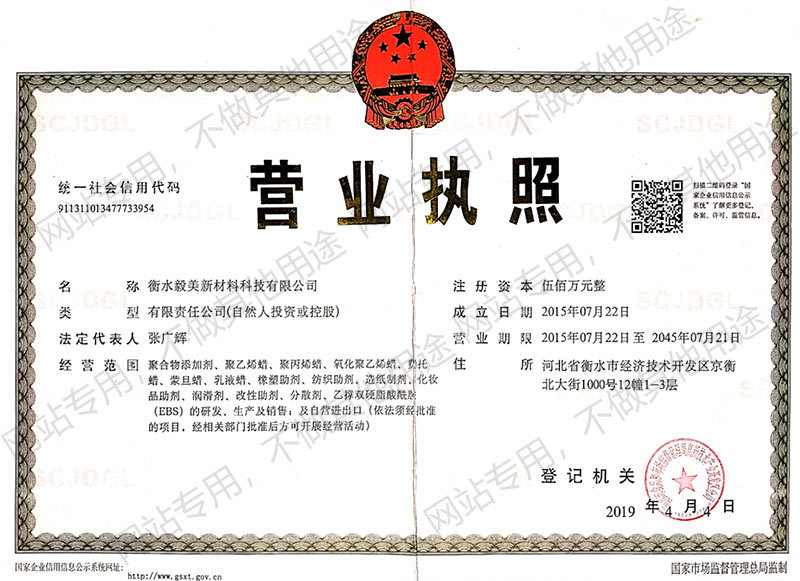
About UsHengshui yi mei new material technology co., ltd. was founded in 2015, is a collection of product development, production, sales and service as one of the high and new technology enterprises, yi mei company focused on deep processing of wax products, determined to become china's professional wax products supplier

-
ProductsThe company mainly produces and sells: polyethylene wax, oxidized polyethylene wax, synthetic Fischer-Tropsch wax, oxidized Fischer-Tropsch wax, maleic anhydride grafted wax, polypropylene wax, micro-powder wax, high-end composite wax and other eight series of dozens of models of high quality products.
-
NewsAt the beginning of its establishment, Yimei Company invested in the establishment of the "Polymer Additive R & D Center", insisting on scientific and technological innovation as the life force of enterprise development. Concentrate funds, technology, and talents in the company's scientific and technological innovation activities, focus on scientific research, public relations and technological breakthroughs of new products, new technologies, and new processes, and resolutely master core technologies.
-
SupportAt the beginning of its establishment, Yimei Company invested in the establishment of the "Polymer Additive R & D Center", insisting on scientific and technological innovation as the life force of enterprise development. Concentrate funds, technology, and talents in the company's scientific and technological innovation activities, focus on scientific research, public relations and technological breakthroughs of new products, new technologies, and new processes, and resolutely master core technologies.
-
RecruitmentOur company always adheres to the talent concept of "people-oriented", actively creates an atmosphere of respect, understanding, integrity and friendship, respects people's knowledge and talents, selects and develops mechanisms, and provides a growth platform for talents. make talents become a strong support for the sustainable development of enterprises, and realize the common growth and development of enterprises and talents.


How Fischer Tropsch Wax Revolutionizes the Manufacturing Process
Release time:
2024-08-06
How Fischer Tropsch Wax Revolutionizes the Manufacturing Process Table of Contents 1. Introduction to Fischer Tropsch Wax 2. What is Fischer Tropsch Wax? 3. History and Development of Fischer Tropsch Wax 4. Applications of Fischer Tropsch Wax in Manufacturing 5. Benefits of Using Fischer Tropsch Wax 6. Fischer Tropsch Wax vs. Traditional Waxes 7. The Future of Fischer
How Fischer Tropsch Wax Revolutionizes the Manufacturing Process
Table of Contents
- 1. Introduction to Fischer Tropsch Wax
- 2. What is Fischer Tropsch Wax?
- 3. History and Development of Fischer Tropsch Wax
- 4. Applications of Fischer Tropsch Wax in Manufacturing
- 5. Benefits of Using Fischer Tropsch Wax
- 6. Fischer Tropsch Wax vs. Traditional Waxes
- 7. The Future of Fischer Tropsch Wax in Manufacturing
- 8. Conclusion
- 9. Frequently Asked Questions
1. Introduction to Fischer Tropsch Wax
Fischer Tropsch wax has emerged as a game-changing material in various manufacturing processes. As industries strive for higher quality and efficiency, this synthetic wax offers unparalleled advantages over traditional waxes. In this article, we will explore Fischer Tropsch wax's characteristics, its applications in manufacturing, and why it is progressively revolutionizing how products are designed and produced.
2. What is Fischer Tropsch Wax?
Fischer Tropsch wax is a **synthetic wax produced through the Fischer-Tropsch synthesis**, a process that converts carbon monoxide and hydrogen into liquid hydrocarbons. This high-molecular-weight hydrocarbon can be further processed to produce waxes with specific properties tailored for various applications.
The Fischer-Tropsch process, developed in the 1920s, has evolved significantly, enabling the production of waxes that exhibit desirable characteristics such as **high melting points, excellent hardness, and low viscosity**. These features make Fischer Tropsch wax an attractive alternative in industries such as cosmetics, automotive, and construction.
3. History and Development of Fischer Tropsch Wax
The origins of Fischer Tropsch wax can be traced back to **the work of Franz Fischer and Hans Tropsch**, who pioneered the synthesis in Germany. Initially intended to create synthetic fuels, further research uncovered the potential for producing waxes with diverse applications.
With advancements in catalyst technology and process optimization, the production of Fischer Tropsch wax has become more efficient and cost-effective. By the early 2000s, manufacturers began to harness this synthetic wax in practical applications, paving the way for its widespread industrial adoption.
4. Applications of Fischer Tropsch Wax in Manufacturing
Fischer Tropsch wax has found a multitude of applications across various industries, thanks to its unique properties. Some key applications include:
4.1 Coatings and Sealants
In the coatings industry, Fischer Tropsch wax is utilized as a **functional additive** in paints and varnishes. It improves the **water resistance** and **durability** of coatings, enhancing their overall performance.
4.2 Cosmetics and Personal Care Products
Fischer Tropsch wax serves as a **thickening agent** and emollient in cosmetics. Its ability to provide a smooth texture and enhance product stability makes it a preferred choice in cream and lotion formulations.
4.3 Candle Manufacturing
The candle industry benefits from Fischer Tropsch wax due to its **clean-burning** properties and high gloss finish. Its versatility allows manufacturers to produce candles that burn longer and more evenly than those made with traditional waxes.
4.4 Adhesives
In adhesive formulations, Fischer Tropsch wax improves the **adhesion** and **flexibility** of products. It enhances the overall performance of adhesives used in various applications, from packaging to construction.
4.5 Plastics and Polymers
Fischer Tropsch wax acts as a **processing aid** in the plastics industry, improving the flow properties of polymers during manufacturing. Its use reduces friction and wear, resulting in improved efficiency and product quality.
5. Benefits of Using Fischer Tropsch Wax
The use of Fischer Tropsch wax offers numerous benefits, making it an attractive option for manufacturers:
5.1 Customizable Properties
One of the most significant advantages of Fischer Tropsch wax is its **customizability**. Manufacturers can modify the synthesis process to achieve specific melting points, viscosities, and hardness levels tailored to product requirements.
5.2 Enhanced Performance
Fischer Tropsch wax exhibits **superior performance characteristics** compared to traditional waxes. Its high melting point and low viscosity improve the stability and longevity of products across various applications.
5.3 Environmentally Friendly
Being derived from natural gas, Fischer Tropsch wax is often regarded as a more **sustainable** option. Its production process has a lower environmental impact than conventional waxes derived from petroleum or other non-renewable resources.
5.4 Improved Processing Efficiency
Fischer Tropsch wax contributes to **increased processing efficiency** in manufacturing. Its unique properties help reduce production times and improve overall product quality.
5.5 Compatibility with Other Materials
Fischer Tropsch wax is compatible with a wide range of materials, making it an excellent additive in various formulations. This compatibility enhances the functionality and performance of end products.
6. Fischer Tropsch Wax vs. Traditional Waxes
When comparing Fischer Tropsch wax to traditional waxes, several key differences emerge:
6.1 Composition
Traditional waxes, such as paraffin and beeswax, are derived from natural sources or crude oil. In contrast, Fischer Tropsch wax is a **synthetically produced** material, offering a more consistent quality.
6.2 Melting Point
Fischer Tropsch wax typically has a higher melting point than traditional waxes, allowing for greater versatility in various applications. This characteristic ensures that products maintain their integrity under higher temperatures.
6.3 Purity
Fischer Tropsch wax is known for its **high purity**, with minimal impurities compared to conventional waxes. This purity translates to better performance in formulations, especially in sensitive applications like cosmetics.
6.4 Performance
The performance of Fischer Tropsch wax often surpasses that of traditional waxes. Its **lower viscosity** and enhanced durability contribute to superior product quality and longevity.
7. The Future of Fischer Tropsch Wax in Manufacturing
As industries continue to evolve, the future of Fischer Tropsch wax looks promising. Research and development are focusing on optimizing production processes and exploring new applications.
There is a growing demand for sustainable materials, and Fischer Tropsch wax aligns perfectly with this trend. Its eco-friendly characteristics and ability to meet stringent performance standards position it well for future growth in various sectors.
Innovations in technology and manufacturing methods will further enhance the capabilities of Fischer Tropsch wax, fostering its integration into cutting-edge applications.
8. Conclusion
Fischer Tropsch wax is undeniably transforming the manufacturing landscape. Its unique properties, extensive applications, and numerous benefits make it an invaluable material in various industries. As we advance into a future that prioritizes efficiency and sustainability, the role of Fischer Tropsch wax will only become more prominent, ushering in new possibilities for manufacturers worldwide.
9. Frequently Asked Questions
1. What is the main advantage of Fischer Tropsch wax over traditional waxes?
Fischer Tropsch wax offers higher purity, customizable properties, and better performance in various applications compared to traditional waxes.
2. Is Fischer Tropsch wax environmentally friendly?
Yes, Fischer Tropsch wax is derived from natural gas, making it a more sustainable alternative to conventional waxes sourced from petroleum.
3. What industries benefit from Fischer Tropsch wax?
Industries such as cosmetics, coatings, adhesives, and plastic manufacturing utilize Fischer Tropsch wax for its unique properties and performance enhancements.
4. Can Fischer Tropsch wax be used in candle making?
Absolutely! Fischer Tropsch wax is prized in the candle industry for its clean-burning properties and ability to produce high-quality, long-lasting candles.
5. How does Fischer Tropsch wax enhance product stability?
Fischer Tropsch wax improves product stability through its unique composition, which provides excellent hardness and resistance to temperature variations, ensuring product integrity over time.
Key words:
Fischer tropsch wax
Previous article
recommend reading