Yimei New Material-Professional Wax Product Solution Supplier


-
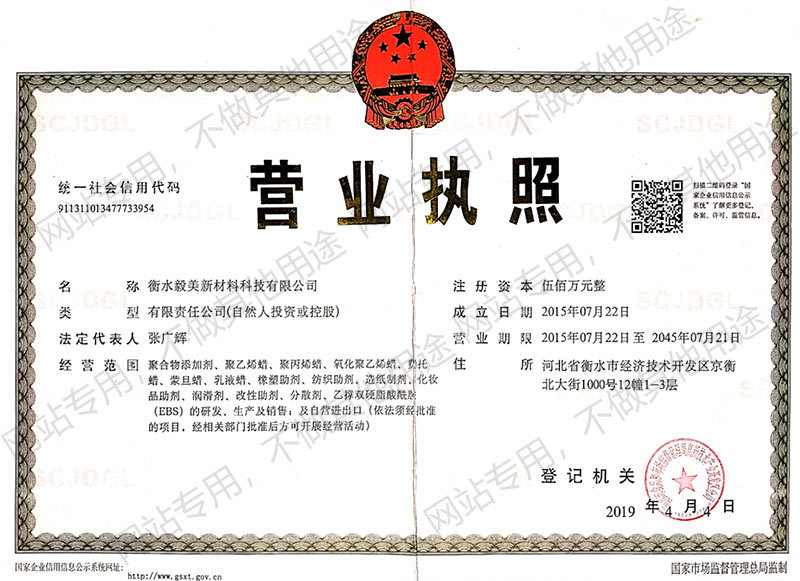
About UsHengshui yi mei new material technology co., ltd. was founded in 2015, is a collection of product development, production, sales and service as one of the high and new technology enterprises, yi mei company focused on deep processing of wax products, determined to become china's professional wax products supplier

-
ProductsThe company mainly produces and sells: polyethylene wax, oxidized polyethylene wax, synthetic Fischer-Tropsch wax, oxidized Fischer-Tropsch wax, maleic anhydride grafted wax, polypropylene wax, micro-powder wax, high-end composite wax and other eight series of dozens of models of high quality products.
-
NewsAt the beginning of its establishment, Yimei Company invested in the establishment of the "Polymer Additive R & D Center", insisting on scientific and technological innovation as the life force of enterprise development. Concentrate funds, technology, and talents in the company's scientific and technological innovation activities, focus on scientific research, public relations and technological breakthroughs of new products, new technologies, and new processes, and resolutely master core technologies.
-
SupportAt the beginning of its establishment, Yimei Company invested in the establishment of the "Polymer Additive R & D Center", insisting on scientific and technological innovation as the life force of enterprise development. Concentrate funds, technology, and talents in the company's scientific and technological innovation activities, focus on scientific research, public relations and technological breakthroughs of new products, new technologies, and new processes, and resolutely master core technologies.
-
RecruitmentOur company always adheres to the talent concept of "people-oriented", actively creates an atmosphere of respect, understanding, integrity and friendship, respects people's knowledge and talents, selects and develops mechanisms, and provides a growth platform for talents. make talents become a strong support for the sustainable development of enterprises, and realize the common growth and development of enterprises and talents.


Exploring the Diverse Applications of Fischer Tropsch Wax in the Chemical Industry
Release time:
2024-08-04
Exploring the Diverse Applications of Fischer Tropsch Wax in the Chemical Industry Table of Contents 1. Introduction to Fischer Tropsch Wax 2. Unique Properties of Fischer Tropsch Wax 3. The Production Process of Fischer Tropsch Wax 4. Diverse Applications of Fischer Tropsch Wax 4.1 Fischer Tropsch Wax in Coatings and Inks 4.2 Use in Plastics and Polymer
Exploring the Diverse Applications of Fischer Tropsch Wax in the Chemical Industry
Table of Contents
- 1. Introduction to Fischer Tropsch Wax
- 2. Unique Properties of Fischer Tropsch Wax
- 3. The Production Process of Fischer Tropsch Wax
- 4. Diverse Applications of Fischer Tropsch Wax
- 4.1 Fischer Tropsch Wax in Coatings and Inks
- 4.2 Use in Plastics and Polymer Industries
- 4.3 Applications in Cosmetics and Personal Care
- 4.4 Role in Adhesives and Sealants
- 4.5 Textile Industry Applications
- 5. Sustainability and the Future of Fischer Tropsch Wax
- 6. Frequently Asked Questions
- 7. Conclusion
1. Introduction to Fischer Tropsch Wax
Fischer Tropsch wax is a synthetic wax produced through a chemical process known as the Fischer-Tropsch synthesis. This process converts carbon monoxide and hydrogen into liquid hydrocarbons, resulting in a versatile wax that finds applications across numerous industries. Its unique chemical properties, including a high molecular weight and excellent thermal stability, make it an attractive option for manufacturers seeking to enhance their products. Understanding the diverse applications of Fischer Tropsch wax is essential for grasping its significance in the chemical industry.
2. Unique Properties of Fischer Tropsch Wax
Fischer Tropsch wax exhibits several key characteristics that distinguish it from other waxes. These properties include:
2.1 High Purity and Consistency
One of the most notable features of Fischer Tropsch wax is its remarkable purity. Unlike natural waxes, which can contain impurities, Fischer Tropsch wax is produced through a controlled process, resulting in a consistent product that meets high standards.
2.2 Excellent Thermal Stability
Fischer Tropsch wax maintains its properties at elevated temperatures, making it suitable for applications that require robustness under heat. This thermal stability ensures that products formulated with this wax can withstand various processing conditions without compromising quality.
2.3 Versatile Formulation Options
This wax can be easily modified and blended with other materials, allowing manufacturers to create customized formulations tailored to specific applications. Its adaptability further broadens its range of uses in different sectors.
3. The Production Process of Fischer Tropsch Wax
The production of Fischer Tropsch wax involves a series of carefully controlled steps, primarily utilizing the Fischer-Tropsch synthesis process. This process occurs in two main stages:
3.1 Gasification
The first stage involves gasification, where feedstock such as natural gas, coal, or biomass is converted into synthesis gas (syngas), composed of hydrogen and carbon monoxide. This step is crucial as it sets the foundation for the subsequent reactions.
3.2 Fischer-Tropsch Synthesis
The syngas is then passed over a catalyst in a reactor, typically made of iron or cobalt. Under specific conditions of temperature and pressure, the Fischer-Tropsch synthesis occurs, resulting in the formation of long-chain hydrocarbons, which are then purified to produce Fischer Tropsch wax.
Once synthesized, the wax can be further processed through hydrocracking or hydroisomerization to modify its properties according to intended applications.
4. Diverse Applications of Fischer Tropsch Wax
Fischer Tropsch wax finds its way into various applications, making it a vital component across multiple industries. Here, we explore some of its primary uses.
4.1 Fischer Tropsch Wax in Coatings and Inks
Fischer Tropsch wax significantly enhances the performance of coatings and inks. Its high melting point and excellent gloss properties make it an ideal candidate for formulations used in paints, varnishes, and printing inks. The wax improves flow, reduces viscosity, and enhances the final product's durability, leading to superior coverage and finish.
4.2 Use in Plastics and Polymer Industries
In the plastics sector, Fischer Tropsch wax serves as a processing aid and modifier. When added to plastics, it enhances slip properties, improving the surface finish and reducing friction. This wax also acts as a dispersing agent for pigments and fillers, ensuring uniform distribution and color consistency in plastic products.
4.3 Applications in Cosmetics and Personal Care
Fischer Tropsch wax has made its mark in the cosmetics and personal care industry. Its emollient properties provide a smooth and luxurious texture to creams, lotions, and lip products. Moreover, it contributes to the stability and longevity of formulations, making it an essential ingredient for high-quality cosmetic products.
4.4 Role in Adhesives and Sealants
In adhesives and sealants, Fischer Tropsch wax plays a critical role in improving adhesive performance. It enhances the flexibility and thermal stability of formulations, contributing to better adhesion and durability. This characteristic is especially valuable in demanding applications such as construction and automotive sectors, where reliable bonding is crucial.
4.5 Textile Industry Applications
The textile industry benefits from Fischer Tropsch wax through its use as a finishing agent. When applied to fabrics, it enhances water repellency, improves surface feel, and increases durability. These properties are particularly important in applications where textiles are subjected to harsh environmental conditions.
5. Sustainability and the Future of Fischer Tropsch Wax
Sustainability is a growing concern in the chemical industry, and Fischer Tropsch wax aligns well with these ideals. Its production process can utilize renewable sources, such as biomass, reducing dependence on fossil fuels and lowering carbon emissions. Moreover, Fischer Tropsch wax's versatility allows for the development of eco-friendly products, meeting the increasing demand for sustainable materials in various applications.
As industries continue to evolve, the demand for innovative and sustainable solutions will drive further research and development in Fischer Tropsch wax applications. This progress ensures that Fischer Tropsch wax will remain a significant player in the future of the chemical industry.
6. Frequently Asked Questions
6.1 What is Fischer Tropsch wax made from?
Fischer Tropsch wax is synthesized from carbon monoxide and hydrogen, typically derived from natural gas, coal, or biomass through a process called gasification.
6.2 How does Fischer Tropsch wax differ from natural waxes?
Fischer Tropsch wax is produced through a controlled process, resulting in a high-purity and consistent product, unlike natural waxes, which may contain impurities and have variable properties.
6.3 What industries use Fischer Tropsch wax?
Fischer Tropsch wax is utilized in various industries, including coatings and inks, plastics, cosmetics, adhesives, sealants, and textiles.
6.4 Is Fischer Tropsch wax environmentally friendly?
Yes, Fischer Tropsch wax can be produced using renewable feedstocks, like biomass, making it a more sustainable option in the chemical industry.
6.5 Can Fischer Tropsch wax be modified for specific applications?
Absolutely! Fischer Tropsch wax can be blended with other materials or further processed to tailor its properties for specific uses across various industries.
7. Conclusion
Fischer Tropsch wax stands out as a remarkable material with diverse applications across the chemical industry. Its unique properties, coupled with an environmentally friendly production process, make it invaluable for enhancing product quality and meeting sustainability goals. From coatings and plastics to cosmetics and textiles, Fischer Tropsch wax continues to play a pivotal role in driving innovation and improving product performance. As industries strive for greater efficiency and sustainability, the future of Fischer Tropsch wax appears promising, ensuring its lasting presence in the evolving landscape of the chemical industry.
Key words:
Fischer tropsch wax
recommend reading