Yimei New Material-Professional Wax Product Solution Supplier


-
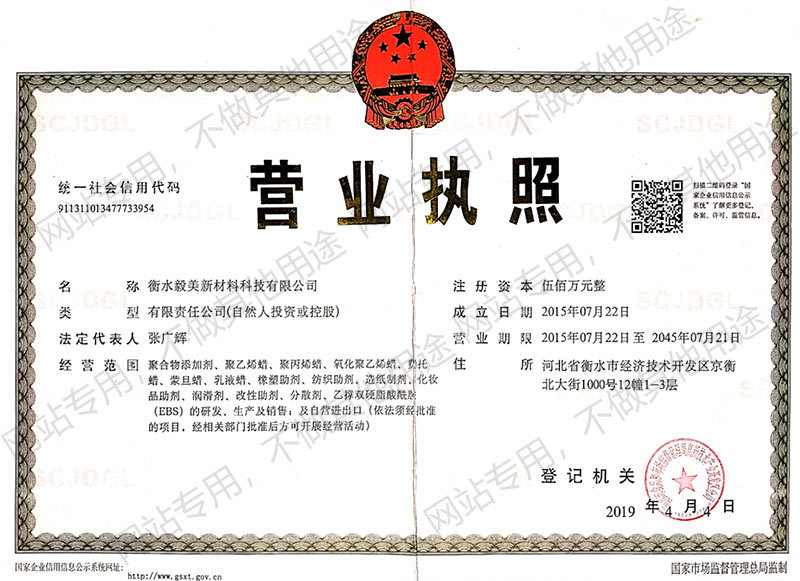
About UsHengshui yi mei new material technology co., ltd. was founded in 2015, is a collection of product development, production, sales and service as one of the high and new technology enterprises, yi mei company focused on deep processing of wax products, determined to become china's professional wax products supplier

-
ProductsThe company mainly produces and sells: polyethylene wax, oxidized polyethylene wax, synthetic Fischer-Tropsch wax, oxidized Fischer-Tropsch wax, maleic anhydride grafted wax, polypropylene wax, micro-powder wax, high-end composite wax and other eight series of dozens of models of high quality products.
-
NewsAt the beginning of its establishment, Yimei Company invested in the establishment of the "Polymer Additive R & D Center", insisting on scientific and technological innovation as the life force of enterprise development. Concentrate funds, technology, and talents in the company's scientific and technological innovation activities, focus on scientific research, public relations and technological breakthroughs of new products, new technologies, and new processes, and resolutely master core technologies.
-
SupportAt the beginning of its establishment, Yimei Company invested in the establishment of the "Polymer Additive R & D Center", insisting on scientific and technological innovation as the life force of enterprise development. Concentrate funds, technology, and talents in the company's scientific and technological innovation activities, focus on scientific research, public relations and technological breakthroughs of new products, new technologies, and new processes, and resolutely master core technologies.
-
RecruitmentOur company always adheres to the talent concept of "people-oriented", actively creates an atmosphere of respect, understanding, integrity and friendship, respects people's knowledge and talents, selects and develops mechanisms, and provides a growth platform for talents. make talents become a strong support for the sustainable development of enterprises, and realize the common growth and development of enterprises and talents.


Exploring Fischer Tropsch Wax: Applications and Properties
Release time:
2024-08-03
Fischer Tropsch wax, derived from the Fischer-Tropsch synthesis process, is a synthetic wax that boasts a range of unique properties, making it a valuable addition to various industries. This wax is produced by converting carbon monoxide and hydrogen into liquid hydrocarbons through a catalytic process. Characterized by its long-chain hydrocarbons, Fischer Tropsch wax exhibits properties that dist
Fischer Tropsch wax, derived from the Fischer-Tropsch synthesis process, is a synthetic wax that boasts a range of unique properties, making it a valuable addition to various industries. This wax is produced by converting carbon monoxide and hydrogen into liquid hydrocarbons through a catalytic process. Characterized by its long-chain hydrocarbons, Fischer Tropsch wax exhibits properties that distinguish it from natural waxes and other synthetic alternatives.
One of the key features of Fischer Tropsch wax is its high purity, which results in low viscosity and excellent stability. This purity enables it to be used in applications where cleanliness and consistency are paramount. In the chemical industry, it serves as a base material for a variety of formulations, enhancing the performance of products in sectors such as coatings, adhesives, and sealants.
In coatings, Fischer Tropsch wax can be used as a slip agent or to improve gloss and hardness. It helps in reducing friction and enhances the surface feel of finished products. Similarly, in adhesives and sealants, this wax contributes to improved adhesion properties and stability under varying environmental conditions, ensuring that the final products perform reliably over time.
Another noteworthy application of Fischer Tropsch wax is in the production of candles. Its unique properties allow for cleaner burning and improved scent throw, making it a preferred choice among manufacturers aiming for high-quality products. Additionally, its ability to blend well with other waxes and additives enhances the versatility of candle formulations.
Fischer Tropsch wax is also gaining traction in the cosmetics industry. Its emollient properties make it an excellent ingredient for formulations aimed at providing moisture retention and skin protection. By incorporating Fischer Tropsch wax, cosmetic products can achieve improved texture and application characteristics, appealing to a broader range of consumers.
Moreover, the wax is utilized in the production of specialty lubricants and greases, where its stability at elevated temperatures is a significant advantage. This characteristic ensures that machinery and equipment can operate smoothly under demanding conditions, reducing wear and tear and extending their lifespan.
As industries continue to seek sustainable and efficient alternatives, Fischer Tropsch wax stands out for its potential to replace traditional petroleum-based waxes. Its production process allows for the use of renewable resources, aligning with the growing emphasis on sustainability in modern manufacturing.
In conclusion, Fischer Tropsch wax is a versatile compound with a broad spectrum of applications across various industries. Its unique properties not only enhance product performance but also contribute to the development of innovative solutions in chemical formulations. As professionals explore the possibilities of this synthetic wax, its role in shaping the future of the chemical industry becomes increasingly prominent.
One of the key features of Fischer Tropsch wax is its high purity, which results in low viscosity and excellent stability. This purity enables it to be used in applications where cleanliness and consistency are paramount. In the chemical industry, it serves as a base material for a variety of formulations, enhancing the performance of products in sectors such as coatings, adhesives, and sealants.
In coatings, Fischer Tropsch wax can be used as a slip agent or to improve gloss and hardness. It helps in reducing friction and enhances the surface feel of finished products. Similarly, in adhesives and sealants, this wax contributes to improved adhesion properties and stability under varying environmental conditions, ensuring that the final products perform reliably over time.
Another noteworthy application of Fischer Tropsch wax is in the production of candles. Its unique properties allow for cleaner burning and improved scent throw, making it a preferred choice among manufacturers aiming for high-quality products. Additionally, its ability to blend well with other waxes and additives enhances the versatility of candle formulations.
Fischer Tropsch wax is also gaining traction in the cosmetics industry. Its emollient properties make it an excellent ingredient for formulations aimed at providing moisture retention and skin protection. By incorporating Fischer Tropsch wax, cosmetic products can achieve improved texture and application characteristics, appealing to a broader range of consumers.
Moreover, the wax is utilized in the production of specialty lubricants and greases, where its stability at elevated temperatures is a significant advantage. This characteristic ensures that machinery and equipment can operate smoothly under demanding conditions, reducing wear and tear and extending their lifespan.
As industries continue to seek sustainable and efficient alternatives, Fischer Tropsch wax stands out for its potential to replace traditional petroleum-based waxes. Its production process allows for the use of renewable resources, aligning with the growing emphasis on sustainability in modern manufacturing.
In conclusion, Fischer Tropsch wax is a versatile compound with a broad spectrum of applications across various industries. Its unique properties not only enhance product performance but also contribute to the development of innovative solutions in chemical formulations. As professionals explore the possibilities of this synthetic wax, its role in shaping the future of the chemical industry becomes increasingly prominent.
Key words:
Fischer tropsch wax
recommend reading