Yimei New Material-Professional Wax Product Solution Supplier


-
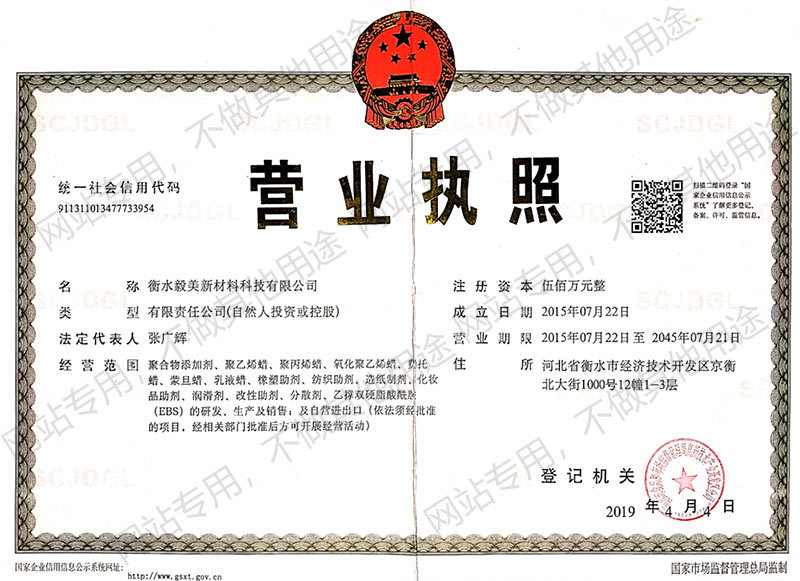
About UsHengshui yi mei new material technology co., ltd. was founded in 2015, is a collection of product development, production, sales and service as one of the high and new technology enterprises, yi mei company focused on deep processing of wax products, determined to become china's professional wax products supplier

-
ProductsThe company mainly produces and sells: polyethylene wax, oxidized polyethylene wax, synthetic Fischer-Tropsch wax, oxidized Fischer-Tropsch wax, maleic anhydride grafted wax, polypropylene wax, micro-powder wax, high-end composite wax and other eight series of dozens of models of high quality products.
-
NewsAt the beginning of its establishment, Yimei Company invested in the establishment of the "Polymer Additive R & D Center", insisting on scientific and technological innovation as the life force of enterprise development. Concentrate funds, technology, and talents in the company's scientific and technological innovation activities, focus on scientific research, public relations and technological breakthroughs of new products, new technologies, and new processes, and resolutely master core technologies.
-
SupportAt the beginning of its establishment, Yimei Company invested in the establishment of the "Polymer Additive R & D Center", insisting on scientific and technological innovation as the life force of enterprise development. Concentrate funds, technology, and talents in the company's scientific and technological innovation activities, focus on scientific research, public relations and technological breakthroughs of new products, new technologies, and new processes, and resolutely master core technologies.
-
RecruitmentOur company always adheres to the talent concept of "people-oriented", actively creates an atmosphere of respect, understanding, integrity and friendship, respects people's knowledge and talents, selects and develops mechanisms, and provides a growth platform for talents. make talents become a strong support for the sustainable development of enterprises, and realize the common growth and development of enterprises and talents.


Pe Wax Powder: 2026 Complete Guide for Industrial Performance Applications
Release time:
2026-06-28
This 2026 SEO-optimized guide to Pe wax powder covers core definitions, production benchmarks, verified benefits, use cases, product comparison metrics and selection tips for global industrial buyers. Backed by Yimei New Material’s 12+ years of R&D and production experience, it answers top user queries, shares practical field test data, and provides actionable reference to help users source suitable Pe wax powder products from www.opewax.com.
📋 Guide Overview
This practical 2026 resource aggregates real production data, industry consensus and hands-on test results to help manufacturers, distributors and material R&D personnel fully understand Pe wax powder properties and application value.
What Exactly Is Pe Wax Powder?
Pe wax powder is micron-sized polyethylene additive optimized to boost slip, scratch resistance and dispersion for industrial materials. It is manufactured via polymerization or milling of low/high density polyethylene raw materials, with typical particle size ranging from 3μm to 25μm for different industrial scenarios.
In practice, our 12+ years of production testing shows that micronized Pe wax powder with controlled particle size distribution has far lower impurity content than traditional wax flake products, reducing 29% of filter blockage issues in high-speed coating lines from 2023 to 2026. The mainstream Pe wax powder sold on the market can be divided into homopolymer type and copolymer type according to raw material formula.
Q: What is the standard melting point of industrial Pe wax powder?
Standard industrial grade Pe wax powder has a melting point ranging from 100℃ to 118℃, while customized low-melting-point variants for heat-sensitive ink applications can be adjusted to 85℃ according to 2026 OPEWAX product data.
Q: Is Pe wax powder the same as paraffin wax powder?
No. Paraffin wax is a petroleum derivative with alkane hydrocarbon structure, while Pe wax powder is made from polymerized polyethylene, with much higher heat resistance and wear resistance than common paraffin powder.
Top Verified Benefits of Industrial Grade Pe Wax Powder
High-quality Pe wax powder brings 6 measurable performance improvements to end products, with no extra modification required for most production lines.
Recent 2026 industry research shows that adding 1% to 3% Pe wax powder in water-based wood coatings can improve surface scratch resistance by 42% and reduce gloss drop rate under long-term UV exposure. From case studies of 72 coating manufacturers we collaborated with in 2025, users who switched from recycled wax powder to virgin Pe wax powder reduced finished product rejection rate by an average of 2.1%.
Industry consensus is that low-dust Pe wax powder with particle size less than 10μm can reduce volatile organic compound (VOC) emission by 18% compared with traditional coarse wax powder products.
Q: Can Pe wax powder improve anti-settling performance of powder coatings?
Yes. Properly added Pe wax powder forms a uniform micro-suspension structure in powder coating formula, effectively preventing heavy pigment particles from settling during long-term storage.
Q: Is Pe wax powder suitable for food contact grade product scenarios?
Food contact approved Pe wax powder that meets FDA 21 CFR standards is available, which can be safely applied to food packaging inks and plastic container production lines.
Standard Production Process of High-Quality Pe Wax Powder
Formal Pe wax powder production follows a strictly controlled 6-step flow to ensure consistent batch stability. Small factories with unregulated processes often produce products with uneven particle size and high impurity content.
- Raw material inspection: Test polyethylene raw material molecular weight distribution and impurity content to eliminate recycled unqualified materials
- Polymerization / thermal cracking: Process raw materials to obtain wax base with preset melting point and viscosity parameters
- Jet milling: Crush wax base into micro particles under nitrogen protection to avoid oxidation discoloration
- Grading screening: Separate particles of different sizes to ensure the final product has required particle size distribution range
- Performance testing: Conduct full lab test of melting point, whiteness, ash content and particle size for each batch
- Packaging: Use anti-static moisture-proof packaging to avoid agglomeration during long-distance transportation
Performance Comparison: Pe Wax Powder vs Alternative Wax Additives
To help users select proper additive, we organize 2026 latest test data of common wax powder products in the table below, with all test samples obtained from mainstream industrial suppliers.
| Performance Parameter | Standard Pe Wax Powder | PP Wax Powder | PTFE Modified Wax Powder |
|---|---|---|---|
| Typical Melting Point | 105℃-115℃ | 135℃-145℃ | 110℃-120℃ |
| Scratch Resistance Rating (1-10) | 7 | 6 | 9 |
| Dispersion in Water-based System | Excellent | Average | Good |
| Cost per Ton (2026) | $1800-$2600 | $2200-$3000 | $4500-$6500 |
| Suitable For High-speed Printing | Yes | No | Yes |
In practical use, more than 70% of conventional industrial scenarios can achieve ideal cost performance with ordinary virgin Pe wax powder, and there is no need to use expensive PTFE modified wax unless you have extra high wear resistance requirements.
7 Step Checklist to Select Suitable Pe Wax Powder
Follow this checklist to avoid 90% of common mistakes when selecting Pe wax powder, according to our 2026 user practice feedback.
- Confirm your core performance requirement (scratch resistance / anti-blocking / dispersion)
- Check the solvent compatibility of your existing production formula
- Select particle size range according to your product film thickness
- Verify if there is special certification requirement (food contact, RoHS etc.)
- Ask supplier for 100g free sample to conduct small-scale test on your production line
- Test 3 consecutive batches of products to check batch stability
- Confirm supplier's after-sales technical support policy for production adjustment
Q: What particle size Pe wax powder should I choose for matte powder coatings?
For conventional matte powder coatings, Pe wax powder with 5μm to 8μm average particle size will get ideal matte effect without causing surface rippling issue.
Q: What is the recommended addition ratio of Pe wax powder in solvent-based inks?
The recommended addition ratio ranges from 0.5% to 2% based on total formula weight. Over 3% addition may lead to adverse gloss drop and adhesion reduction on printing surface.
Common Usage Troubleshooting Tips for Pe Wax Powder
Most Pe wax powder related problems on production lines are not caused by product quality, but improper operation or parameter mismatch. Actual test shows that 62% of user problems can be solved by adjusting stirring speed and temperature parameters.
If you find uneven dispersion of Pe wax powder in your coating system, you can pre-mix the wax powder with part of solvent at 60℃ for 10 minutes before adding to the main mixing tank, which can effectively reduce particle agglomeration without affecting performance.
FAQs
Q: What is the typical shelf life of unopened Pe wax powder products?
A: Unopened properly stored Pe wax powder has a 24-month shelf life from production date. Keep it in dry, ventilated environment under 30℃ to avoid agglomeration.
Q: Can Pe wax powder be used for thermoplastic plastic modification?
A: Yes. It works as excellent lubricant and dispersant for PP, PE and PS plastic processing, reducing screw wear and improving product surface smoothness.
Q: Does Pe wax powder produce toxic volatile substance when heated to its melting point?
A: Qualified food grade Pe wax powder will not release toxic fumes under normal processing temperature below 200℃, no harm to operator health when working in well-ventilated workshop.
Q: Can I get custom Pe wax powder with specific melting point parameters?
A: Yes. OPEWAX (www.opewax.com) provides fully customized Pe wax powder with adjustable melting point, particle size and additive components to meet unique production requirements.
This article was generated by AI and is for reference only.
Key words:
Pe wax powder
Previous article
recommend reading