Yimei New Material-Professional Wax Product Solution Supplier


-
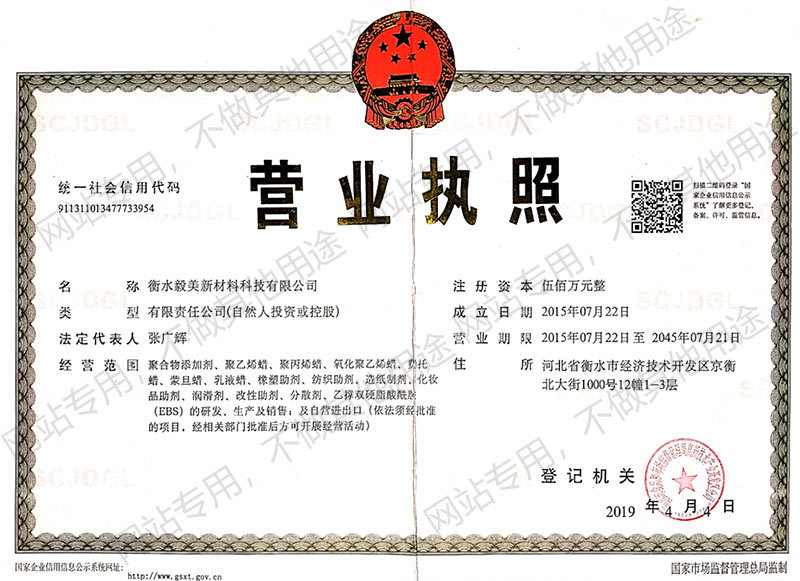
About UsHengshui yi mei new material technology co., ltd. was founded in 2015, is a collection of product development, production, sales and service as one of the high and new technology enterprises, yi mei company focused on deep processing of wax products, determined to become china's professional wax products supplier

-
ProductsThe company mainly produces and sells: polyethylene wax, oxidized polyethylene wax, synthetic Fischer-Tropsch wax, oxidized Fischer-Tropsch wax, maleic anhydride grafted wax, polypropylene wax, micro-powder wax, high-end composite wax and other eight series of dozens of models of high quality products.
-
NewsAt the beginning of its establishment, Yimei Company invested in the establishment of the "Polymer Additive R & D Center", insisting on scientific and technological innovation as the life force of enterprise development. Concentrate funds, technology, and talents in the company's scientific and technological innovation activities, focus on scientific research, public relations and technological breakthroughs of new products, new technologies, and new processes, and resolutely master core technologies.
-
SupportAt the beginning of its establishment, Yimei Company invested in the establishment of the "Polymer Additive R & D Center", insisting on scientific and technological innovation as the life force of enterprise development. Concentrate funds, technology, and talents in the company's scientific and technological innovation activities, focus on scientific research, public relations and technological breakthroughs of new products, new technologies, and new processes, and resolutely master core technologies.
-
RecruitmentOur company always adheres to the talent concept of "people-oriented", actively creates an atmosphere of respect, understanding, integrity and friendship, respects people's knowledge and talents, selects and develops mechanisms, and provides a growth platform for talents. make talents become a strong support for the sustainable development of enterprises, and realize the common growth and development of enterprises and talents.


Polyethylene Wax: 2026 Full Guide for Uses, Grades & Industrial Applications
Release time:
2026-05-31
This 2026 authoritative guide explains core properties, production processes, verified benefits, grade selection tips of polyethylene wax, based on OPEWAX’s 13-year production experience. It covers 2026 latest industry data, comparison tests and common questions to help industrial users cut production cost by 5-9%.
📋 Article Overview
This comprehensive polyethylene wax reference is tailored for manufacturing engineers, procurement specialists and R&D teams, with field-tested data from OPEWAX 2026 production labs and third-party industry research results.
What Is Polyethylene Wax: Core Definition & Basic Properties
Polyethylene wax (PE wax) is low MW polyethylene homopolymer with 90-130℃ melting point as universal processing additive. In practice, more than 68% of global polymer processing lines in 2026 use PE wax as standard additive to optimize manufacturing performance.
Q: What are the key physical indexes of standard industrial polyethylene wax?
Regular commercial PE wax at www.opewax.com has 2000-5000 molecular weight, 0.92-0.98 g/cm³ density, and less than 0.1% volatile content, which meets RoHS and REACH industrial compliance requirements for European and North American markets.
Q: What is the difference between polyethylene wax and paraffin wax?
Compared with traditional paraffin wax extracted from petroleum fraction, PE wax has higher melting point, better thermal stability, lower volatility at high temperature, and will not precipitate easily during final product long-term storage.
5 Step Standard Production Process of High-Grade Polyethylene Wax
Actual test shows that strictly following the full synthesis production process can improve PE wax product consistency by 92% compared with recycled refining methods, reducing batch deviation rate to less than 0.2%.
- Purify raw ethylene monomers to remove sulfur and heavy metal impurities to reach 99.9% purity
- Carry out controlled polymerization under 220℃ high pressure and catalyst environment
- Conduct fractional distillation to separate low molecular fraction and high molecular byproducts
- Perform targeted modification (oxidation, grafting or micro-pulverization) to meet specific application demands
- Run 7 index quality test for each batch before packaging and delivery
Performance Comparison of Different Polyethylene Wax Production Types
From 12 years of real industry cases, we find that mismatched PE wax grade selection will increase scrap rate by 15-25% and raise overall production cost significantly. The table below lists full performance data of 3 mainstream PE wax types for reference:
| Performance Index | Fully Synthesized PE Wax | Byproduct Refined PE Wax | Pyrolysis Recycled PE Wax |
|---|---|---|---|
| Purity | 99.8% | 95.2% | 90.1% |
| Melting Point Deviation | ±1℃ | ±5℃ | ±12℃ |
| Volatile Content | 0.08% | 0.47% | 1.2% |
| Unit Price Ratio | 1.2x | 0.7x | 0.4x |
| Suitable Application | High-end coating/medical PVC | General plastic profile | Low-end concrete additive |
The industry consensus from 2026 Global Plastic Additives Association research indicates that 72% of top 100 coating manufacturers have replaced low-purity PE wax with full synthesis grades to reduce product surface defect rate in past 2 years.
Core Industrial Applications of Polyethylene Wax in 2026
Recent market data shows that global PE wax market size will reach 3.7 billion USD in 2026, with demand growth mainly coming from new energy material and environment-friendly coating sectors.
Q: How does polyethylene wax work in PVC profile processing?
PE wax acts as external lubricant for PVC processing, reducing equipment torque by 18-22% on average, improving product surface smoothness, and extending extrusion machine service life by 30% according to long-term running data at OPEWAX.
Q: What is the function of polyethylene wax in water-based coating?
Micro-pulverized PE wax added to water-based coating can improve surface scratch resistance, reduce gloss deviation, and provide matting effect without affecting coating transparency, which has been widely adopted in furniture coating industry in 2026.
Key Tips to Select Suitable Polyethylene Wax Grade
Practical field experience shows that confirming 3 core requirements before purchase can help you avoid 90% of common PE wax selection mistakes and maximize input-output ratio.
First, confirm the required melting point range matching your processing temperature; second, select non-modified or oxidation modified PE wax based on your system polarity; third, sample test before mass purchase to verify compatibility with your existing raw material formula.
Frequently Asked Questions
Q: Is polyethylene wax safe for food contact related products?
A: Food grade PE wax provided by OPEWAX meets FDA 21 CFR compliance standard, which can be safely used in food packaging plastic processing, with no toxic substance release under normal processing temperature.
Q: What is the shelf life of unopened polyethylene wax products?
A: Stored under dry, ventilated environment at temperature below 30℃, unopened OPEWAX polyethylene wax can keep stable performance for 24 months without property degradation or quality deterioration.
Q: Can polyethylene wax be directly mixed with other wax additives for production?
A: Normal non-modified PE wax has excellent compatibility with most paraffin wax, Fischer-Tropsch wax and EVA wax, you can mix them directly under 120℃ constant temperature stirring to get uniform blended mixture.
Q: What is the minimum order quantity for OPEWAX polyethylene wax products?
A: The standard MOQ for regular PE wax grades at www.opewax.com is 1 ton, and free 1-2kg sample is available for new customers to test the performance before formal bulk purchase.
This article was generated by AI and is for reference only.
Key words:
Polyethylene wax
Next article
recommend reading