Yimei New Material-Professional Wax Product Solution Supplier


-
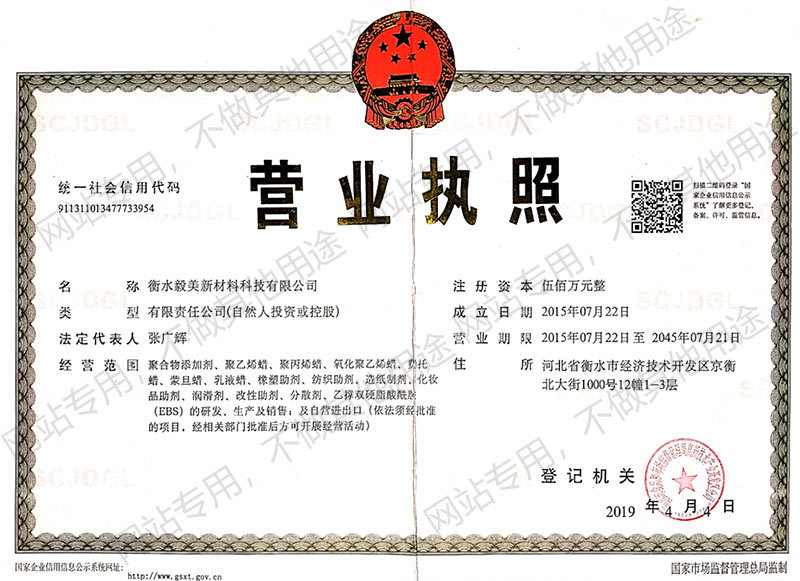
About UsHengshui yi mei new material technology co., ltd. was founded in 2015, is a collection of product development, production, sales and service as one of the high and new technology enterprises, yi mei company focused on deep processing of wax products, determined to become china's professional wax products supplier

-
ProductsThe company mainly produces and sells: polyethylene wax, oxidized polyethylene wax, synthetic Fischer-Tropsch wax, oxidized Fischer-Tropsch wax, maleic anhydride grafted wax, polypropylene wax, micro-powder wax, high-end composite wax and other eight series of dozens of models of high quality products.
-
NewsAt the beginning of its establishment, Yimei Company invested in the establishment of the "Polymer Additive R & D Center", insisting on scientific and technological innovation as the life force of enterprise development. Concentrate funds, technology, and talents in the company's scientific and technological innovation activities, focus on scientific research, public relations and technological breakthroughs of new products, new technologies, and new processes, and resolutely master core technologies.
-
SupportAt the beginning of its establishment, Yimei Company invested in the establishment of the "Polymer Additive R & D Center", insisting on scientific and technological innovation as the life force of enterprise development. Concentrate funds, technology, and talents in the company's scientific and technological innovation activities, focus on scientific research, public relations and technological breakthroughs of new products, new technologies, and new processes, and resolutely master core technologies.
-
RecruitmentOur company always adheres to the talent concept of "people-oriented", actively creates an atmosphere of respect, understanding, integrity and friendship, respects people's knowledge and talents, selects and develops mechanisms, and provides a growth platform for talents. make talents become a strong support for the sustainable development of enterprises, and realize the common growth and development of enterprises and talents.


Enhance Product Performance with Lead Based Compound Stabilizers: A Comprehensive Guide
Release time:
2024-10-12
In the chemical industry, the quest for enhanced product performance is never-ending. One critical aspect of achieving this goal lies in the use of compound stabilizers. Among these, lead-based compound stabilizers have proven to be effective in improving the durability, stability, and overall performance of various products. This article delves into the significance, advantages, and applications of lead-based stabilizers, offering insights into how they can enhance chemical products.
In the chemical industry, the quest for enhanced product performance is never-ending. One critical aspect of achieving this goal lies in the use of compound stabilizers. Among these, lead-based compound stabilizers have proven to be effective in improving the durability, stability, and overall performance of various products. This article delves into the significance, advantages, and applications of lead-based stabilizers, offering insights into how they can enhance chemical products.
Lead-based compound stabilizers are additives used in the formulation of various chemical products to improve their stability and performance. These stabilizers work primarily by preventing degradation caused by heat, light, and other environmental factors. They are commonly used in plastics, coatings, and rubber products, offering unique properties that enhance the longevity and functionality of the finished products.
One of the primary benefits of lead-based stabilizers is their ability to enhance the durability of products. By preventing chemical reactions that lead to degradation, these stabilizers ensure that materials can withstand wear and tear over extended periods. This durability is crucial for applications in demanding environments, where product failure can lead to significant costs and safety concerns.
Lead-based stabilizers excel in high-temperature applications. Many materials, particularly polymers, can lose structural integrity when exposed to elevated temperatures. Lead-based stabilizers help maintain the performance of these materials, ensuring that they retain their properties even in challenging conditions. This makes them indispensable in industries such as automotive and aerospace, where temperature fluctuations can be extreme.
Another significant advantage of lead-based stabilizers is their compatibility with a variety of other materials. This compatibility allows manufacturers to formulate products without compromising on quality or performance. By integrating lead-based stabilizers into their formulations, companies can achieve optimal results in terms of processability and final product attributes.
In the plastics industry, lead-based stabilizers are widely used to improve the stability and longevity of plastic products. They help maintain color and clarity while preventing the degradation that can occur due to UV exposure or heat. This makes them particularly useful in outdoor applications, such as automotive parts and construction materials, where exposure to the elements is a constant concern.
Lead-based stabilizers are also essential in the formulation of coatings. These stabilizers help ensure that coatings maintain their adhesion, flexibility, and resistance to weathering over time. By incorporating lead-based stabilizers into coatings, manufacturers can provide products that offer superior performance and durability, making them ideal for use in industrial and consumer applications.
In rubber manufacturing, lead-based stabilizers contribute to improved physical properties, such as tensile strength and elasticity. These stabilizers help prevent the deterioration of rubber products caused by heat and oxidation, ensuring they perform optimally in a range of applications, from tires to industrial seals.
While lead-based stabilizers offer numerous benefits, it is essential to consider their environmental impact. Concerns surrounding lead exposure have led to increased scrutiny and regulation of lead-based products. Manufacturers are encouraged to adopt best practices to minimize environmental risks associated with lead. The industry is also exploring alternative stabilizers that can provide similar performance benefits without the risks associated with lead.
The future of lead-based compound stabilizers is likely to be shaped by regulatory changes, technological advancements, and evolving market demands. As industries push for safer and more sustainable practices, manufacturers may need to adapt their use of lead-based stabilizers. Research into alternative stabilizers that maintain the performance benefits of lead without the associated risks will likely be a focus in the coming years.
Lead-based compound stabilizers play a pivotal role in enhancing the performance of various chemical products. Their unique properties contribute to improved durability, stability, and compatibility with other materials, making them invaluable in industries where product integrity is paramount. While considerations regarding environmental safety are essential, the ongoing advancements in stabilizer technology and regulatory compliance will continue to shape the future of these compounds. Manufacturers seeking to enhance their product performance should consider the advantages of incorporating lead-based stabilizers into their formulations, ensuring that they meet modern standards while delivering quality and reliability.
Key words:
Lead Based Compound Stabilizer
Next article
recommend reading