Yimei New Material-Professional Wax Product Solution Supplier


-
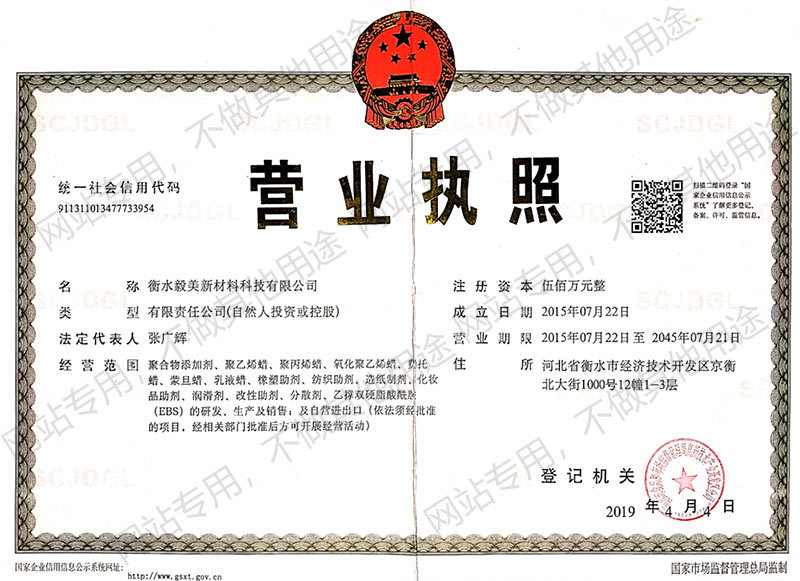
About UsHengshui yi mei new material technology co., ltd. was founded in 2015, is a collection of product development, production, sales and service as one of the high and new technology enterprises, yi mei company focused on deep processing of wax products, determined to become china's professional wax products supplier

-
ProductsThe company mainly produces and sells: polyethylene wax, oxidized polyethylene wax, synthetic Fischer-Tropsch wax, oxidized Fischer-Tropsch wax, maleic anhydride grafted wax, polypropylene wax, micro-powder wax, high-end composite wax and other eight series of dozens of models of high quality products.
-
NewsAt the beginning of its establishment, Yimei Company invested in the establishment of the "Polymer Additive R & D Center", insisting on scientific and technological innovation as the life force of enterprise development. Concentrate funds, technology, and talents in the company's scientific and technological innovation activities, focus on scientific research, public relations and technological breakthroughs of new products, new technologies, and new processes, and resolutely master core technologies.
-
SupportAt the beginning of its establishment, Yimei Company invested in the establishment of the "Polymer Additive R & D Center", insisting on scientific and technological innovation as the life force of enterprise development. Concentrate funds, technology, and talents in the company's scientific and technological innovation activities, focus on scientific research, public relations and technological breakthroughs of new products, new technologies, and new processes, and resolutely master core technologies.
-
RecruitmentOur company always adheres to the talent concept of "people-oriented", actively creates an atmosphere of respect, understanding, integrity and friendship, respects people's knowledge and talents, selects and develops mechanisms, and provides a growth platform for talents. make talents become a strong support for the sustainable development of enterprises, and realize the common growth and development of enterprises and talents.


Exploring the Applications and Benefits of Oxidized Polyethylene Wax
Release time:
2024-12-11
Oxidized polyethylene wax is a high-performance polymer that is derived from polyethylene through an oxidation process. This transformation introduces functional groups that enhance its properties, making it suitable for a wide range of applications. One of the most notable characteristics of oxidized polyethylene wax is its excellent lubricating properties, which make it a preferred additive in t
Oxidized polyethylene wax is a high-performance polymer that is derived from polyethylene through an oxidation process. This transformation introduces functional groups that enhance its properties, making it suitable for a wide range of applications. One of the most notable characteristics of oxidized polyethylene wax is its excellent lubricating properties, which make it a preferred additive in the production of various materials.
In the plastics industry, oxidized polyethylene wax is commonly used as a processing aid. It improves the flow of molten plastics during manufacturing, thus enhancing the final product's quality. By reducing friction between the polymer and the processing equipment, it helps in minimizing wear and tear, ultimately leading to increased production efficiency. This wax is particularly beneficial in applications involving high-temperature processing, where it maintains its properties and effectiveness.
Another important application of oxidized polyethylene wax is in the paint and coatings industry. Its incorporation into formulations can improve the gloss and hardness of the coatings, providing a more durable finish. Additionally, it acts as a dispersing agent, helping to evenly distribute pigments and fillers within the formulation. This can lead to better color consistency and improved overall performance of the final product.
In the realm of cosmetics and personal care products, oxidized polyethylene wax serves as a binder and thickener. Its unique properties contribute to the stability and texture of creams, lotions, and other formulations. The wax can help in achieving the desired viscosity while also enhancing the product's overall sensory experience, making it smoother and more appealing to consumers.
Furthermore, oxidized polyethylene wax is utilized in the asphalt industry as an additive to modify the properties of asphalt mixtures. It can enhance the workability and adhesion of the asphalt, improving its performance in various weather conditions. This application is particularly important for extending the lifespan of road surfaces and reducing maintenance costs.
In summary, oxidized polyethylene wax is a versatile additive with a wide array of applications across different industries. Its unique properties, such as lubricity, binding capability, and stabilization, make it an essential component in manufacturing processes. As industries continue to seek ways to improve efficiency and product performance, the use of oxidized polyethylene wax is likely to grow, providing valuable benefits to manufacturers and consumers alike. Understanding its applications can help professionals make informed decisions on how to incorporate this material into their products effectively.
In the plastics industry, oxidized polyethylene wax is commonly used as a processing aid. It improves the flow of molten plastics during manufacturing, thus enhancing the final product's quality. By reducing friction between the polymer and the processing equipment, it helps in minimizing wear and tear, ultimately leading to increased production efficiency. This wax is particularly beneficial in applications involving high-temperature processing, where it maintains its properties and effectiveness.
Another important application of oxidized polyethylene wax is in the paint and coatings industry. Its incorporation into formulations can improve the gloss and hardness of the coatings, providing a more durable finish. Additionally, it acts as a dispersing agent, helping to evenly distribute pigments and fillers within the formulation. This can lead to better color consistency and improved overall performance of the final product.
In the realm of cosmetics and personal care products, oxidized polyethylene wax serves as a binder and thickener. Its unique properties contribute to the stability and texture of creams, lotions, and other formulations. The wax can help in achieving the desired viscosity while also enhancing the product's overall sensory experience, making it smoother and more appealing to consumers.
Furthermore, oxidized polyethylene wax is utilized in the asphalt industry as an additive to modify the properties of asphalt mixtures. It can enhance the workability and adhesion of the asphalt, improving its performance in various weather conditions. This application is particularly important for extending the lifespan of road surfaces and reducing maintenance costs.
In summary, oxidized polyethylene wax is a versatile additive with a wide array of applications across different industries. Its unique properties, such as lubricity, binding capability, and stabilization, make it an essential component in manufacturing processes. As industries continue to seek ways to improve efficiency and product performance, the use of oxidized polyethylene wax is likely to grow, providing valuable benefits to manufacturers and consumers alike. Understanding its applications can help professionals make informed decisions on how to incorporate this material into their products effectively.
Key words:
oxidized polyethylene wax
recommend reading