Yimei New Material-Professional Wax Product Solution Supplier


-
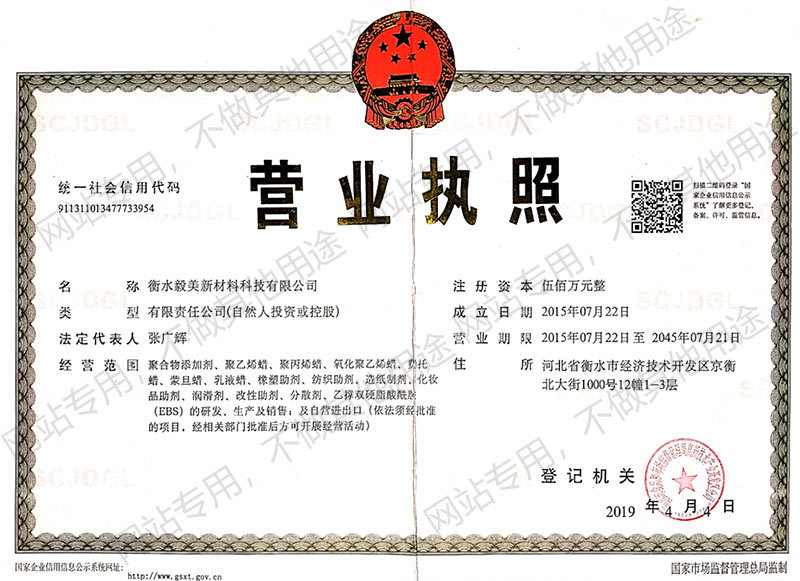
About UsHengshui yi mei new material technology co., ltd. was founded in 2015, is a collection of product development, production, sales and service as one of the high and new technology enterprises, yi mei company focused on deep processing of wax products, determined to become china's professional wax products supplier

-
ProductsThe company mainly produces and sells: polyethylene wax, oxidized polyethylene wax, synthetic Fischer-Tropsch wax, oxidized Fischer-Tropsch wax, maleic anhydride grafted wax, polypropylene wax, micro-powder wax, high-end composite wax and other eight series of dozens of models of high quality products.
-
NewsAt the beginning of its establishment, Yimei Company invested in the establishment of the "Polymer Additive R & D Center", insisting on scientific and technological innovation as the life force of enterprise development. Concentrate funds, technology, and talents in the company's scientific and technological innovation activities, focus on scientific research, public relations and technological breakthroughs of new products, new technologies, and new processes, and resolutely master core technologies.
-
SupportAt the beginning of its establishment, Yimei Company invested in the establishment of the "Polymer Additive R & D Center", insisting on scientific and technological innovation as the life force of enterprise development. Concentrate funds, technology, and talents in the company's scientific and technological innovation activities, focus on scientific research, public relations and technological breakthroughs of new products, new technologies, and new processes, and resolutely master core technologies.
-
RecruitmentOur company always adheres to the talent concept of "people-oriented", actively creates an atmosphere of respect, understanding, integrity and friendship, respects people's knowledge and talents, selects and develops mechanisms, and provides a growth platform for talents. make talents become a strong support for the sustainable development of enterprises, and realize the common growth and development of enterprises and talents.

Improving Barrier Properties with Oxidized PE Wax in Films: A Comprehensive Guide
Release time:
2024-09-21
Introduction to Barrier Properties in Films Barrier properties are crucial in various industries, particularly in packaging, where they protect products from environmental factors such as moisture, gases, and contaminants. **Oxidized polyethylene (PE) wax** has emerged as a game-changer in enhancing these properties. This article will explore how oxidized PE wax improves barrier performance in fil
Introduction to Barrier Properties in Films
Barrier properties are crucial in various industries, particularly in packaging, where they protect products from environmental factors such as moisture, gases, and contaminants. **Oxidized polyethylene (PE) wax** has emerged as a game-changer in enhancing these properties. This article will explore how oxidized PE wax improves barrier performance in films, making it an essential component in modern packaging solutions.
Understanding Oxidized PE Wax
Oxidized PE wax is a derivative of polyethylene, modified through oxidation processes to introduce functional groups that enhance its performance in various applications.
What is Oxidized PE Wax?
Oxidized PE wax is created by subjecting polyethylene wax to oxidative conditions, resulting in a product with improved polarity and functionality. This modification increases its compatibility with other materials, making it a valuable additive in film formulations.
Properties of Oxidized PE Wax
The properties of oxidized PE wax play a vital role in its effectiveness as a barrier enhancer:
- **Increased Polarity**: The oxidation process introduces polar functional groups, allowing for better adhesion to other polymers.
- **High Thermal Stability**: Oxidized PE wax can withstand various processing temperatures, maintaining its integrity during film production.
- **Excellent Compatibility**: It blends well with a range of polymers, making it versatile for different film applications.
The Importance of Barrier Properties in Films
Barrier properties are essential for maintaining the quality and safety of packaged products. Inadequate barrier performance can lead to spoilage, contamination, and loss of product integrity.
Moisture Barrier Properties
Moisture can degrade products, especially in food packaging. Films with superior moisture barrier properties help prolong shelf life by preventing water vapor transmission.
Gas Barrier Properties
Gas permeability is another critical factor, particularly for sensitive products. Films that effectively block gases like oxygen and carbon dioxide prevent oxidation and maintain product freshness.
How Oxidized PE Wax Enhances Barrier Properties
Oxidized PE wax enhances barrier properties in films through several mechanisms:
Improved Film Structure
The incorporation of oxidized PE wax into film formulations can lead to a more cohesive structure. This improved morphology minimizes voids and defects, ultimately enhancing barrier performance.
Increased Compatibility with Other Polymers
Due to its polar nature, oxidized PE wax can bond more effectively with various polymers, leading to enhanced adhesion and reduced permeation rates.
Reduction of Crystallinity
Oxidized PE wax can also reduce the crystallinity of the film, which can enhance its barrier properties by creating a denser and more uniform film matrix.
Applications of Oxidized PE Wax in Film Production
The versatility of oxidized PE wax makes it suitable for various applications across different industries.
Food Packaging
In food packaging, oxidized PE wax is widely used to improve moisture and gas barrier properties, ensuring product freshness and safety.
Cosmetic and Pharmaceutical Packaging
For cosmetics and pharmaceuticals, maintaining product integrity is crucial. Films enhanced with oxidized PE wax provide the necessary barriers against moisture and oxygen, extending shelf life.
Industrial Applications
In industrial applications, films incorporated with oxidized PE wax can offer protection against harsh environmental conditions, making them ideal for packaging machinery parts or chemical products.
Formulation Techniques for Incorporating Oxidized PE Wax
Integrating oxidized PE wax into film formulations requires careful consideration of processing techniques.
Blending Methods
Blending oxidized PE wax with other polymers can be achieved through several methods, including melt blending and solvent blending.
Melt Blending
This method involves melting the polymers and oxidized PE wax together, ensuring uniform dispersion throughout the film.
Solvent Blending
In solvent blending, the oxidized PE wax is dissolved in a suitable solvent before being mixed with the polymer solution. This technique allows for better control over the dispersion of the wax.
Processing Conditions
Optimizing processing conditions is essential for maximizing the benefits of oxidized PE wax. Factors such as temperature, shear rate, and cooling conditions can significantly influence the final film properties.
Future Trends in Barrier Film Technology
The demand for enhanced barrier properties continues to grow, driven by consumer expectations for longer shelf life and product safety.
Innovations in Polymer Science
Ongoing research in polymer science aims to develop new formulations that combine oxidized PE wax with other innovative materials, improving barrier performance even further.
Sustainability Considerations
As sustainability becomes increasingly important, the future of film technology may involve biodegradable options that still provide excellent barrier properties.
FAQs about Oxidized PE Wax and Barrier Properties
1. What is the primary benefit of using oxidized PE wax in films?
The primary benefit is the significant improvement in moisture and gas barrier properties, which enhances product protection and shelf life.
2. How does oxidized PE wax compare to other barrier materials?
Oxidized PE wax offers excellent compatibility with various polymers and improves adhesion, making it a versatile choice compared to other barrier materials.
3. Can oxidized PE wax be used in biodegradable films?
Yes, research is ongoing to develop biodegradable films that incorporate oxidized PE wax while maintaining barrier performance.
4. What industries benefit the most from oxidized PE wax in films?
Industries such as food packaging, cosmetics, pharmaceuticals, and industrial applications benefit significantly from the enhanced barrier properties provided by oxidized PE wax.
5. What processing techniques are recommended for incorporating oxidized PE wax?
Both melt blending and solvent blending are effective techniques for incorporating oxidized PE wax into film formulations.
Conclusion
In conclusion, oxidized polyethylene wax plays a pivotal role in enhancing the barrier properties of films across various applications. Its ability to improve moisture and gas resistance, combined with its compatibility with multiple polymers, makes it an invaluable additive in packaging solutions. As we move towards a more sustainable future, the continued innovation in barrier film technology will likely lead to even greater advancements in product protection and longevity. Embracing oxidized PE wax in film formulations is not just about improved performance; it’s about meeting the evolving needs of consumers and industries alike.
Key words:
Oxidized PE wax
recommend reading