Yimei New Material-Professional Wax Product Solution Supplier


-
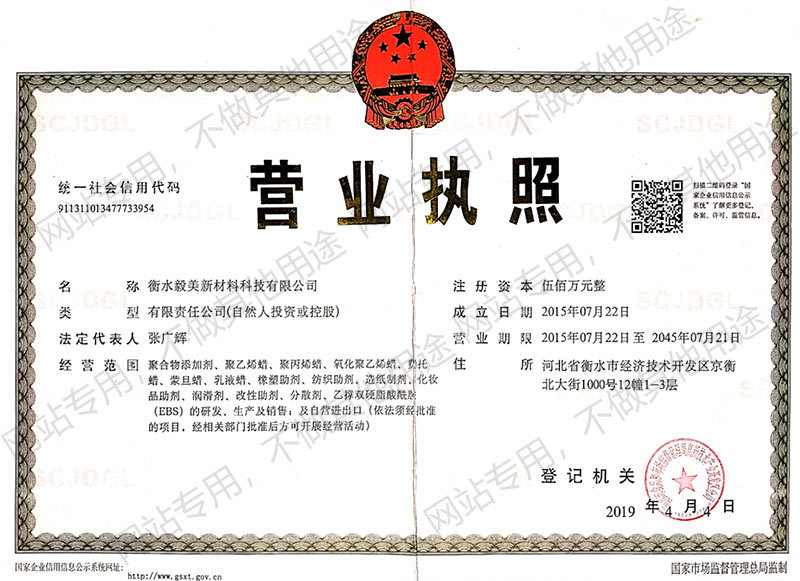
About UsHengshui yi mei new material technology co., ltd. was founded in 2015, is a collection of product development, production, sales and service as one of the high and new technology enterprises, yi mei company focused on deep processing of wax products, determined to become china's professional wax products supplier

-
ProductsThe company mainly produces and sells: polyethylene wax, oxidized polyethylene wax, synthetic Fischer-Tropsch wax, oxidized Fischer-Tropsch wax, maleic anhydride grafted wax, polypropylene wax, micro-powder wax, high-end composite wax and other eight series of dozens of models of high quality products.
-
NewsAt the beginning of its establishment, Yimei Company invested in the establishment of the "Polymer Additive R & D Center", insisting on scientific and technological innovation as the life force of enterprise development. Concentrate funds, technology, and talents in the company's scientific and technological innovation activities, focus on scientific research, public relations and technological breakthroughs of new products, new technologies, and new processes, and resolutely master core technologies.
-
SupportAt the beginning of its establishment, Yimei Company invested in the establishment of the "Polymer Additive R & D Center", insisting on scientific and technological innovation as the life force of enterprise development. Concentrate funds, technology, and talents in the company's scientific and technological innovation activities, focus on scientific research, public relations and technological breakthroughs of new products, new technologies, and new processes, and resolutely master core technologies.
-
RecruitmentOur company always adheres to the talent concept of "people-oriented", actively creates an atmosphere of respect, understanding, integrity and friendship, respects people's knowledge and talents, selects and develops mechanisms, and provides a growth platform for talents. make talents become a strong support for the sustainable development of enterprises, and realize the common growth and development of enterprises and talents.

Understanding Oxidized PE Wax: Properties, Applications, and Benefits
Release time:
2024-09-20
Oxidized PE wax, a derivative of polyethylene, is produced through the oxidation of polyethylene under controlled conditions. This process results in a waxy substance with unique properties that differentiate it from regular PE wax. One of the primary characteristics of oxidized PE wax is its increased polarity, which enhances its compatibility with various polar substrates. This makes it an ideal
Oxidized PE wax, a derivative of polyethylene, is produced through the oxidation of polyethylene under controlled conditions. This process results in a waxy substance with unique properties that differentiate it from regular PE wax. One of the primary characteristics of oxidized PE wax is its increased polarity, which enhances its compatibility with various polar substrates. This makes it an ideal choice for applications requiring improved adhesion and dispersion.
In terms of physical properties, oxidized PE wax typically exhibits a lower melting point compared to its non-oxidized counterparts. This characteristic allows for easier processing and incorporation into different formulations. The wax is often used as a processing aid, lubricant, or emulsifier, contributing significantly to the performance of paints, coatings, inks, and various plastic applications.
In the coatings industry, oxidized PE wax plays a crucial role in enhancing the durability and finish of products. It provides improved scratch resistance, reduces gloss, and enhances flow characteristics. This makes it particularly valuable in applications where surface quality is paramount. Additionally, its ability to control viscosity allows for better application properties, leading to a smoother finish.
In the realm of plastics, oxidized PE wax can improve the dispersion of pigments and fillers, ensuring a more uniform color and consistency throughout the material. This property is particularly beneficial in the manufacturing of colored plastics, as it reduces the risk of pigment settling and clumping during processing. Furthermore, the enhanced compatibility of oxidized PE wax with various resin systems allows for greater formulation flexibility, enabling manufacturers to tailor products to specific needs.
The use of oxidized PE wax is also prevalent in the adhesive and sealant industry. Its ability to enhance adhesion properties makes it a valuable additive in formulations designed for bonding a variety of substrates. The wax improves the wetting of surfaces, which is critical for achieving effective adhesion.
Moreover, oxidized PE wax is increasingly utilized in the cosmetic and personal care industry. Its emollient properties contribute to the formulation of creams, lotions, and other products, providing a desirable texture and feel. The wax can also help stabilize emulsions, ensuring that formulations maintain their intended consistency over time.
In summary, oxidized PE wax is a multifunctional additive that enhances the performance of a wide array of products across various industries. Its unique properties, including increased polarity, improved adhesion, and enhanced processing capabilities, make it an essential component in modern formulations. Whether in coatings, plastics, adhesives, or personal care products, oxidized PE wax continues to play a pivotal role in driving innovation and improving product quality.
In terms of physical properties, oxidized PE wax typically exhibits a lower melting point compared to its non-oxidized counterparts. This characteristic allows for easier processing and incorporation into different formulations. The wax is often used as a processing aid, lubricant, or emulsifier, contributing significantly to the performance of paints, coatings, inks, and various plastic applications.
In the coatings industry, oxidized PE wax plays a crucial role in enhancing the durability and finish of products. It provides improved scratch resistance, reduces gloss, and enhances flow characteristics. This makes it particularly valuable in applications where surface quality is paramount. Additionally, its ability to control viscosity allows for better application properties, leading to a smoother finish.
In the realm of plastics, oxidized PE wax can improve the dispersion of pigments and fillers, ensuring a more uniform color and consistency throughout the material. This property is particularly beneficial in the manufacturing of colored plastics, as it reduces the risk of pigment settling and clumping during processing. Furthermore, the enhanced compatibility of oxidized PE wax with various resin systems allows for greater formulation flexibility, enabling manufacturers to tailor products to specific needs.
The use of oxidized PE wax is also prevalent in the adhesive and sealant industry. Its ability to enhance adhesion properties makes it a valuable additive in formulations designed for bonding a variety of substrates. The wax improves the wetting of surfaces, which is critical for achieving effective adhesion.
Moreover, oxidized PE wax is increasingly utilized in the cosmetic and personal care industry. Its emollient properties contribute to the formulation of creams, lotions, and other products, providing a desirable texture and feel. The wax can also help stabilize emulsions, ensuring that formulations maintain their intended consistency over time.
In summary, oxidized PE wax is a multifunctional additive that enhances the performance of a wide array of products across various industries. Its unique properties, including increased polarity, improved adhesion, and enhanced processing capabilities, make it an essential component in modern formulations. Whether in coatings, plastics, adhesives, or personal care products, oxidized PE wax continues to play a pivotal role in driving innovation and improving product quality.
Key words:
Oxidized PE wax
recommend reading