Yimei New Material-Professional Wax Product Solution Supplier


-
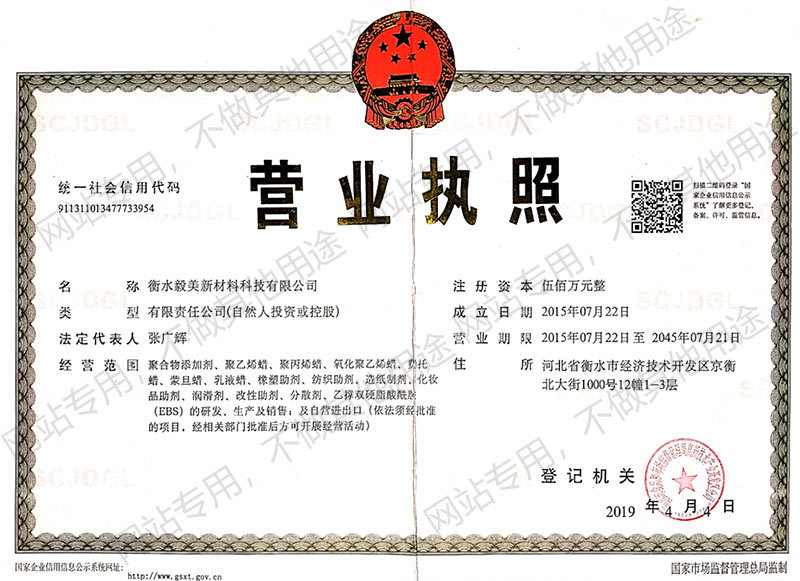
About UsHengshui yi mei new material technology co., ltd. was founded in 2015, is a collection of product development, production, sales and service as one of the high and new technology enterprises, yi mei company focused on deep processing of wax products, determined to become china's professional wax products supplier

-
ProductsThe company mainly produces and sells: polyethylene wax, oxidized polyethylene wax, synthetic Fischer-Tropsch wax, oxidized Fischer-Tropsch wax, maleic anhydride grafted wax, polypropylene wax, micro-powder wax, high-end composite wax and other eight series of dozens of models of high quality products.
-
NewsAt the beginning of its establishment, Yimei Company invested in the establishment of the "Polymer Additive R & D Center", insisting on scientific and technological innovation as the life force of enterprise development. Concentrate funds, technology, and talents in the company's scientific and technological innovation activities, focus on scientific research, public relations and technological breakthroughs of new products, new technologies, and new processes, and resolutely master core technologies.
-
SupportAt the beginning of its establishment, Yimei Company invested in the establishment of the "Polymer Additive R & D Center", insisting on scientific and technological innovation as the life force of enterprise development. Concentrate funds, technology, and talents in the company's scientific and technological innovation activities, focus on scientific research, public relations and technological breakthroughs of new products, new technologies, and new processes, and resolutely master core technologies.
-
RecruitmentOur company always adheres to the talent concept of "people-oriented", actively creates an atmosphere of respect, understanding, integrity and friendship, respects people's knowledge and talents, selects and develops mechanisms, and provides a growth platform for talents. make talents become a strong support for the sustainable development of enterprises, and realize the common growth and development of enterprises and talents.


Understanding Oxidized Polyethylene Wax: Benefits and Applications in the Chemical Industry
Release time:
2024-09-06
Oxidized polyethylene wax is a modified form of polyethylene wax that has undergone an oxidation process, resulting in a range of unique properties beneficial for various industrial applications. This versatile material finds its significance primarily in the chemical industry, where it serves as an important additive in numerous formulations. One of the standout characteristics of oxidized polyet
Oxidized polyethylene wax is a modified form of polyethylene wax that has undergone an oxidation process, resulting in a range of unique properties beneficial for various industrial applications. This versatile material finds its significance primarily in the chemical industry, where it serves as an important additive in numerous formulations.
One of the standout characteristics of oxidized polyethylene wax is its excellent lubricating properties. This makes it an ideal choice in applications requiring enhanced flow and processing efficiency. In the manufacturing of plastics and coatings, for instance, incorporating oxidized polyethylene wax can significantly improve the ease of processing, reduce friction, and enhance the overall performance of the final product.
Moreover, oxidized polyethylene wax boasts excellent compatibility with a broad spectrum of substrates, including polar and non-polar materials. This compatibility allows for its use in various formulations, such as paints, inks, and adhesives, where it contributes to improved stability and enhanced surface properties. For example, when used in coatings, it can result in a smoother finish, increased durability, and improved resistance to abrasion.
Another essential property of oxidized polyethylene wax is its ability to act as a surfactant, which can aid in stabilizing emulsions and dispersions. This feature is particularly valuable in the production of cosmetic and personal care products, where maintaining a stable mixture is crucial for product efficacy and consumer satisfaction.
Furthermore, the chemical resistance exhibited by oxidized polyethylene wax makes it suitable for applications in harsh environments. Its stability under varying temperatures and pH levels ensures that it can maintain its functional properties even in demanding conditions. This attribute is essential for products that require longevity and reliability, particularly in industrial settings.
In addition to its functional benefits, oxidized polyethylene wax is also considered environmentally friendly, making it an attractive option for manufacturers looking to enhance the sustainability of their products. As industries increasingly prioritize eco-friendly practices, the use of such materials can contribute positively to a company’s environmental profile.
In summary, oxidized polyethylene wax is a highly functional additive that plays a vital role across various sectors within the chemical industry. Its lubricating properties, compatibility with diverse substrates, surfactant capabilities, chemical resistance, and eco-friendly nature position it as a valuable component in many formulations. As professionals in the field continue to innovate, the applications and benefits of oxidized polyethylene wax are likely to expand, making it an essential subject of interest in contemporary chemical manufacturing.
One of the standout characteristics of oxidized polyethylene wax is its excellent lubricating properties. This makes it an ideal choice in applications requiring enhanced flow and processing efficiency. In the manufacturing of plastics and coatings, for instance, incorporating oxidized polyethylene wax can significantly improve the ease of processing, reduce friction, and enhance the overall performance of the final product.
Moreover, oxidized polyethylene wax boasts excellent compatibility with a broad spectrum of substrates, including polar and non-polar materials. This compatibility allows for its use in various formulations, such as paints, inks, and adhesives, where it contributes to improved stability and enhanced surface properties. For example, when used in coatings, it can result in a smoother finish, increased durability, and improved resistance to abrasion.
Another essential property of oxidized polyethylene wax is its ability to act as a surfactant, which can aid in stabilizing emulsions and dispersions. This feature is particularly valuable in the production of cosmetic and personal care products, where maintaining a stable mixture is crucial for product efficacy and consumer satisfaction.
Furthermore, the chemical resistance exhibited by oxidized polyethylene wax makes it suitable for applications in harsh environments. Its stability under varying temperatures and pH levels ensures that it can maintain its functional properties even in demanding conditions. This attribute is essential for products that require longevity and reliability, particularly in industrial settings.
In addition to its functional benefits, oxidized polyethylene wax is also considered environmentally friendly, making it an attractive option for manufacturers looking to enhance the sustainability of their products. As industries increasingly prioritize eco-friendly practices, the use of such materials can contribute positively to a company’s environmental profile.
In summary, oxidized polyethylene wax is a highly functional additive that plays a vital role across various sectors within the chemical industry. Its lubricating properties, compatibility with diverse substrates, surfactant capabilities, chemical resistance, and eco-friendly nature position it as a valuable component in many formulations. As professionals in the field continue to innovate, the applications and benefits of oxidized polyethylene wax are likely to expand, making it an essential subject of interest in contemporary chemical manufacturing.
Key words:
oxidized polyethylene wax
recommend reading