Yimei New Material-Professional Wax Product Solution Supplier


-
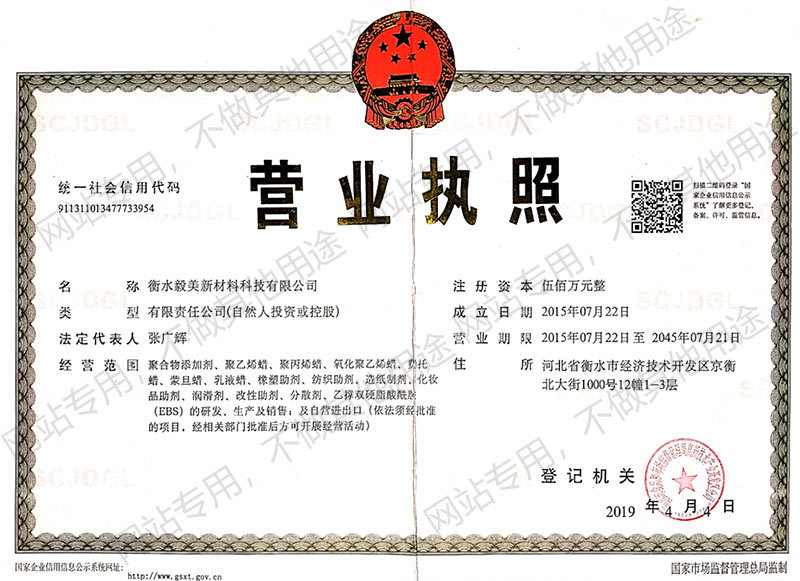
About UsHengshui yi mei new material technology co., ltd. was founded in 2015, is a collection of product development, production, sales and service as one of the high and new technology enterprises, yi mei company focused on deep processing of wax products, determined to become china's professional wax products supplier

-
ProductsThe company mainly produces and sells: polyethylene wax, oxidized polyethylene wax, synthetic Fischer-Tropsch wax, oxidized Fischer-Tropsch wax, maleic anhydride grafted wax, polypropylene wax, micro-powder wax, high-end composite wax and other eight series of dozens of models of high quality products.
-
NewsAt the beginning of its establishment, Yimei Company invested in the establishment of the "Polymer Additive R & D Center", insisting on scientific and technological innovation as the life force of enterprise development. Concentrate funds, technology, and talents in the company's scientific and technological innovation activities, focus on scientific research, public relations and technological breakthroughs of new products, new technologies, and new processes, and resolutely master core technologies.
-
SupportAt the beginning of its establishment, Yimei Company invested in the establishment of the "Polymer Additive R & D Center", insisting on scientific and technological innovation as the life force of enterprise development. Concentrate funds, technology, and talents in the company's scientific and technological innovation activities, focus on scientific research, public relations and technological breakthroughs of new products, new technologies, and new processes, and resolutely master core technologies.
-
RecruitmentOur company always adheres to the talent concept of "people-oriented", actively creates an atmosphere of respect, understanding, integrity and friendship, respects people's knowledge and talents, selects and develops mechanisms, and provides a growth platform for talents. make talents become a strong support for the sustainable development of enterprises, and realize the common growth and development of enterprises and talents.


Understanding the Benefits of Oxidized Polyethylene Wax in Industrial Applications
Release time:
2024-09-05
Understanding the Benefits of Oxidized Polyethylene Wax in Industrial Applications Introduction to Oxidized Polyethylene Wax Oxidized polyethylene wax (OPW) is a versatile chemical compound that has gained significant traction in various industrial sectors. It is produced by the oxidation of polyethylene, resulting in a waxy substance that possesses unique properties beneficial for multiple applic
Understanding the Benefits of Oxidized Polyethylene Wax in Industrial Applications
Introduction to Oxidized Polyethylene Wax
Oxidized polyethylene wax (OPW) is a versatile chemical compound that has gained significant traction in various industrial sectors. It is produced by the oxidation of polyethylene, resulting in a waxy substance that possesses unique properties beneficial for multiple applications. This article aims to provide a detailed understanding of oxidized polyethylene wax, its benefits, and its role in different industrial applications.
The Chemical Structure and Properties of Oxidized Polyethylene Wax
Oxidized polyethylene wax has a distinctive chemical structure characterized by the presence of functional groups such as carboxylic acids, esters, and aldehydes. These functional groups enhance the wax's compatibility with other materials, making it an ideal additive in various formulations.
Key Properties of Oxidized Polyethylene Wax
Some of the key properties of oxidized polyethylene wax that contribute to its suitability in industrial applications include:
- High melting point: The melting point of OPW typically ranges from 80 to 100 degrees Celsius, providing stability in high-temperature environments.
- Low viscosity: This characteristic allows for easy incorporation into formulations, enhancing processability.
- Chemical resistance: Oxidized polyethylene wax exhibits excellent resistance to acids, bases, and solvents, making it ideal for harsh environments.
- Improved adhesion: Its unique structure enhances the adhesion properties of coatings and inks.
- Low surface tension: This property helps in reducing friction and enhancing flow characteristics.
Applications of Oxidized Polyethylene Wax in Industry
Oxidized polyethylene wax is employed across a multitude of industries due to its versatile properties. Here are some prominent applications:
1. Coatings and Paints
In the coatings industry, OPW functions as a dispersing agent and rheology modifier. It improves the flow and leveling of paints, resulting in a smoother finish. Additionally, it enhances the adhesion of coatings to various substrates, ensuring durability and longevity.
2. Plastics and Polymers
OPW is extensively used as a processing aid in the plastics industry. It improves the melt flow properties of polymers, facilitating easier processing during manufacturing. Moreover, it enhances the surface characteristics of plastic products, providing better gloss and scratch resistance.
3. Adhesives and Sealants
In adhesive formulations, oxidized polyethylene wax acts as an additive to improve the grip and bonding strength. It also helps in reducing the viscosity of the adhesive, allowing for easier application and improved performance.
4. Cosmetics and Personal Care Products
The cosmetic industry utilizes OPW for its emollient properties. It provides a smooth application and acts as a thickener in creams and lotions, enhancing their texture and feel on the skin.
5. Rubber and Elastomers
In rubber formulations, OPW serves as a processing aid, improving the flow and dispersion of fillers. It enhances the mechanical properties of rubber products, making them more durable and resilient.
Benefits of Oxidized Polyethylene Wax in Industrial Applications
The incorporation of oxidized polyethylene wax in industrial processes offers numerous advantages:
1. Enhanced Product Performance
By improving the adhesion, flow, and leveling properties of products, OPW significantly enhances overall performance. This leads to higher quality outputs in coatings, adhesives, and plastics.
2. Increased Efficiency in Manufacturing
OPW helps in reducing processing times and energy consumption, making manufacturing processes more efficient. Its low viscosity allows for easy incorporation into formulations, streamlining production workflows.
3. Cost-Effectiveness
The use of oxidized polyethylene wax can lead to cost savings by reducing the need for additional additives and improving the longevity of products. This translates to decreased operational costs and improved profit margins.
4. Environmentally Friendly Option
As a wax derived from polyethylene, OPW is considered a more environmentally friendly option compared to traditional chemical additives. Its stability and low toxicity make it a safer choice for various applications.
5. Versatility Across Industries
One of the most significant benefits of OPW is its adaptability across various sectors. Its unique properties allow it to be used in a wide range of formulations, from industrial coatings to personal care products.
Challenges and Considerations
While oxidized polyethylene wax offers numerous benefits, there are some challenges and considerations to keep in mind:
1. Compatibility with Other Materials
Although OPW is compatible with many substances, it's essential to conduct thorough compatibility tests when formulating products. Some combinations may yield unpredictable results.
2. Temperature Sensitivity
The melting point of OPW can influence its performance in certain applications. It's crucial to monitor temperature conditions during processing to maintain optimal performance.
3. Potential for Contamination
As with any chemical product, there's a risk of contamination during handling and storage. Proper protocols should be established to ensure product integrity.
Frequently Asked Questions (FAQs)
1. What is oxidized polyethylene wax used for?
Oxidized polyethylene wax is used in various applications, including coatings, adhesives, plastics, and personal care products, due to its unique properties.
2. Is oxidized polyethylene wax environmentally friendly?
Yes, OPW is considered environmentally friendly due to its stability and low toxicity compared to traditional chemical additives.
3. How does oxidized polyethylene wax improve product performance?
It enhances adhesion, flow, and leveling properties in formulations, resulting in higher quality finished products.
4. Can oxidized polyethylene wax be used in cosmetics?
Yes, it is commonly used in cosmetics for its emollient properties and ability to enhance texture in creams and lotions.
5. What are the challenges of using oxidized polyethylene wax?
Challenges may include compatibility with other materials, temperature sensitivity, and potential contamination during handling.
Conclusion
Oxidized polyethylene wax is a versatile and beneficial additive that plays a significant role across various industrial applications. Its unique properties, including high melting point, low viscosity, and excellent chemical resistance, make it an ideal choice for improving the performance of coatings, plastics, adhesives, and more. By understanding the benefits and applications of OPW, industries can leverage its advantages to enhance product quality, increase efficiency, and drive cost savings. As the demand for environmentally friendly solutions continues to grow, oxidized polyethylene wax stands out as a valuable option for modern manufacturing processes.
Key words:
oxidized polyethylene wax
recommend reading