Yimei New Material-Professional Wax Product Solution Supplier


-
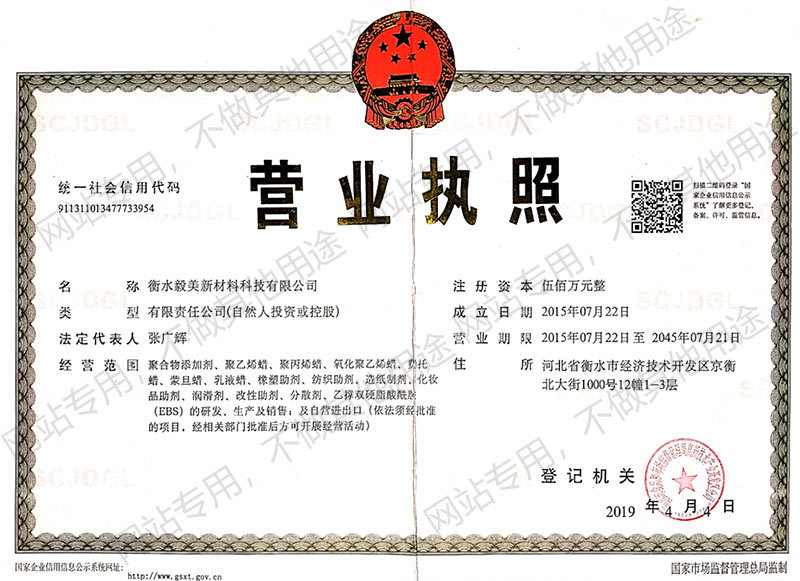
About UsHengshui yi mei new material technology co., ltd. was founded in 2015, is a collection of product development, production, sales and service as one of the high and new technology enterprises, yi mei company focused on deep processing of wax products, determined to become china's professional wax products supplier

-
ProductsThe company mainly produces and sells: polyethylene wax, oxidized polyethylene wax, synthetic Fischer-Tropsch wax, oxidized Fischer-Tropsch wax, maleic anhydride grafted wax, polypropylene wax, micro-powder wax, high-end composite wax and other eight series of dozens of models of high quality products.
-
NewsAt the beginning of its establishment, Yimei Company invested in the establishment of the "Polymer Additive R & D Center", insisting on scientific and technological innovation as the life force of enterprise development. Concentrate funds, technology, and talents in the company's scientific and technological innovation activities, focus on scientific research, public relations and technological breakthroughs of new products, new technologies, and new processes, and resolutely master core technologies.
-
SupportAt the beginning of its establishment, Yimei Company invested in the establishment of the "Polymer Additive R & D Center", insisting on scientific and technological innovation as the life force of enterprise development. Concentrate funds, technology, and talents in the company's scientific and technological innovation activities, focus on scientific research, public relations and technological breakthroughs of new products, new technologies, and new processes, and resolutely master core technologies.
-
RecruitmentOur company always adheres to the talent concept of "people-oriented", actively creates an atmosphere of respect, understanding, integrity and friendship, respects people's knowledge and talents, selects and develops mechanisms, and provides a growth platform for talents. make talents become a strong support for the sustainable development of enterprises, and realize the common growth and development of enterprises and talents.


Understanding PE Wax Flake: A Versatile Additive in Chemical Products
Release time:
2024-08-25
Polyethylene (PE) wax flake, a product derived from the polymerization of ethylene, has garnered attention across various industries, particularly in chemical formulations. These flakes are known for their unique properties, including low viscosity, excellent thermal stability, and resistance to moisture, making them an ideal choice for a range of applications. One of the primary uses of PE wax fl
Polyethylene (PE) wax flake, a product derived from the polymerization of ethylene, has garnered attention across various industries, particularly in chemical formulations. These flakes are known for their unique properties, including low viscosity, excellent thermal stability, and resistance to moisture, making them an ideal choice for a range of applications.
One of the primary uses of PE wax flakes is as a processing aid in the production of coatings, inks, and adhesives. Their incorporation helps improve the flow and leveling properties of these products, enhancing the overall quality and appearance. Additionally, PE wax flakes act as a slip agent, providing improved surface lubricity. This characteristic reduces friction and wear on the equipment during processing, leading to increased efficiency.
In the plastics industry, PE wax flakes serve as a functional additive that can enhance the performance of various polymer blends. They are particularly valuable in applications such as thermoplastics and polyolefin compounds, where they help improve the melt flow characteristics and reduce surface defects. By optimizing the processing conditions, manufacturers can achieve better mechanical properties and surface finishes in their final products.
Another significant application of PE wax flakes is in the formulation of masterbatches. These concentrated mixtures of pigments and additives are often used to impart color and specific properties to plastics. The addition of PE wax flakes can enhance the dispersion of pigments and ensure a uniform distribution throughout the polymer matrix, resulting in vibrant colors and consistent performance.
Moreover, PE wax flake is also utilized as a rheology modifier in various formulations. This property allows manufacturers to control the flow behavior of their products, making it easier to achieve desired viscosity levels. This is particularly important in applications such as paints and coatings, where consistent application and appearance are crucial.
The environmental aspect of using PE wax flakes cannot be overlooked. As a product derived from polyethylene, they are often classified as low in toxicity and can be considered a safer alternative to some other chemical additives. Additionally, many manufacturers are exploring more sustainable sourcing options for polyethylene, contributing to a more eco-friendly approach in the chemical industry.
In summary, PE wax flake is a versatile additive with a myriad of applications across the chemical sector. Its beneficial properties, including improved flow, slip, and dispersion characteristics, make it a valuable choice for enhancing various formulations. As professionals in the industry continue to leverage the advantages of PE wax flakes, it is essential to stay informed about their potential and applications, ensuring optimal performance in a wide range of products.
One of the primary uses of PE wax flakes is as a processing aid in the production of coatings, inks, and adhesives. Their incorporation helps improve the flow and leveling properties of these products, enhancing the overall quality and appearance. Additionally, PE wax flakes act as a slip agent, providing improved surface lubricity. This characteristic reduces friction and wear on the equipment during processing, leading to increased efficiency.
In the plastics industry, PE wax flakes serve as a functional additive that can enhance the performance of various polymer blends. They are particularly valuable in applications such as thermoplastics and polyolefin compounds, where they help improve the melt flow characteristics and reduce surface defects. By optimizing the processing conditions, manufacturers can achieve better mechanical properties and surface finishes in their final products.
Another significant application of PE wax flakes is in the formulation of masterbatches. These concentrated mixtures of pigments and additives are often used to impart color and specific properties to plastics. The addition of PE wax flakes can enhance the dispersion of pigments and ensure a uniform distribution throughout the polymer matrix, resulting in vibrant colors and consistent performance.
Moreover, PE wax flake is also utilized as a rheology modifier in various formulations. This property allows manufacturers to control the flow behavior of their products, making it easier to achieve desired viscosity levels. This is particularly important in applications such as paints and coatings, where consistent application and appearance are crucial.
The environmental aspect of using PE wax flakes cannot be overlooked. As a product derived from polyethylene, they are often classified as low in toxicity and can be considered a safer alternative to some other chemical additives. Additionally, many manufacturers are exploring more sustainable sourcing options for polyethylene, contributing to a more eco-friendly approach in the chemical industry.
In summary, PE wax flake is a versatile additive with a myriad of applications across the chemical sector. Its beneficial properties, including improved flow, slip, and dispersion characteristics, make it a valuable choice for enhancing various formulations. As professionals in the industry continue to leverage the advantages of PE wax flakes, it is essential to stay informed about their potential and applications, ensuring optimal performance in a wide range of products.
Key words:
PE wax flake
Previous article
recommend reading