Yimei New Material-Professional Wax Product Solution Supplier


-
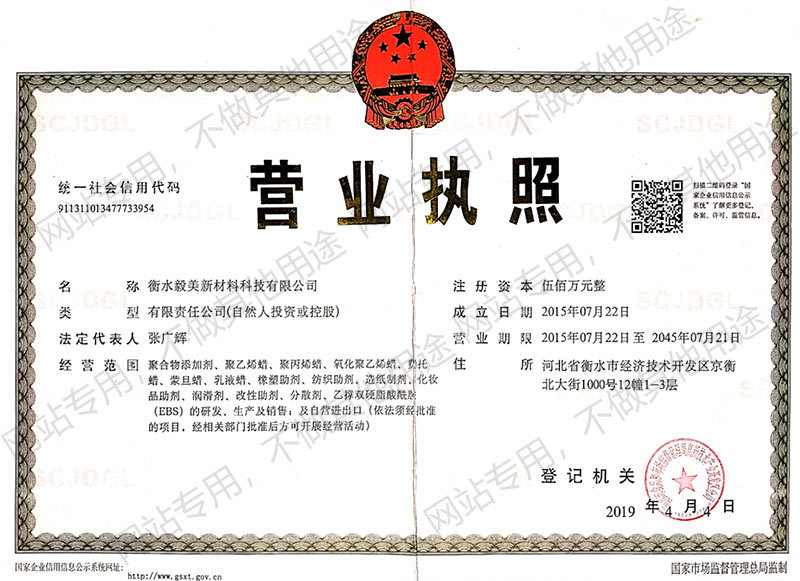
About UsHengshui yi mei new material technology co., ltd. was founded in 2015, is a collection of product development, production, sales and service as one of the high and new technology enterprises, yi mei company focused on deep processing of wax products, determined to become china's professional wax products supplier

-
ProductsThe company mainly produces and sells: polyethylene wax, oxidized polyethylene wax, synthetic Fischer-Tropsch wax, oxidized Fischer-Tropsch wax, maleic anhydride grafted wax, polypropylene wax, micro-powder wax, high-end composite wax and other eight series of dozens of models of high quality products.
-
NewsAt the beginning of its establishment, Yimei Company invested in the establishment of the "Polymer Additive R & D Center", insisting on scientific and technological innovation as the life force of enterprise development. Concentrate funds, technology, and talents in the company's scientific and technological innovation activities, focus on scientific research, public relations and technological breakthroughs of new products, new technologies, and new processes, and resolutely master core technologies.
-
SupportAt the beginning of its establishment, Yimei Company invested in the establishment of the "Polymer Additive R & D Center", insisting on scientific and technological innovation as the life force of enterprise development. Concentrate funds, technology, and talents in the company's scientific and technological innovation activities, focus on scientific research, public relations and technological breakthroughs of new products, new technologies, and new processes, and resolutely master core technologies.
-
RecruitmentOur company always adheres to the talent concept of "people-oriented", actively creates an atmosphere of respect, understanding, integrity and friendship, respects people's knowledge and talents, selects and develops mechanisms, and provides a growth platform for talents. make talents become a strong support for the sustainable development of enterprises, and realize the common growth and development of enterprises and talents.


Unlocking the Potential of PVC Lead Compound Stabilizers Technology for Enhanced Performance
Release time:
2024-10-17
Polyvinyl chloride (PVC) is one of the most widely used synthetic plastic polymers, playing a pivotal role in various industries, including construction, healthcare, and packaging. However, for PVC to maintain its structural integrity and performance characteristics, the incorporation of stabilizers is essential. PVC lead compound stabilizers are crucial in enhancing the material's durability and thermal stability, ensuring that the end products meet rigorous performance criteria.
Polyvinyl chloride (PVC) is one of the most widely used synthetic plastic polymers, playing a pivotal role in various industries, including construction, healthcare, and packaging. However, for PVC to maintain its structural integrity and performance characteristics, the incorporation of stabilizers is essential. PVC lead compound stabilizers are crucial in enhancing the material's durability and thermal stability, ensuring that the end products meet rigorous performance criteria.
Stabilizers serve multiple purposes in PVC processing. They are primarily used to prevent the degradation of PVC during processing and throughout the lifecycle of the final product. Without stabilizers, PVC can become brittle, discolored, and lose its mechanical properties when exposed to heat and UV light. By incorporating lead-based stabilizers, manufacturers can significantly enhance the performance and longevity of PVC products.
There are several types of PVC lead compound stabilizers, each with unique properties and benefits. Understanding these types can help manufacturers select the appropriate stabilizer for their specific applications.
Organotin compounds are effective stabilizers that offer excellent thermal stability and processing characteristics. They are particularly useful in applications requiring high performance, such as window profiles and flooring.
Barium-cadmium stabilizers have been traditional choices for many PVC applications. They provide good thermal stability and are relatively cost-effective. However, due to environmental concerns associated with cadmium, their use is declining.
Calcium-zinc stabilizers are considered safer alternatives to lead and cadmium stabilizers. They provide good thermal stability and are increasingly popular in applications where environmental safety is a priority, such as food packaging and medical devices.
Lead stabilizers provide superior thermal stability, allowing PVC products to withstand higher processing temperatures without degradation. This stability translates to a longer lifespan for the products in various applications.
PVC lead compound stabilizers enhance the mechanical properties of the material, including tensile strength and impact resistance. This improvement makes the products more resilient and versatile for different uses.
Many countries have implemented stringent regulations regarding the use of lead in manufacturing processes. Compliance with these regulations is essential for companies to avoid legal repercussions and environmental damage.
As awareness of the environmental impact of lead compounds increases, manufacturers are exploring alternative stabilizers that offer similar performance without the associated risks. Calcium-zinc and organotin stabilizers are leading the way in this aspect.
The integration of nanotechnology in PVC lead stabilizers can enhance their performance characteristics. Nanoparticles can improve the distribution of stabilizers within the PVC matrix, leading to better thermal stability and mechanical properties.
The push towards sustainability is encouraging researchers to develop green chemistry methods for producing stabilizers. These methods aim to reduce the environmental impact while maintaining the efficacy of stabilizers.
The future of PVC lead compound stabilizers is likely to be shaped by ongoing research and the demand for sustainable solutions. Innovations in biodegradable alternatives, alongside the continued improvement of existing stabilizers, will redefine how these compounds are utilized in manufacturing.
The advancements in PVC lead compound stabilizers technology represent a significant leap forward in the chemical industry. By unlocking the potential of these stabilizers, manufacturers can enhance product performance, meet environmental regulations, and pave the way for a more sustainable future. As technology evolves, the focus on innovation and safety will continue to drive the development of new stabilizers that maintain the integrity of PVC while prioritizing environmental health.
Key words:
PVC Lead compound stabilizer
Next article
Next article
recommend reading