Yimei New Material-Professional Wax Product Solution Supplier


-
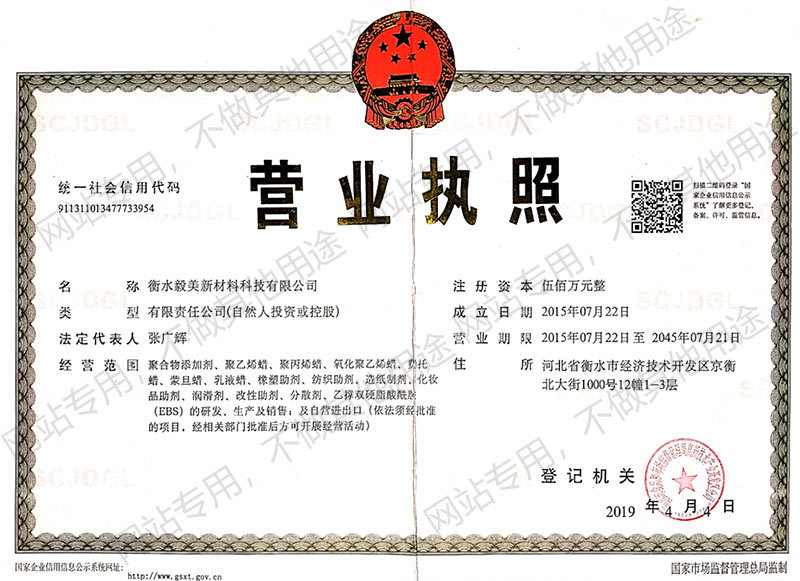
About UsHengshui yi mei new material technology co., ltd. was founded in 2015, is a collection of product development, production, sales and service as one of the high and new technology enterprises, yi mei company focused on deep processing of wax products, determined to become china's professional wax products supplier

-
ProductsThe company mainly produces and sells: polyethylene wax, oxidized polyethylene wax, synthetic Fischer-Tropsch wax, oxidized Fischer-Tropsch wax, maleic anhydride grafted wax, polypropylene wax, micro-powder wax, high-end composite wax and other eight series of dozens of models of high quality products.
-
NewsAt the beginning of its establishment, Yimei Company invested in the establishment of the "Polymer Additive R & D Center", insisting on scientific and technological innovation as the life force of enterprise development. Concentrate funds, technology, and talents in the company's scientific and technological innovation activities, focus on scientific research, public relations and technological breakthroughs of new products, new technologies, and new processes, and resolutely master core technologies.
-
SupportAt the beginning of its establishment, Yimei Company invested in the establishment of the "Polymer Additive R & D Center", insisting on scientific and technological innovation as the life force of enterprise development. Concentrate funds, technology, and talents in the company's scientific and technological innovation activities, focus on scientific research, public relations and technological breakthroughs of new products, new technologies, and new processes, and resolutely master core technologies.
-
RecruitmentOur company always adheres to the talent concept of "people-oriented", actively creates an atmosphere of respect, understanding, integrity and friendship, respects people's knowledge and talents, selects and develops mechanisms, and provides a growth platform for talents. make talents become a strong support for the sustainable development of enterprises, and realize the common growth and development of enterprises and talents.


Exploring the Role of Barium Stearate in Modern Chemical Processes: Applications, Properties, and Innovations
Release time:
2024-10-19
Barium Stearate, a chemical compound with the formula Ba(C18H35O2)2, is extensively used across various sectors due to its unique properties. This versatile compound showcases both hydrophobic and lipophilic characteristics, making it invaluable in numerous applications. Its ability to function as a lubricant, stabilizer, and emulsifier places it at the forefront of modern chemical processes.
Barium Stearate, a chemical compound with the formula Ba(C18H35O2)2, is extensively used across various sectors due to its unique properties. This versatile compound showcases both hydrophobic and lipophilic characteristics, making it invaluable in numerous applications. Its ability to function as a lubricant, stabilizer, and emulsifier places it at the forefront of modern chemical processes.
Barium Stearate is a white, waxy solid that is insoluble in water but soluble in organic solvents. Its molecular weight is significant, and its melting point typically ranges between 170-190 °C. The compound exhibits thermal stability, making it suitable for high-temperature applications. Additionally, Barium Stearate is a non-toxic substance, contributing to its widespread acceptance in various industries.
The production of Barium Stearate typically involves the reaction of stearic acid with barium oxide or barium carbonate. The process requires careful control of temperature and reaction conditions to ensure optimal yield and purity. After synthesis, the compound is purified through filtration and drying processes, which enhance its quality for industrial applications.
Barium Stearate is widely utilized in the plastics industry as a lubricant and processing aid. It facilitates the molding process of various polymers, including polyvinyl chloride (PVC), by reducing friction and improving flow properties. This enhances the overall quality of plastic products and extends their lifespan.
In the paint industry, Barium Stearate serves as a stabilizer and thickening agent. It helps achieve uniform dispersion of pigments, ensuring high-quality finishes. Additionally, it enhances the durability and resistance of coatings against environmental factors, making it an essential component of modern paint formulations.
Barium Stearate plays a crucial role in rubber production by acting as a lubricant and processing aid. Its incorporation in rubber formulations improves flow characteristics during processing, resulting in a smoother, more consistent final product. Furthermore, it contributes to the overall performance of rubber products, enhancing their elasticity and durability.
In cosmetics, Barium Stearate is valued for its emulsifying properties, helping to stabilize creams and lotions. It provides a smooth texture and improves the spreadability of products, making it a popular ingredient in skincare formulations. Additionally, its non-toxic nature makes it suitable for use in personal care products.
Pharmaceutical applications of Barium Stearate include its use as a lubricant in tablet manufacturing. It enhances the flow of powders and granules, ensuring uniformity in tablet composition. The compound's inert nature makes it safe for consumption, allowing it to meet stringent regulatory standards in the pharmaceutical industry.
The demand for Barium Stearate continues to grow as industries seek more efficient and sustainable solutions. Recent innovations in chemical processing and formulation technologies are driving the development of new applications. For instance, the exploration of eco-friendly alternatives to traditional lubricants is gaining traction, positioning Barium Stearate as a potential candidate due to its natural derivation and biodegradability.
Moreover, advancements in nanotechnology are opening new avenues for Barium Stearate's application, particularly in the creation of nanocomposites that enhance material properties. As research progresses, we can expect to see Barium stalemate utilized in innovative ways that benefit both industries and consumers.
While Barium Stearate is generally considered safe for use, it is essential to adhere to safety guidelines during handling and processing. Proper protective measures should be taken to minimize exposure, as with any chemical compound. Environmentally, Barium Stearate is recognized for its low toxicity and biodegradability, making it a preferable choice in formulations aimed at reducing environmental impact.
Barium Stearate plays a pivotal role in modern chemical processes, offering unique properties that enhance product performance across various industries. From its applications in plastics and coatings to its significance in cosmetics and pharmaceuticals, this versatile compound continues to shape the landscape of modern chemistry. As we look toward the future, ongoing innovations and increased awareness of its environmental benefits will likely expand its usage, solidifying its position as an essential ingredient in the chemical industry. Understanding the functionality and impact of Barium Stearate empowers industries to optimize their processes and products, ultimately benefiting end-users and the environment alike.
Key words:
Barium Stearate
recommend reading