Yimei New Material-Professional Wax Product Solution Supplier


-
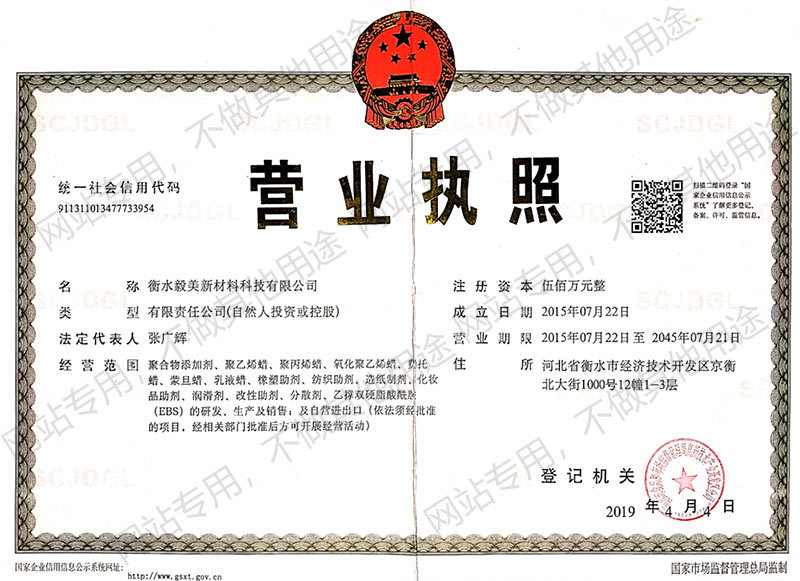
About UsHengshui yi mei new material technology co., ltd. was founded in 2015, is a collection of product development, production, sales and service as one of the high and new technology enterprises, yi mei company focused on deep processing of wax products, determined to become china's professional wax products supplier

-
ProductsThe company mainly produces and sells: polyethylene wax, oxidized polyethylene wax, synthetic Fischer-Tropsch wax, oxidized Fischer-Tropsch wax, maleic anhydride grafted wax, polypropylene wax, micro-powder wax, high-end composite wax and other eight series of dozens of models of high quality products.
-
NewsAt the beginning of its establishment, Yimei Company invested in the establishment of the "Polymer Additive R & D Center", insisting on scientific and technological innovation as the life force of enterprise development. Concentrate funds, technology, and talents in the company's scientific and technological innovation activities, focus on scientific research, public relations and technological breakthroughs of new products, new technologies, and new processes, and resolutely master core technologies.
-
SupportAt the beginning of its establishment, Yimei Company invested in the establishment of the "Polymer Additive R & D Center", insisting on scientific and technological innovation as the life force of enterprise development. Concentrate funds, technology, and talents in the company's scientific and technological innovation activities, focus on scientific research, public relations and technological breakthroughs of new products, new technologies, and new processes, and resolutely master core technologies.
-
RecruitmentOur company always adheres to the talent concept of "people-oriented", actively creates an atmosphere of respect, understanding, integrity and friendship, respects people's knowledge and talents, selects and develops mechanisms, and provides a growth platform for talents. make talents become a strong support for the sustainable development of enterprises, and realize the common growth and development of enterprises and talents.


Enhancing Product Quality with FT Wax: A Comprehensive Guide
Release time:
2025-03-02
Enhancing Product Quality with FT Wax: A Comprehensive Guide Table of Contents 1. Introduction to FT Wax and Its Importance 2. What is FT Wax? 3. Benefits of Using FT Wax in Product Manufacturing 4. Applications of FT Wax Across Industries 5. How FT Wax Improves Product Quality 6. FT Wax in Formulation Chemistry 7. Case Studies: Success Stories Using FT Wax 8. Frequently Asked Que
Enhancing Product Quality with FT Wax: A Comprehensive Guide
Table of Contents
- 1. Introduction to FT Wax and Its Importance
- 2. What is FT Wax?
- 3. Benefits of Using FT Wax in Product Manufacturing
- 4. Applications of FT Wax Across Industries
- 5. How FT Wax Improves Product Quality
- 6. FT Wax in Formulation Chemistry
- 7. Case Studies: Success Stories Using FT Wax
- 8. Frequently Asked Questions
- 9. Conclusion
1. Introduction to FT Wax and Its Importance
In the ever-evolving landscape of the chemical industry, the quest for **enhancing product quality** remains paramount. Manufacturers are continually seeking innovative solutions that not only meet but exceed industry standards. FT Wax has emerged as a pivotal component in this pursuit, offering a range of benefits that contribute to superior product performance and durability.
2. What is FT Wax?
FT Wax, or Fischer-Tropsch Wax, is a synthetic wax produced through the Fischer-Tropsch synthesis process. This process converts carbon monoxide and hydrogen into liquid hydrocarbons, resulting in a versatile wax that can be tailored for various applications. Characterized by its high melting point, low viscosity, and chemical stability, FT Wax stands out as an essential additive in multiple industries, including coatings, plastics, and cosmetics.
2.1 The Composition of FT Wax
FT Wax is primarily composed of long-chain hydrocarbons, which contribute to its unique properties. The absence of branching in its molecular structure results in a wax that exhibits excellent hardness and thermal stability. This composition makes FT Wax an ideal candidate for applications requiring high-performance characteristics.
3. Benefits of Using FT Wax in Product Manufacturing
The integration of FT Wax into manufacturing processes presents numerous advantages:
3.1 Improved Durability
One of the standout features of FT Wax is its ability to enhance the durability of products. When incorporated into formulations, FT Wax contributes to a **more resilient** final product, capable of withstanding harsh conditions without compromising performance.
3.2 Enhanced Aesthetic Appeal
FT Wax also plays a significant role in improving the **aesthetic qualities** of products. Its ability to provide a smooth finish and glossy appearance makes it a desirable additive in coatings and other applications where visual appeal is essential.
3.3 Increased Resistance to Chemicals
Incorporating FT Wax into formulations enhances resistance to various chemicals. This property is particularly important in the chemical industry, where products often face exposure to aggressive substances.
3.4 Cost-Effectiveness
Despite its superior properties, FT Wax is cost-effective. It allows manufacturers to achieve high-quality results while keeping production costs in check, making it an attractive option for companies looking to optimize their processes.
4. Applications of FT Wax Across Industries
The versatility of FT Wax enables its use in numerous applications across various industries:
4.1 Coatings and Paints
In the coatings industry, FT Wax is commonly utilized to improve the scratch resistance and durability of paints. Its incorporation enhances the overall performance of the coating, resulting in longer-lasting finishes.
4.2 Plastics and Polymers
FT Wax is used as a processing aid in the production of plastics. It improves flow properties and reduces friction during manufacturing, leading to better processing efficiency and product quality.
4.3 Personal Care and Cosmetics
In the personal care sector, FT Wax is an ingredient in various cosmetic formulations. It contributes to the stability and texture of creams and lotions, enhancing user experience.
4.4 Adhesives and Sealants
FT Wax enhances the performance of adhesives and sealants by improving their thermal stability and resistance to aging. This ensures that end products maintain their effectiveness over time.
5. How FT Wax Improves Product Quality
The impact of FT Wax on product quality can be attributed to several key factors:
5.1 Optimizing Mechanical Properties
By improving the mechanical properties of materials, FT Wax ensures that final products can withstand stress and strain without failure. This optimization is crucial in applications where strength and stability are paramount.
5.2 Enhancing Processability
FT Wax enhances the processability of polymers, allowing for smoother operations during manufacturing. This leads to fewer defects and higher-quality outputs, ultimately benefiting the end user.
5.3 Reducing Production Costs
Through its cost-effectiveness and ability to enhance product quality, FT Wax helps manufacturers reduce overall production costs. This allows for more competitive pricing in the marketplace without compromising quality.
6. FT Wax in Formulation Chemistry
In formulation chemistry, the role of FT Wax is crucial. It acts as a multifunctional additive, improving various properties of formulations. Here’s how:
6.1 Compatibility with Other Ingredients
FT Wax is compatible with a wide range of other ingredients, making it a versatile choice for formulators. Its ability to blend seamlessly with other components ensures that the desired properties can be achieved without hassle.
6.2 Tailoring Properties for Specific Applications
The unique properties of FT Wax can be tailored to suit specific applications, allowing formulators to customize their products for various market needs. This adaptability is critical in a competitive landscape.
7. Case Studies: Success Stories Using FT Wax
Numerous companies have successfully integrated FT Wax into their manufacturing processes, yielding impressive results. Here are a few notable examples:
7.1 Case Study 1: Coatings Manufacturer
A leading coatings manufacturer adopted FT Wax to enhance the durability and scratch resistance of its products. As a result, customer satisfaction increased significantly, leading to a boost in sales.
7.2 Case Study 2: Plastic Products Company
A plastic products company incorporated FT Wax to improve the flow properties during production. This change reduced material waste and increased overall efficiency, resulting in substantial cost savings.
7.3 Case Study 3: Cosmetic Brand
A cosmetic brand utilized FT Wax in their cream formulations to achieve a smoother texture and better stability. The improved product quality attracted positive customer reviews and increased brand loyalty.
8. Frequently Asked Questions
8.1 What are the main uses of FT Wax?
FT Wax is primarily used in coatings, plastics, personal care products, and adhesives.
8.2 How does FT Wax enhance product quality?
It improves durability, aesthetic appeal, resistance to chemicals, and overall processability.
8.3 Is FT Wax cost-effective?
Yes, FT Wax is a cost-effective additive that enhances product quality while reducing production costs.
8.4 Can FT Wax be used in food-grade applications?
While FT Wax is primarily used in industrial applications, specific grades may be suitable for food contact. It’s essential to consult product specifications.
8.5 What are the environmental impacts of using FT Wax?
FT Wax is considered environmentally friendly due to its synthetic nature and the ability to minimize waste in production processes.
9. Conclusion
Incorporating FT Wax into manufacturing processes is a strategic move for companies seeking to enhance product quality. With its wide range of benefits, from improved durability to cost-effectiveness, FT Wax stands out as an essential additive in the chemical industry. By understanding its applications and advantages, businesses can optimize their products and processes, ensuring they remain competitive in a rapidly evolving market. Embrace the potential of FT Wax and elevate your product quality today.
Key words:
FT wax
Previous article
recommend reading