Yimei New Material-Professional Wax Product Solution Supplier


-
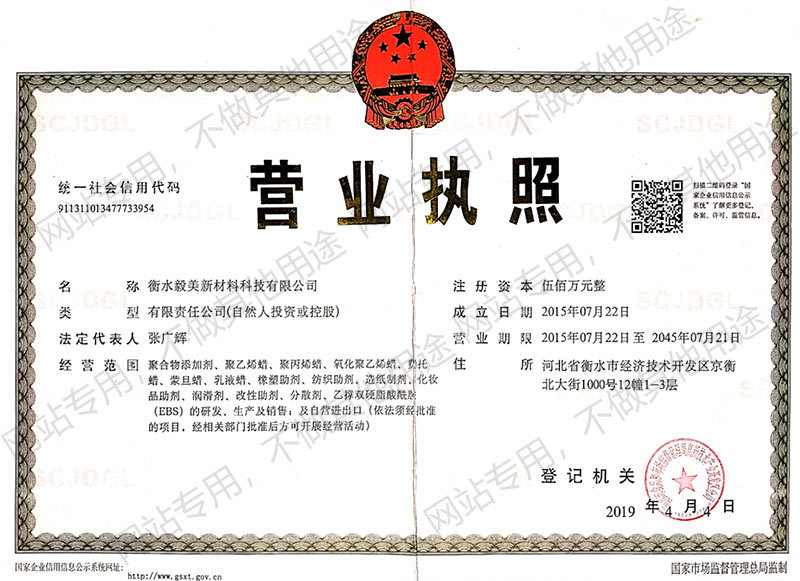
About UsHengshui yi mei new material technology co., ltd. was founded in 2015, is a collection of product development, production, sales and service as one of the high and new technology enterprises, yi mei company focused on deep processing of wax products, determined to become china's professional wax products supplier

-
ProductsThe company mainly produces and sells: polyethylene wax, oxidized polyethylene wax, synthetic Fischer-Tropsch wax, oxidized Fischer-Tropsch wax, maleic anhydride grafted wax, polypropylene wax, micro-powder wax, high-end composite wax and other eight series of dozens of models of high quality products.
-
NewsAt the beginning of its establishment, Yimei Company invested in the establishment of the "Polymer Additive R & D Center", insisting on scientific and technological innovation as the life force of enterprise development. Concentrate funds, technology, and talents in the company's scientific and technological innovation activities, focus on scientific research, public relations and technological breakthroughs of new products, new technologies, and new processes, and resolutely master core technologies.
-
SupportAt the beginning of its establishment, Yimei Company invested in the establishment of the "Polymer Additive R & D Center", insisting on scientific and technological innovation as the life force of enterprise development. Concentrate funds, technology, and talents in the company's scientific and technological innovation activities, focus on scientific research, public relations and technological breakthroughs of new products, new technologies, and new processes, and resolutely master core technologies.
-
RecruitmentOur company always adheres to the talent concept of "people-oriented", actively creates an atmosphere of respect, understanding, integrity and friendship, respects people's knowledge and talents, selects and develops mechanisms, and provides a growth platform for talents. make talents become a strong support for the sustainable development of enterprises, and realize the common growth and development of enterprises and talents.

Oxidized PE Wax: A Key Ingredient in Inkjet Receptive Coatings
Release time:
2025-02-06
Understanding Oxidized PE Wax and Its Role in Inkjet Receptive Coatings In the realm of industrial coatings, **oxidized polyethylene (PE) wax** has emerged as a crucial component, especially in **inkjet receptive coatings**. As businesses strive for improved print quality and durability, understanding the properties and applications of oxidized PE wax becomes essential. This article delves into th
Understanding Oxidized PE Wax and Its Role in Inkjet Receptive Coatings
In the realm of industrial coatings, **oxidized polyethylene (PE) wax** has emerged as a crucial component, especially in **inkjet receptive coatings**. As businesses strive for improved print quality and durability, understanding the properties and applications of oxidized PE wax becomes essential. This article delves into the significance of oxidized PE wax, its functional properties, and its impact on various coating solutions.
Table of Contents
1. Introduction to Oxidized PE Wax
2. Composition of Oxidized PE Wax
3. Functional Properties of Oxidized PE Wax
4. Applications in Inkjet Receptive Coatings
4.1 Enhancing Print Quality
4.2 Improving Coating Durability
5. Comparative Analysis: Oxidized PE Wax vs. Other Wax Types
6. Future Trends in Inkjet Coatings
7. FAQs
8. Conclusion
1. Introduction to Oxidized PE Wax
Oxidized polyethylene wax is a specialty wax derived from the oxidation of polyethylene. Unlike conventional wax, its unique properties make it particularly effective in various applications, especially in the formulation of **inkjet receptive coatings**. This product is not just a generic additive; it serves as a pivotal ingredient that facilitates optimal ink adhesion and print quality.
2. Composition of Oxidized PE Wax
Oxidized PE wax is composed of long-chain hydrocarbon structures that undergo a controlled oxidation process. This process alters the surface properties, enhancing attributes such as polarity and compatibility with different resin systems. Typically, oxidized PE wax contains functional groups like carboxyl and hydroxyl, which contribute to its unique characteristics, making it suitable for various coating applications.
3. Functional Properties of Oxidized PE Wax
The effectiveness of oxidized PE wax in inkjet receptive coatings can be attributed to several key functional properties:
- **Increased Polarity**: This enhanced polarity allows for better interaction between the inks and the coated surface, promoting superior adhesion.
- **Surface Tension Modification**: Oxidized PE wax reduces surface tension, aiding the spreading of ink droplets. This results in improved print quality and color vibrancy.
- **Thermal Stability**: The wax exhibits excellent thermal stability, ensuring that the coatings maintain integrity under various temperature conditions.
- **Enhanced Water Resistance**: It provides a barrier against moisture, thus maintaining the integrity of printed images over time.
4. Applications in Inkjet Receptive Coatings
The applications of oxidized PE wax in inkjet receptive coatings are vast and varied. Here, we explore two significant aspects:
4.1 Enhancing Print Quality
One of the primary applications of oxidized PE wax is its ability to enhance print quality. The wax modifies the surface characteristics of the coating, allowing for uniform ink absorption. This results in sharper images and vibrant colors, significantly improving the overall aesthetic of printed materials. When used in inkjet receptive coatings, oxidized PE wax ensures that the ink adheres properly, preventing issues such as smudging and bleed, which are critical for high-quality printing outcomes.
4.2 Improving Coating Durability
In addition to enhancing print quality, oxidized PE wax contributes to the durability of the coatings. Its water-resistant properties prevent the degradation of ink and image quality when exposed to moisture. Furthermore, the wax's thermal stability ensures that the coatings can withstand varying environmental conditions, making them suitable for outdoor applications as well. This durability extends the lifespan of printed products, offering long-term value for manufacturers and consumers alike.
5. Comparative Analysis: Oxidized PE Wax vs. Other Wax Types
In the market, various types of wax are available, including paraffin wax, microcrystalline wax, and carnauba wax. However, oxidized PE wax stands out due to its specific functional properties.
- **Adhesion**: Oxidized PE wax provides superior adhesion compared to paraffin wax, which often struggles with ink binding.
- **Compatibility**: It easily blends with various resins, unlike some natural waxes that may not offer the same level of compatibility.
- **Cost-Effectiveness**: Although initial costs may vary, the long-term benefits of using oxidized PE wax in terms of improved quality and durability often outweigh the initial investment.
Choosing the right type of wax is essential for achieving optimal performance in inkjet receptive coatings, and oxidized PE wax consistently proves to be a reliable choice.
6. Future Trends in Inkjet Coatings
As technology continues to evolve, so too do the formulations used in inkjet coatings. Future trends indicate a growing demand for environmentally friendly and sustainable materials.
- **Bio-based Alternatives**: There is an increasing interest in bio-based waxes derived from renewable resources, which may complement or even replace traditional oxidized PE wax in some applications.
- **Smart Coatings**: Innovations in smart coatings that can change properties in response to environmental stimuli are on the horizon, potentially integrating oxidized PE wax for enhanced functionality.
- **Customization and Tailored Solutions**: Manufacturers are focusing on creating customized formulations to meet the specific needs of varied applications, ensuring that oxidized PE wax remains relevant in the industry.
7. FAQs
What is oxidized PE wax?
Oxidized PE wax is a modified polyethylene wax that has been oxidized to enhance its properties, making it effective in applications such as inkjet receptive coatings.
How does oxidized PE wax improve ink adhesion?
Its increased polarity and surface tension modifications allow for better interaction with inks, resulting in enhanced adhesion and print quality.
Is oxidized PE wax environmentally friendly?
While oxidized PE wax is a petrochemical product, there is a growing trend towards developing bio-based alternatives that offer similar benefits with a reduced environmental impact.
Can oxidized PE wax be used in other applications?
Yes, oxidized PE wax is versatile and can be utilized in various industries, including paints, adhesives, and cosmetics, due to its unique properties.
What are the advantages of using oxidized PE wax in coatings?
The advantages include improved print quality, enhanced durability, compatibility with various resins, and excellent thermal and water resistance.
8. Conclusion
In conclusion, oxidized PE wax plays a pivotal role in the formulation of inkjet receptive coatings. Its unique properties, such as increased polarity, superior adhesion, and impressive durability, make it an indispensable ingredient in achieving high-quality printed materials. As the industry moves towards more sustainable solutions, the relevance of oxidized PE wax and its potential alternatives will continue to evolve. Understanding its benefits not only aids manufacturers in selecting the right components but also enhances product performance in an increasingly competitive market.
Key words:
Oxidized PE wax
recommend reading