Yimei New Material-Professional Wax Product Solution Supplier


-
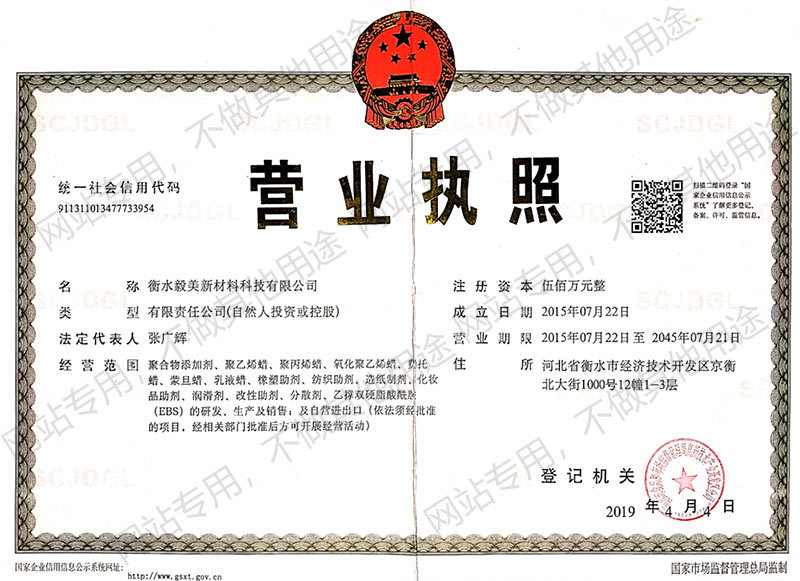
About UsHengshui yi mei new material technology co., ltd. was founded in 2015, is a collection of product development, production, sales and service as one of the high and new technology enterprises, yi mei company focused on deep processing of wax products, determined to become china's professional wax products supplier

-
ProductsThe company mainly produces and sells: polyethylene wax, oxidized polyethylene wax, synthetic Fischer-Tropsch wax, oxidized Fischer-Tropsch wax, maleic anhydride grafted wax, polypropylene wax, micro-powder wax, high-end composite wax and other eight series of dozens of models of high quality products.
-
NewsAt the beginning of its establishment, Yimei Company invested in the establishment of the "Polymer Additive R & D Center", insisting on scientific and technological innovation as the life force of enterprise development. Concentrate funds, technology, and talents in the company's scientific and technological innovation activities, focus on scientific research, public relations and technological breakthroughs of new products, new technologies, and new processes, and resolutely master core technologies.
-
SupportAt the beginning of its establishment, Yimei Company invested in the establishment of the "Polymer Additive R & D Center", insisting on scientific and technological innovation as the life force of enterprise development. Concentrate funds, technology, and talents in the company's scientific and technological innovation activities, focus on scientific research, public relations and technological breakthroughs of new products, new technologies, and new processes, and resolutely master core technologies.
-
RecruitmentOur company always adheres to the talent concept of "people-oriented", actively creates an atmosphere of respect, understanding, integrity and friendship, respects people's knowledge and talents, selects and develops mechanisms, and provides a growth platform for talents. make talents become a strong support for the sustainable development of enterprises, and realize the common growth and development of enterprises and talents.

Oxidized PE Wax: Unlocking the Potential of Versatile Additives in Paints and Coatings
Release time:
2025-01-31
Oxidized PE Wax as a Versatile Additive for Paints and Coatings Table of Contents 1. Introduction to Oxidized PE Wax 2. Key Properties of Oxidized PE Wax 3. Applications in Paints and Coatings 3.1 Enhanced Durability and Scratch Resistance 3.2 Improved Flow and Leveling 3.3 Gloss Control and Surface Finish 4. Benefits of Using Oxidized PE Wax 5. Incorporating
Oxidized PE Wax as a Versatile Additive for Paints and Coatings
Table of Contents
- 1. Introduction to Oxidized PE Wax
- 2. Key Properties of Oxidized PE Wax
- 3. Applications in Paints and Coatings
- 3.1 Enhanced Durability and Scratch Resistance
- 3.2 Improved Flow and Leveling
- 3.3 Gloss Control and Surface Finish
- 4. Benefits of Using Oxidized PE Wax
- 5. Incorporating Oxidized PE Wax into Formulations
- 6. Sustainability Aspects of Oxidized PE Wax
- 7. Frequently Asked Questions
- 8. Conclusion
1. Introduction to Oxidized PE Wax
In the world of paints and coatings, achieving optimal performance while maintaining quality is crucial. One of the standout additives that have emerged in this field is **oxidized polyethylene (PE) wax**. Known for its versatility, this additive has gained significant attention from formulators seeking to enhance their products' overall performance.
Oxidized PE wax is produced through the oxidation of polyethylene wax, resulting in a material that boasts a variety of unique properties. These characteristics make it an ideal candidate for incorporation into various formulations, including paints, coatings, inks, and adhesives.
2. Key Properties of Oxidized PE Wax
Before exploring the applications of oxidized PE wax, it is essential to understand its fundamental properties. These attributes contribute to its effectiveness as an additive in paints and coatings.
2.1 Chemical Stability
One of the most significant advantages of oxidized PE wax is its **chemical stability**. This stability ensures that the wax will not react adversely with other components in the formulation, providing peace of mind for manufacturers and formulators alike.
2.2 Thermal Resistance
Another notable property is the **thermal resistance** of oxidized PE wax. It can withstand high temperatures without degrading, making it suitable for applications that may encounter heat during processing or end-use.
2.3 Low Surface Energy
Oxidized PE wax exhibits **low surface energy**, which enhances its ability to reduce surface tension and improve wetting properties. This feature is particularly beneficial in paint formulations, as it helps achieve better dispersion of pigments and fillers.
2.4 Excellent Lubrication
The **lubrication** properties of oxidized PE wax contribute to smoother application and enhanced flow characteristics in coatings. This feature is particularly advantageous in achieving uniformity and consistency across large surfaces.
3. Applications in Paints and Coatings
With its unique properties, oxidized PE wax serves multiple applications within the paints and coatings industry.
3.1 Enhanced Durability and Scratch Resistance
One of the primary benefits of incorporating oxidized PE wax into paint formulations is **enhanced durability**. The wax acts as a protective barrier, increasing the resistance of the paint to scratches, abrasions, and general wear and tear. This property is particularly crucial for high-traffic areas where surface longevity is essential.
3.2 Improved Flow and Leveling
Another significant application is in improving the **flow and leveling** of coatings. When added to formulations, oxidized PE wax facilitates a smoother application, minimizing the likelihood of brush strokes or roller marks. This characteristic is vital for achieving a professional finish in both industrial and decorative coatings.
3.3 Gloss Control and Surface Finish
Oxidized PE wax can also be used to control **gloss levels** in paints. Depending on the desired finish, formulators can adjust the amount of wax added to achieve specific gloss characteristics, from matte to high-gloss finishes. This flexibility allows manufacturers to cater to a broader range of customer preferences.
4. Benefits of Using Oxidized PE Wax
The advantages of using oxidized PE wax extend beyond its properties and applications.
4.1 Cost-Effectiveness
Using oxidized PE wax can be a **cost-effective** solution for formulators. Its effectiveness in enhancing performance often means that lower quantities of other, more expensive additives can be used, ultimately reducing overall production costs.
4.2 Easy Incorporation
Incorporating oxidized PE wax into formulations is straightforward. Its compatibility with a wide range of other materials ensures that it can be seamlessly blended into existing formulations without significant reformulation efforts.
4.3 Improved Customer Satisfaction
By utilizing oxidized PE wax in paints and coatings, manufacturers can offer products that meet or exceed customer expectations. Enhanced durability, improved finish, and overall performance contribute to higher customer satisfaction and loyalty.
5. Incorporating Oxidized PE Wax into Formulations
To maximize the benefits of oxidized PE wax, formulators must understand the best practices for incorporating it into their products.
5.1 Recommended Dosage
The optimal dosage of oxidized PE wax can vary depending on the specific formulation and desired outcomes. Generally, concentrations ranging from **1% to 5%** are recommended, but careful testing is essential to determine the ideal amount for each unique application.
5.2 Processing Techniques
Incorporation techniques can also influence the efficacy of oxidized PE wax. The wax should ideally be added during the **grinding or milling stage** of formulation. This ensures uniform dispersion throughout the mixture, leading to consistent performance in the final product.
5.3 Compatibility Testing
It is crucial to conduct **compatibility testing** with other formulation components to ensure optimal performance. This testing helps identify any potential interactions that may impact the overall formulation's effectiveness.
6. Sustainability Aspects of Oxidized PE Wax
As the industry increasingly focuses on sustainability, the choice of additives plays a significant role. Oxidized PE wax is regarded as a more environmentally friendly option compared to many traditional additives.
6.1 Biodegradable Properties
While oxidized PE wax is derived from polyethylene, which is a synthetic material, certain formulations are designed to be **biodegradable**. This aspect aligns with the industry's push towards greener alternatives.
6.2 Reduced Volatile Organic Compounds (VOCs)
Using oxidized PE wax can also contribute to lower levels of **volatile organic compounds (VOCs)** in coatings. This reduction is vital in meeting regulatory standards and promoting healthier indoor air quality.
7. Frequently Asked Questions
7.1 What is oxidized PE wax?
Oxidized PE wax is a derivative of polyethylene wax that has undergone oxidation, resulting in a compound with distinct properties that enhance the performance of paints and coatings.
7.2 How does oxidized PE wax improve paint durability?
Oxidized PE wax increases the scratch and abrasion resistance of the paint, providing a protective layer that extends the lifespan of the coating.
7.3 Can oxidized PE wax be used in water-based coatings?
Yes, oxidized PE wax can be used in both solvent-based and water-based coatings, although its effectiveness may vary based on compatibility with other formulation components.
7.4 Is oxidized PE wax environmentally friendly?
While oxidized PE wax is a synthetic product, certain formulations can be biodegradable and contribute to lower VOC levels, making them more sustainable options.
7.5 What are the recommended dosages for oxidized PE wax?
Typically, a dosage of **1% to 5%** is recommended, but it is crucial to conduct testing to determine the ideal amount for your specific formulation.
8. Conclusion
Incorporating oxidized PE wax as an additive in paints and coatings presents an array of benefits for formulators and manufacturers. Its unique properties, including chemical stability, thermal resistance, and low surface energy, enhance the performance and aesthetic qualities of coatings. The versatile applications range from improving durability and scratch resistance to allowing precise control over gloss levels.
As the industry continues to evolve, the importance of quality additives like oxidized PE wax cannot be overstated. By leveraging its advantages, manufacturers can create high-performing products that meet the demands of modern consumers while also contributing to a more sustainable future. Embracing oxidized PE wax is not just a choice; it is a strategic decision to elevate your coatings and stand out in a competitive marketplace.
Key words:
Oxidized PE wax
recommend reading