Yimei New Material-Professional Wax Product Solution Supplier


-
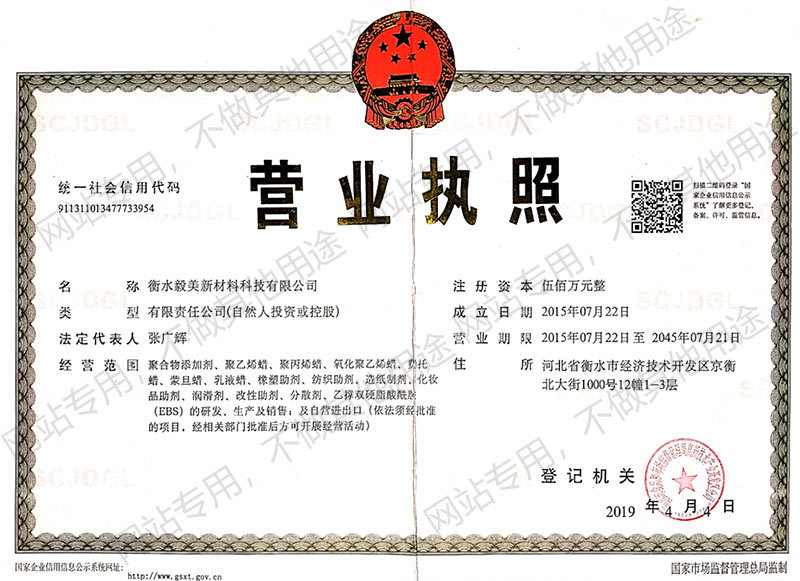
About UsHengshui yi mei new material technology co., ltd. was founded in 2015, is a collection of product development, production, sales and service as one of the high and new technology enterprises, yi mei company focused on deep processing of wax products, determined to become china's professional wax products supplier

-
ProductsThe company mainly produces and sells: polyethylene wax, oxidized polyethylene wax, synthetic Fischer-Tropsch wax, oxidized Fischer-Tropsch wax, maleic anhydride grafted wax, polypropylene wax, micro-powder wax, high-end composite wax and other eight series of dozens of models of high quality products.
-
NewsAt the beginning of its establishment, Yimei Company invested in the establishment of the "Polymer Additive R & D Center", insisting on scientific and technological innovation as the life force of enterprise development. Concentrate funds, technology, and talents in the company's scientific and technological innovation activities, focus on scientific research, public relations and technological breakthroughs of new products, new technologies, and new processes, and resolutely master core technologies.
-
SupportAt the beginning of its establishment, Yimei Company invested in the establishment of the "Polymer Additive R & D Center", insisting on scientific and technological innovation as the life force of enterprise development. Concentrate funds, technology, and talents in the company's scientific and technological innovation activities, focus on scientific research, public relations and technological breakthroughs of new products, new technologies, and new processes, and resolutely master core technologies.
-
RecruitmentOur company always adheres to the talent concept of "people-oriented", actively creates an atmosphere of respect, understanding, integrity and friendship, respects people's knowledge and talents, selects and develops mechanisms, and provides a growth platform for talents. make talents become a strong support for the sustainable development of enterprises, and realize the common growth and development of enterprises and talents.


Enhancing Coating Formulations with High Density PE Wax: A Comprehensive Guide
Release time:
2025-01-19
Enhancing Coating Formulations with High Density PE Wax Introduction to High Density PE Wax High Density Polyethylene (HDPE) wax has emerged as a crucial component in the formulation of various coatings. Its unique properties enhance the performance of coatings across multiple industries, from automotive to construction. This article delves into the applications, benefits, and formulation techniqu
Enhancing Coating Formulations with High Density PE Wax
Introduction to High Density PE Wax
High Density Polyethylene (HDPE) wax has emerged as a crucial component in the formulation of various coatings. Its unique properties enhance the performance of coatings across multiple industries, from automotive to construction. This article delves into the applications, benefits, and formulation techniques involving HDPE wax, providing valuable insights for manufacturers and formulators.
The Importance of Coating Formulations
Coating formulations serve critical roles, offering protection, aesthetic appeal, and functional properties to various substrates. The efficacy of these coatings depends on the selection and combination of raw materials used. Here, we focus on the role of high-density polyethylene wax in optimizing these formulations.
What is High Density PE Wax?
High Density PE wax is a synthetic wax derived from polyethylene. Unlike traditional waxes, HDPE wax possesses a higher molecular weight and density, providing unique advantages in coating applications. Its chemical structure lends itself to excellent thermal stability, low viscosity, and superior hardness, making it an ideal additive for enhancing coating formulations.
Key Properties of High Density PE Wax
Understanding the properties of HDPE wax is essential for its effective application in coatings. Some of its notable characteristics include:
- **High Melting Point**: Ensures stability under elevated temperature conditions.
- **Chemical Resistance**: Provides protection against solvents and chemicals.
- **Low Viscosity**: Facilitates easy incorporation into various formulations.
- **Enhanced Hardness**: Improves the overall durability and scratch resistance of coatings.
Applications of High Density PE Wax in Coatings
The versatile nature of high density PE wax allows for its use in a variety of coating applications:
1. Automotive Coatings
In the automotive sector, HDPE wax enhances the durability and aesthetic qualities of paints and clear coats. It improves scratch resistance, ensuring that vehicles maintain their appearance over time.
2. Industrial Coatings
High density PE wax is vital in industrial coatings, offering protection against wear and chemical exposure. Its incorporation can lead to longer-lasting finishes, reducing maintenance costs.
3. Architectural Coatings
In architectural coatings, HDPE wax contributes to better surface smoothness and gloss levels. It also improves resistance to weathering, ensuring that exterior coatings remain vibrant and intact.
4. Wood Coatings
For wood finishes, high density PE wax provides enhanced waterproofing properties and protection against UV radiation. This is crucial for preserving the integrity and appearance of wood surfaces.
Formulating Coatings with High Density PE Wax
Incorporating high density PE wax into coating formulations requires careful consideration of various factors:
1. Selection of Base Resins
Choosing the right base resin is critical. HDPE wax can be combined effectively with various resins, including acrylics, polyurethanes, and alkyds, to optimize performance characteristics.
2. Determining Wax Concentration
The concentration of HDPE wax in the formulation significantly affects the final properties of the coating. Typically, concentrations range from 1% to 10%, depending on the desired outcomes.
3. Mixing and Dispersion Techniques
Achieving uniform dispersion of HDPE wax is vital for optimal performance. High shear mixers or melt blending techniques are often employed to ensure homogeneous mixing.
4. Evaluating Performance Characteristics
After formulation, it's important to evaluate the performance characteristics of the coating, including adhesion, hardness, and chemical resistance. Testing methods such as the pencil hardness test or impact resistance test can provide insights into the coating’s quality.
Benefits of Using High Density PE Wax in Coatings
Incorporating high density PE wax into coating formulations offers numerous benefits:
1. Improved Durability
The increased hardness and chemical resistance associated with HDPE wax lead to longer-lasting coatings that withstand harsh conditions.
2. Enhanced Aesthetic Qualities
Coatings with HDPE wax exhibit improved gloss and surface smoothness, enhancing the overall appearance of the finished product.
3. Cost-Effectiveness
While there may be an initial investment, the longevity and reduced need for maintenance associated with HDPE wax-enhanced coatings can translate to significant cost savings.
4. Versatility
HDPE wax is compatible with a wide range of resins and additives, making it a versatile choice for formulators looking to optimize their coatings.
Challenges and Considerations
While high density PE wax offers numerous advantages, formulators must consider potential challenges:
1. Compatibility with Other Additives
Not all additives work well with HDPE wax. Conducting compatibility tests is essential to avoid negative interactions that could compromise performance.
2. Processing Conditions
The processing temperature and shear conditions during formulation can affect the performance of HDPE wax. Careful monitoring is required to maintain product integrity.
3. Regulatory Compliance
It is vital to ensure that any coatings formulated with HDPE wax meet industry regulations and standards, especially in sectors like automotive and construction.
Case Studies: Success Stories of HDPE Wax in Coatings
Examining real-world applications provides valuable insights into the effectiveness of high density PE wax in coatings.
1. Automotive Paints
A leading automotive manufacturer incorporated HDPE wax into its clear coat formulations, resulting in a 30% improvement in scratch resistance and a more durable finish that extended the life of their paint jobs.
2. Industrial Protective Coatings
An industrial coatings company added HDPE wax to its protective coatings targeting metal surfaces. The result was a significant reduction in corrosion and wear, extending the lifespan of the coatings.
Frequently Asked Questions (FAQs)
1. What is high density PE wax?
High density PE wax is a synthetic wax derived from polyethylene, known for its high melting point, chemical resistance, and low viscosity, making it suitable for various coating applications.
2. How does HDPE wax enhance coating durability?
HDPE wax improves coating durability by increasing hardness and providing chemical resistance, which protects the coating from scratches and environmental degradation.
3. What types of coatings benefit from HDPE wax?
Automotive, industrial, architectural, and wood coatings are examples of formulations that significantly benefit from the inclusion of high density PE wax.
4. What is the recommended concentration of HDPE wax in coatings?
The typical concentration of HDPE wax in coating formulations ranges from 1% to 10%, depending on the desired properties.
5. Are there any compatibility issues with HDPE wax and other additives?
Yes, compatibility issues can arise when combining HDPE wax with certain additives. Conducting compatibility tests is essential to ensure optimal performance.
Conclusion
High Density PE Wax stands out as a game-changer in the formulation of advanced coatings. Its unique properties not only enhance the durability and aesthetic appeal of coatings but also provide significant cost savings through reduced maintenance needs. By understanding its applications and optimizing formulations, manufacturers can leverage HDPE wax to create superior products that meet the demands of various industries. As we continue to explore innovative materials, HDPE wax will undoubtedly play a crucial role in the future of coating technology.
Key words:
high density pe wax
recommend reading