Yimei New Material-Professional Wax Product Solution Supplier


-
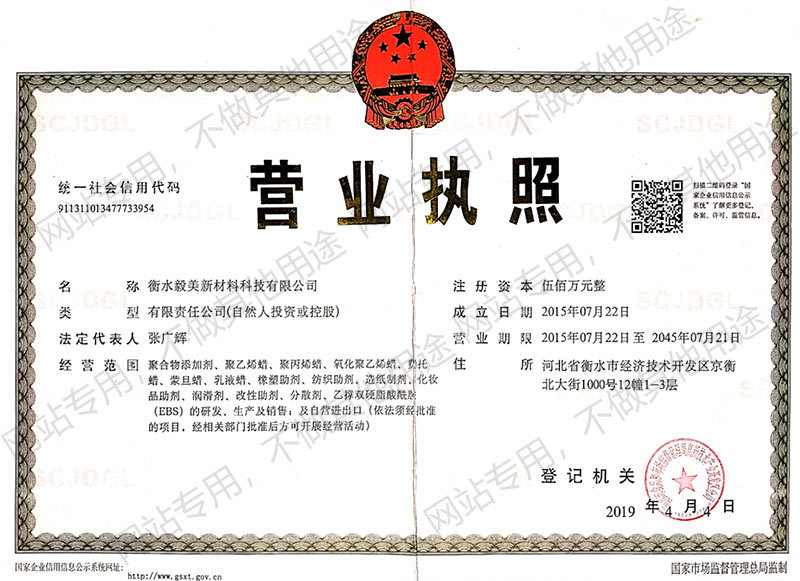
About UsHengshui yi mei new material technology co., ltd. was founded in 2015, is a collection of product development, production, sales and service as one of the high and new technology enterprises, yi mei company focused on deep processing of wax products, determined to become china's professional wax products supplier

-
ProductsThe company mainly produces and sells: polyethylene wax, oxidized polyethylene wax, synthetic Fischer-Tropsch wax, oxidized Fischer-Tropsch wax, maleic anhydride grafted wax, polypropylene wax, micro-powder wax, high-end composite wax and other eight series of dozens of models of high quality products.
-
NewsAt the beginning of its establishment, Yimei Company invested in the establishment of the "Polymer Additive R & D Center", insisting on scientific and technological innovation as the life force of enterprise development. Concentrate funds, technology, and talents in the company's scientific and technological innovation activities, focus on scientific research, public relations and technological breakthroughs of new products, new technologies, and new processes, and resolutely master core technologies.
-
SupportAt the beginning of its establishment, Yimei Company invested in the establishment of the "Polymer Additive R & D Center", insisting on scientific and technological innovation as the life force of enterprise development. Concentrate funds, technology, and talents in the company's scientific and technological innovation activities, focus on scientific research, public relations and technological breakthroughs of new products, new technologies, and new processes, and resolutely master core technologies.
-
RecruitmentOur company always adheres to the talent concept of "people-oriented", actively creates an atmosphere of respect, understanding, integrity and friendship, respects people's knowledge and talents, selects and develops mechanisms, and provides a growth platform for talents. make talents become a strong support for the sustainable development of enterprises, and realize the common growth and development of enterprises and talents.


Enhancing the Rheological Properties of Adhesives with PE Wax Powder: A Comprehensive Guide
Release time:
2025-01-07
Enhancing the Rheological Properties of Adhesives with PE Wax Powder Table of Contents 1. Introduction 2. Understanding Rheology in Adhesives 3. The Role of PE Wax Powder in Adhesives 4. Benefits of Using PE Wax Powder 5. Application Techniques for PE Wax Powder 6. Case Studies: Successful Applications 7. Environmental Considerations in Using PE Wax Powder 8. Futur
Enhancing the Rheological Properties of Adhesives with PE Wax Powder
Table of Contents
- 1. Introduction
- 2. Understanding Rheology in Adhesives
- 3. The Role of PE Wax Powder in Adhesives
- 4. Benefits of Using PE Wax Powder
- 5. Application Techniques for PE Wax Powder
- 6. Case Studies: Successful Applications
- 7. Environmental Considerations in Using PE Wax Powder
- 8. Future Trends in Adhesive Technology with PE Wax
- 9. Conclusion
- 10. FAQs
1. Introduction
In the fast-paced world of adhesive technologies, **rheological properties** play a critical role in determining the performance and application of adhesive products. The viscosity, flow characteristics, and stability of adhesives significantly influence their usability in various industrial applications. One of the most effective ways to enhance these properties is through the incorporation of **PE wax powder**. This article provides an in-depth exploration of how PE wax powder can revolutionize adhesive formulations, ultimately improving their efficacy and reliability.
2. Understanding Rheology in Adhesives
Rheology is the study of the flow and deformation of materials. For adhesives, rheological properties dictate how the product behaves under different conditions, including shear stress, temperature changes, and time. Understanding these properties is crucial for formulators to optimize adhesive performance. Key rheological characteristics that affect adhesive behavior include:
Viscosity
Viscosity measures a fluid's resistance to flow. High viscosity adhesives are typically thicker and may be challenging to apply, whereas low viscosity adhesives flow easily but may not provide adequate bonding strength.
Thixotropy
Thixotropic behavior refers to the property of certain materials to become less viscous over time when subjected to shear stress. This characteristic is particularly beneficial in applications requiring easy application and good positioning before setting.
Yield Stress
Yield stress is the minimum stress required to make a material flow. Adhesives with low yield stress can spread out easily, while those with higher yield stress provide better stability before application.
3. The Role of PE Wax Powder in Adhesives
PE wax powder, derived from polyethylene, is a versatile additive that can significantly enhance the rheological properties of adhesives. It functions primarily by modifying the viscosity and flow characteristics of adhesive formulations. The unique structure of PE wax allows it to interact with other components in the adhesive formulation, leading to improved performance metrics.
Viscosity Modification
PE wax powder can be used to adjust the viscosity of adhesives without compromising their bonding strength. By finely tuning the viscosity, formulators can create products that are easier to apply and manipulate.
Improved Stability
PE wax powder enhances the stability of adhesive formulations, preventing separation of components and ensuring a consistent application throughout the product's shelf life.
Enhanced Performance
With the addition of PE wax powder, adhesives can exhibit improved adhesion to various substrates and superior resistance to environmental factors, such as moisture and temperature fluctuations.
4. Benefits of Using PE Wax Powder
Incorporating PE wax powder into adhesive formulations provides several advantages:
Cost-Effectiveness
PE wax is relatively inexpensive compared to other performance-enhancing additives, making it a cost-effective solution for improving adhesive formulations.
Versatility
PE wax powder can be used across a variety of adhesive systems, including solvent-based, water-based, and hot-melt adhesives, making it a versatile choice for manufacturers.
Non-Toxicity
PE wax is often regarded as a safer alternative to more hazardous chemical additives, aligning with the increasing demand for environmentally friendly and non-toxic materials in the industry.
Enhanced Processability
Adhesives formulated with PE wax powder can be easier to process, leading to improved production efficiency and reduced waste.
5. Application Techniques for PE Wax Powder
To maximize the benefits of PE wax powder in adhesive formulations, it is essential to utilize effective application techniques. Here are some recommended methods:
Dry Blending
Incorporating PE wax powder through dry blending ensures that it is evenly distributed throughout the adhesive matrix. This technique is particularly effective for thermoplastic adhesives.
Compounding
For more complex formulations, compounding involves melting and mixing PE wax powder with other components to create a homogeneous adhesive system.
Incorporation During Manufacturing
Adding PE wax powder during the manufacturing process can enhance the efficiency of the adhesive formulation, allowing the powder to interact more effectively with other ingredients.
6. Case Studies: Successful Applications
Numerous industries have successfully implemented PE wax powder in their adhesive formulations. Here are a few notable examples:
Packaging Industry
In the packaging sector, adhesives incorporating PE wax powder have demonstrated improved adhesion properties, resulting in enhanced seal strength and durability of packaging materials.
Construction Industry
Adhesives used in construction applications, such as flooring and wall coverings, have benefitted from the rheological enhancements provided by PE wax powder, leading to improved application and performance.
Automotive Industry
The automotive sector has reported increased reliability of adhesives used in assembly processes when PE wax powder is included, ensuring long-lasting bonds under varying environmental conditions.
7. Environmental Considerations in Using PE Wax Powder
As the industry shifts toward sustainable practices, the environmental impact of materials used in adhesive formulations is under scrutiny. PE wax powder presents several environmental advantages:
Biodegradability
While PE wax is derived from petroleum, advancements in formulations have led to the development of biodegradable options, reducing the environmental footprint.
Low VOC Emissions
Adhesives formulated with PE wax powder typically exhibit low volatile organic compound (VOC) emissions, contributing to healthier indoor air quality.
Recyclability
Many adhesives containing PE wax powder are recyclable, aligning with the growing demand for sustainable products.
8. Future Trends in Adhesive Technology with PE Wax
The landscape of adhesive technology is evolving, and the incorporation of PE wax powder is becoming increasingly prominent. Emerging trends include:
Smart Adhesives
The development of "smart" adhesives that can respond to environmental stimuli is on the rise. PE wax powder is likely to play a crucial role in these innovations.
Customization
With advancements in manufacturing processes, custom formulations incorporating PE wax powder can be tailored to meet specific performance requirements across various industries.
Regulatory Compliance
As regulations regarding chemical safety become more stringent, PE wax powder's non-toxic nature positions it as a favorable choice for compliant adhesive formulations.
9. Conclusion
Incorporating **PE wax powder** into adhesive formulations offers unparalleled benefits in enhancing rheological properties, improving application performance, and ensuring environmental sustainability. By understanding the advantages and application techniques of PE wax powder, manufacturers can optimize their adhesive products, meeting the demands of various industries. As we look toward the future, the role of PE wax in adhesive technology is set to expand, paving the way for innovative solutions that prioritize performance, safety, and sustainability.
10. FAQs
1. What is PE wax powder, and how is it used in adhesives?
PE wax powder is a finely milled form of polyethylene wax used as an additive in adhesives to enhance their rheological properties, including viscosity and stability.
2. How does PE wax powder improve adhesion?
PE wax powder modifies the flow characteristics of adhesives, allowing for better application and ensuring a stronger bond upon curing.
3. Is PE wax powder environmentally friendly?
Yes, PE wax powder is considered a safer alternative to many hazardous additives and can be formulated to be biodegradable and have low VOC emissions.
4. Can PE wax powder be used in all types of adhesives?
PE wax powder is versatile and can be used in various adhesive systems, including solvent-based, water-based, and hot-melt adhesives.
5. What are the future trends for adhesives using PE wax powder?
Future trends include the development of smart adhesives, increased customization of formulations, and a focus on regulatory compliance regarding chemical safety.
This comprehensive guide serves as an essential resource for those looking to enhance the performance and sustainability of adhesive products through the innovative use of PE wax powder.
Key words:
pe wax powder
Previous article
recommend reading