Yimei New Material-Professional Wax Product Solution Supplier


-
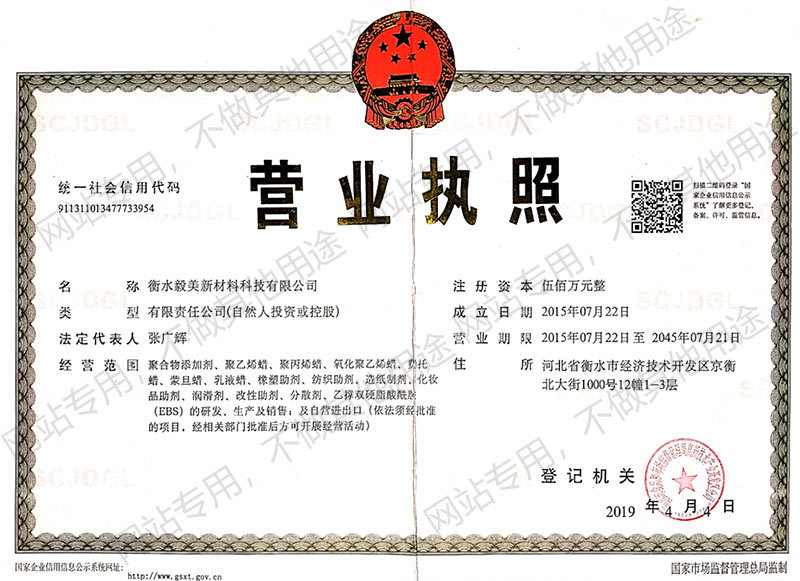
About UsHengshui yi mei new material technology co., ltd. was founded in 2015, is a collection of product development, production, sales and service as one of the high and new technology enterprises, yi mei company focused on deep processing of wax products, determined to become china's professional wax products supplier

-
ProductsThe company mainly produces and sells: polyethylene wax, oxidized polyethylene wax, synthetic Fischer-Tropsch wax, oxidized Fischer-Tropsch wax, maleic anhydride grafted wax, polypropylene wax, micro-powder wax, high-end composite wax and other eight series of dozens of models of high quality products.
-
NewsAt the beginning of its establishment, Yimei Company invested in the establishment of the "Polymer Additive R & D Center", insisting on scientific and technological innovation as the life force of enterprise development. Concentrate funds, technology, and talents in the company's scientific and technological innovation activities, focus on scientific research, public relations and technological breakthroughs of new products, new technologies, and new processes, and resolutely master core technologies.
-
SupportAt the beginning of its establishment, Yimei Company invested in the establishment of the "Polymer Additive R & D Center", insisting on scientific and technological innovation as the life force of enterprise development. Concentrate funds, technology, and talents in the company's scientific and technological innovation activities, focus on scientific research, public relations and technological breakthroughs of new products, new technologies, and new processes, and resolutely master core technologies.
-
RecruitmentOur company always adheres to the talent concept of "people-oriented", actively creates an atmosphere of respect, understanding, integrity and friendship, respects people's knowledge and talents, selects and develops mechanisms, and provides a growth platform for talents. make talents become a strong support for the sustainable development of enterprises, and realize the common growth and development of enterprises and talents.


High Density Polyethylene Wax: A Key Ingredient for Enhanced Product Durability
Release time:
2024-11-26
High Density Polyethylene Wax: A Key Ingredient for Enhanced Product Durability Table of Contents 1. Introduction to High Density Polyethylene Wax 2. Properties of High Density Polyethylene Wax 3. Applications of High Density Polyethylene Wax in Various Industries 4. Advantages of Using High Density Polyethylene Wax 5. Impact of HDPE Wax on Product Durability 6. Comparativ
High Density Polyethylene Wax: A Key Ingredient for Enhanced Product Durability
Table of Contents
- 1. Introduction to High Density Polyethylene Wax
- 2. Properties of High Density Polyethylene Wax
- 3. Applications of High Density Polyethylene Wax in Various Industries
- 4. Advantages of Using High Density Polyethylene Wax
- 5. Impact of HDPE Wax on Product Durability
- 6. Comparative Analysis: HDPE Wax vs. Other Waxes
- 7. Environmental Considerations of HDPE Wax
- 8. Conclusion
- 9. FAQs about High Density Polyethylene Wax
1. Introduction to High Density Polyethylene Wax
High Density Polyethylene (HDPE) wax is increasingly recognized as a vital component in enhancing product durability across a myriad of applications. With its unique chemical structure and physical characteristics, HDPE wax often serves as a lubricant, dispersant, and additive in various formulations. This article delves into the properties, applications, and advantages of HDPE wax, offering insights into why it is a go-to choice for manufacturers aiming to bolster product performance.
2. Properties of High Density Polyethylene Wax
HDPE wax boasts several properties that contribute to its functional versatility:
2.1 Chemical Composition
HDPE wax is composed of long-chain hydrocarbons, which results in a high melting point and low viscosity. This unique composition allows for excellent thermal stability, making it suitable for high-temperature applications.
2.2 Physical Characteristics
The wax has a white to off-white appearance and a waxy texture, which contributes to its effectiveness in various formulations. Its low volatility and high resistance to chemicals further enhance its utility across different sectors.
2.3 Compatibility
One of the notable features of HDPE wax is its compatibility with a broad range of materials, including plastics, coatings, and adhesives. This versatility makes it an excellent additive for improving product formulations.
3. Applications of High Density Polyethylene Wax in Various Industries
The applications of HDPE wax extend across multiple industries, reflecting its adaptability:
3.1 Plastics Industry
In the plastics industry, HDPE wax is utilized as a processing aid and lubricant, enhancing the flow of materials during manufacturing. It is commonly used in polyolefin films, sheets, and molded products.
3.2 Coatings and Inks
HDPE wax serves as an additive in coatings and inks, improving gloss, scratch resistance, and overall durability. Its incorporation enhances the performance of both water-based and solvent-based formulations.
3.3 Adhesives and Sealants
As an additive in adhesives, HDPE wax enhances adhesion properties and provides thermal stability. It also aids in preventing cohesion and improving the overall performance of sealants.
3.4 Personal Care Products
The cosmetic industry utilizes HDPE wax in formulations for its emulsifying properties and as a thickening agent. Its safety profile makes it suitable for use in personal care items like creams and lotions.
4. Advantages of Using High Density Polyethylene Wax
The advantages of incorporating HDPE wax in product formulations are numerous:
4.1 Enhanced Durability
One of the primary benefits of HDPE wax is its ability to enhance the durability of products. By improving resistance to wear and tear, it significantly extends the lifespan of the final product.
4.2 Improved Processing Efficiency
HDPE wax helps in reducing friction during manufacturing processes, thereby improving processing efficiency. It leads to better flow properties and easier mold release in plastics.
4.3 Versatility
The compatibility of HDPE wax with various materials makes it an adaptable choice for manufacturers. Its multiple applications across different sectors enable a wide range of formulations.
4.4 Cost-Effectiveness
Incorporating HDPE wax can lead to cost savings in the long run. Enhanced product durability reduces the need for frequent replacements, thereby lowering overall costs.
5. Impact of HDPE Wax on Product Durability
The influence of HDPE wax on product durability cannot be overstated. By improving mechanical properties and environmental resistance, HDPE wax becomes critical in applications requiring longevity:
5.1 Resistance to Environmental Factors
HDPE wax enhances a product's resistance to moisture, UV light, and temperature fluctuations, making it ideal for outdoor applications where exposure to harsh conditions can degrade materials.
5.2 Long-Lasting Performance
Products fortified with HDPE wax exhibit improved long-term performance due to their enhanced structural integrity. This durability reduces the frequency of replacements and maintenance, resulting in significant savings.
5.3 Aesthetic Quality
In addition to functional benefits, HDPE wax contributes to the aesthetic quality of products. Its ability to improve gloss and surface finish helps in creating visually appealing items, particularly in consumer goods.
6. Comparative Analysis: HDPE Wax vs. Other Waxes
When considering wax additives, the choice between HDPE wax and other wax types is crucial for product formulation:
6.1 HDPE Wax vs. Paraffin Wax
While paraffin wax is often less expensive, HDPE wax offers superior performance in high-temperature applications and better compatibility with various polymers. This makes HDPE wax a more reliable choice for enhancing durability.
6.2 HDPE Wax vs. Microcrystalline Wax
Microcrystalline wax provides flexibility, but HDPE wax excels in processing efficiency and durability. Manufacturers often prefer HDPE wax when formulating products that require extended lifespans.
6.3 HDPE Wax vs. Carnauba Wax
Carnauba wax is a natural product with a high melting point, but HDPE wax offers more consistent performance and lower cost, making it a practical choice for manufacturers looking for reliable results.
7. Environmental Considerations of HDPE Wax
As sustainability becomes an increasing concern for manufacturers, the environmental impact of materials used in production is under scrutiny:
7.1 Biodegradability
HDPE wax is not biodegradable, raising concerns about its environmental footprint. However, its durability contributes to reduced waste, as products last longer and require less frequent replacement.
7.2 Recyclability
HDPE wax is compatible with recycling processes for HDPE materials, meaning that products formulated with HDPE wax can often be recycled, reducing their overall environmental impact.
7.3 Responsible Manufacturing Practices
Many manufacturers are adopting responsible practices in sourcing and using HDPE wax, ensuring that it is produced with minimal environmental impact. Engaging in sustainable practices can further enhance the appeal of products formulated with HDPE wax.
8. Conclusion
High Density Polyethylene Wax has emerged as a crucial ingredient in enhancing product durability across various applications. Its unique properties, compatibility, and ability to improve the longevity of products make it an indispensable additive in the manufacturing process. By incorporating HDPE wax, manufacturers can achieve durable, high-quality products that stand the test of time, all while maintaining cost-effectiveness and aesthetic appeal. As industries continue to evolve, the role of HDPE wax will likely expand, proving its value as a vital component in modern manufacturing.
9. FAQs about High Density Polyethylene Wax
What is High Density Polyethylene Wax?
HDPE wax is a type of synthetic wax derived from polyethylene, characterized by its high melting point, low viscosity, and excellent compatibility with various materials.
How is HDPE Wax used in plastics manufacturing?
In the plastics sector, HDPE wax serves as a processing aid, improving the flow of materials during production and enhancing the overall quality of the final products.
Can HDPE Wax improve the durability of coatings and inks?
Yes, the addition of HDPE wax in coatings and inks can enhance properties such as gloss, scratch resistance, and overall durability, making these products more resilient.
Is HDPE Wax environmentally friendly?
While HDPE wax is not biodegradable, its durability can lead to reduced waste. Furthermore, it is compatible with recycling processes for HDPE materials.
What are the key benefits of using HDPE Wax in product formulations?
The primary benefits include enhanced durability, improved processing efficiency, versatility across applications, and cost-effectiveness through reduced maintenance and replacement needs.
Key words:
high density polyethylene wax
Previous article
recommend reading